I was reminded of something this week that's been bothering me for a while. My school takes attendance, of course, and then parents are required to excuse their student's absences. If a student misses class and isn't excused by their parent, their absence is marked as "unexcused." I imagine that's the way most schools do it, and I don't have a problem with that. We have a legal requirement to keep track of attendance and, more importantly, if a student starts to have unexcused absences it's often a signal that they need extra support (although excessive excused absences are also often a sign of that as well).
My concern, however, is how that translates to the teacher's grade book in some classrooms. Many teachers have classroom policies that allow for a certain number of days to make up work missed for an excused absence, and students are not allowed to make up work for an unexcused absence. That's never really made sense to me. From my perspective, an absence is an absence in terms of the learning that the student is missing. It doesn't matter whether it's excused or not, if the student isn't there, they are missing out. When a student is absent, I want them to do whatever they can to "make up" for that missed learning and, if that learning is being graded in some fashion, that should be represented in the grade book.
I've typically heard two main arguments for treating unexcused absences differently. The first is the "responsibility" argument (with it's silent cousin "punishment" tagging along). As I mentioned, I don't have a problem at all with the school noting that the absence is unexcused and perhaps checking in with the student to see if we can help. Similarly, I don't have a problem with the teacher noting that as well and having a conversation with the student. But that shouldn't impact their grade in the class. The transcript says "Algebra" (or whatever), not "responsible", or "good kid", or "complies with adult rules."
The second argument stems from the fact that, at the high school level at least, unexcused absences tend to be more prevalent on test days. Many teachers deduce that students are missing class either because they aren't prepared for the test, or because they think they might gain an advantage by taking the test later than the rest of the class. I don't doubt that that is often the case (although we shouldn't assume that), but again I don't see the justification for transferring that into the grade book. I think if anything it points out our skewed priorities when it comes to assessment. Implicit in this argument is that tests are somehow more important than learning, and that translates both into student behavior (skip the class because the stakes are higher) and teacher behavior (bring the hammer down, both to "teach the student a lesson" and to assert our authority).
I believe that as teachers we are capable of designing assessments that assess what the student currently knows, and that those assessments are equally valid if given on a different day. The student still has the responsibility to arrange that assessment time and then show up to take it. There may be some small inconvenience to the teacher because of this, but I worry about teachers who consider this inconvenience more important than assessing the student's learning and ultimately helping the student to learn. (And specifically at my school, we have a variable schedule that means that most students can find a way to come in and re-assess during a teacher's unscheduled hours, so it's not even a case of having to stay longer after school than normal - although I don't see that as a huge burden either if it's arranged in advance.)
I think this is another instance when many of us are equating compliance with learning, and assessment with accountability. They are not, and should not be, the same thing. That's not to say we ignore a student's behavior when we are concerned about how it might be impacting them, but it is to say that we don't hold their learning hostage to it. So if your policies currently penalize students for absences, and particularly penalize them extra for unexcused absences, I would ask you to reconsider those policies. I'd ask you to consider your ultimate goals for students and whether those policies actually help you achieve those goals, or whether they might actually undermine them. It's possible your policies are actually inexcusable.
Showing posts with label assessment. Show all posts
Showing posts with label assessment. Show all posts
Saturday, September 03, 2016

Sunday, May 22, 2016
Student and Parent Evaluations of Me: Spring 2016
Similar to last semester, I asked parents and students to evaluate me at the end of the semester via a google form. I think it's always good to ask for this feedback, even though sometimes
you're not sure how honest and accurate it is. Even so, I learn
something from it each time.
I also think it's important to be transparent, so here are the links to their responses. These responses are verbatim, except for some slight editing where personal information was included. Both students and parents could choose to leave their name if they wished (totally optional), and some of the parent comments included their student's name - I edited all of that out.
Student Feedback (36 out of 45 completed the survey)
Parent Feedback (16 responses to the survey)
I also think it's important to be transparent, so here are the links to their responses. These responses are verbatim, except for some slight editing where personal information was included. Both students and parents could choose to leave their name if they wished (totally optional), and some of the parent comments included their student's name - I edited all of that out.
Student Feedback (36 out of 45 completed the survey)
Parent Feedback (16 responses to the survey)
Thursday, December 17, 2015
Student and Parent Evaluations of Me
We began offering an Intro to Computer Science class this fall for the first time in a long time, and I had the, ahem, "opportunity" to teach it. (We are hopefully going to be hiring a teacher for the next school year who is a bit more qualified, but just didn't have the FTE to do that this year as we got it off the ground.)
As when I taught Algebra, I asked both the students and parents for feedback via a google form at the end of the semester. I think it's always good to ask for this feedback, even though sometimes you're not sure how honest and accurate it is. Even so, I learn something from it each time.
I also think it's important to be transparent, so here are the links to their responses. These responses are verbatim, except for some slight editing where personal information was included. Both students and parents could choose to leave their name if they wished (totally optional), and some of the parent comments including their student's name - I edited all of that out.
Student Feedback (36 out of 45 completed the survey)
Parent Feedback (12 responses to the survey)
As when I taught Algebra, I asked both the students and parents for feedback via a google form at the end of the semester. I think it's always good to ask for this feedback, even though sometimes you're not sure how honest and accurate it is. Even so, I learn something from it each time.
I also think it's important to be transparent, so here are the links to their responses. These responses are verbatim, except for some slight editing where personal information was included. Both students and parents could choose to leave their name if they wished (totally optional), and some of the parent comments including their student's name - I edited all of that out.
Student Feedback (36 out of 45 completed the survey)
Parent Feedback (12 responses to the survey)
Thursday, August 27, 2015
Staff Evaluation Of Me
Last spring I read Work Rules by Laszlo Bock, who's the Senior VP of People Operations (Human Resources) at Google. It was an interesting read in many ways, but one particular take away for me was the need to ask more directly for feedback. Like everyone I, of course, get informal day-to-day feedback from the folks I work with, and more formal feedback from my supervising administrator. But that's not the same as specifically asking for feedback, so I decided to ask my colleagues to complete a google form at the beginning of this school year. (I've also posted a link to a Google Form for student feedback for me several places around the building but, so far, I only have one response. If I get some more I'll share that as well.)
When I sat down to create the form I quickly got into the weeds. I wanted specific feedback, yet when I tried writing specific questions I ran into two problems. I felt like the questions were both too "leading" and too "limiting", and to get at everything I wanted feedback on required so many questions that it made the survey way too long. So I eventually decided on a few open-ended questions that I hoped would get me some decent feedback but make the survey short enough that people would complete it.
Here's a screenshot of the survey.
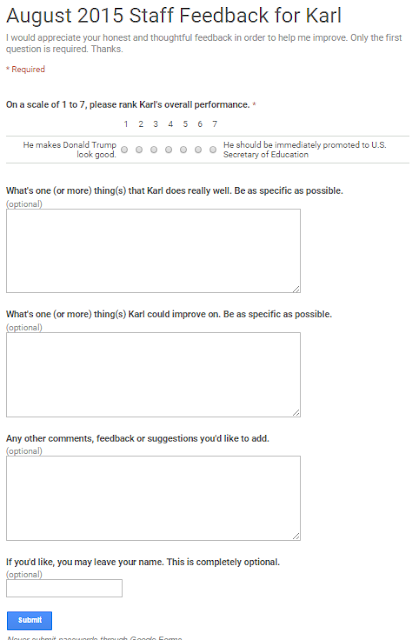
Based on the suggestions in the book and some other things I've read, I decided to go with a simple ranking of 1 to 7, one question on what I do well, one on what I can improve on, and then the usual "anything else they want to add." I was hoping that this would give them enough to give me some valuable feedback without getting too specific or too long. The downside, of course, is that's it's not very specific. They could take it anonymously or give me their name if they wanted to.
Here are the results. This is an exact copy of the actual results, except for the optional name column. In that column I replaced anyone's name with an asterisk for their confidentiality. So, as you look at that column, a blank space indicates that it was an anonymous response and an asterisk that they gave their name. (I received 62 responses. We have about 115 certified staff and about 40 classified staff.)
I think there are a couple of caveats (at least) to keep in mind when looking at these results. First, I think they will tend to skew positive, both because people who were ready to say nice things were more likely to take the time to complete the survey, and just because educators are generally nice. Second, I think you can't read too much into the results (positive or negative) because the questions were so open-ended. I think that's a trade-off I had to make, but still something to keep in mind.
So, I have my own thoughts on what the results mean, but I think I'll keep them to myself for now, because I'd love to hear what other people see in the results without influencing your thinking. So please leave your thoughts in the comments - it would probably be most helpful if you would focus particularly on the "things I could do better column", but all of it is fair game.
When I sat down to create the form I quickly got into the weeds. I wanted specific feedback, yet when I tried writing specific questions I ran into two problems. I felt like the questions were both too "leading" and too "limiting", and to get at everything I wanted feedback on required so many questions that it made the survey way too long. So I eventually decided on a few open-ended questions that I hoped would get me some decent feedback but make the survey short enough that people would complete it.
Here's a screenshot of the survey.

Based on the suggestions in the book and some other things I've read, I decided to go with a simple ranking of 1 to 7, one question on what I do well, one on what I can improve on, and then the usual "anything else they want to add." I was hoping that this would give them enough to give me some valuable feedback without getting too specific or too long. The downside, of course, is that's it's not very specific. They could take it anonymously or give me their name if they wanted to.
Here are the results. This is an exact copy of the actual results, except for the optional name column. In that column I replaced anyone's name with an asterisk for their confidentiality. So, as you look at that column, a blank space indicates that it was an anonymous response and an asterisk that they gave their name. (I received 62 responses. We have about 115 certified staff and about 40 classified staff.)
I think there are a couple of caveats (at least) to keep in mind when looking at these results. First, I think they will tend to skew positive, both because people who were ready to say nice things were more likely to take the time to complete the survey, and just because educators are generally nice. Second, I think you can't read too much into the results (positive or negative) because the questions were so open-ended. I think that's a trade-off I had to make, but still something to keep in mind.
So, I have my own thoughts on what the results mean, but I think I'll keep them to myself for now, because I'd love to hear what other people see in the results without influencing your thinking. So please leave your thoughts in the comments - it would probably be most helpful if you would focus particularly on the "things I could do better column", but all of it is fair game.
Thursday, July 30, 2015
My New Late Work Policy
I’ve been thinking a lot about late work policies lately. I’ve come to the conclusion that it’s unfair to everyone to have different policies within the same school. It’s just not transparent and it makes it harder for everyone to figure out what they need to do to be successful. So I think it’s time that we have a uniform late work policy in my school. Oh, did I mention this policy is for teachers?
I think most of us can agree that as educators we need to be role models for our students. Part of being a role model is demonstrating the habits and behaviors that we want to inculcate in our students. Based on the discussions I hear among my colleagues, preparing for class and completing and turning in assignments on time seems to be highly valued by our staff, yet something our students struggle with. I think if we could model this for our students it would go a long way toward solving this problem but, to be fair to all teachers, we would need to settle on a uniform policy for how to deal with late work.
I’ll acknowledge up front that there will be multiple challenges with this policy. First, since the “reward” we give teachers is a salary, not grades, the logical way to implement the policy is to dock their pay. This might be tricky for Human Resources to implement, but I think it’s something we’re going to have to do.
A second major challenge is figuring out in advance exactly how much each teaching “task” is worth in terms of a teacher’s total salary. Luckily, we have practice with this since, as teachers, we decide in advance how many “points” or what “categories” we are going to use to grade our students. Just like we figure out in advance and in a logical manner exactly how many points we want each assignment in a semester to be worth (and how much each category is going to be worth if we use weighted categories, and then the points for each assignment inside that category) so that it accurately reflects a student’s learning, we should be able to leverage that ability to figure out in advance how much each task is “worth” monetarily for each teacher.
Once we’ve figured that out, then a third challenge will be to determine how much of the pay for each task we should “dock” them for being “late.” This is tricky not only in determining how much to dock them, but also involves some judgment in terms of when they do complete something on time, but it’s clearly just been put together at the last minute and doesn’t reflect the teacher’s best work. Again, thankfully, we have experience as teachers to guide us with this, as we often make that judgment call when students turn in something “on time” that clearly isn’t good enough, so we just need to translate that to our own tasks.
I definitely think this needs to be a whole staff discussion but, much like with my “big ideas” series of posts, I’d like to offer one possible vision of how this might look just to get the conversation started. First, I’ll address the Human Resources challenge. The good news is that Human Resources already knows how much each teacher should make each year, so it’s pretty easy for them to divide that in half to have a working total dollar amount for each semester. (I’m going to just assume that a semester is the correct duration to determine this since we’ve clearly determined over time that that’s the ideal length of time in which to judge students and assign grades.) So really all we need to do is figure out a system whereby schools can “report” to Human Resources how teachers are doing during the current semester. Again, we’ve already designed such a system, we just need to change the name of it from “grade book” to something more appropriate, perhaps “Teacher Tally” or something. Schools, presumably via administrators performing teacher evaluations, would simply input the scores for each task for each teacher. Since we get paid monthly, at the end of each month Human Resources would simply take the percent each teacher has achieved on that month’s tasks, multiply it by the portion of that semester’s pay the teacher is supposed to get, and that would determine the teacher’s gross pay for the month. Easy.
The second challenge will take a bit more work. As you know, teachers have many different aspects of their jobs and each teacher is different. But, in order to be fair, we will need a standardized system with clear, uniform standards in order to judge each teacher. So we’ll have to ignore some of those differences between teachers and settle on a single, uniform list of tasks that they will be assessed over and have a single, uniform due date and time for each task. In general, I see three categories that teacher tasks can pretty easily be divided into, so I would suggest a weighted category system. Those categories might be called administrative (the “paperwork” portion of our jobs), planning (the preparation and lesson planning portion of our jobs), and instruction/assessment (the teaching and feedback portion of our jobs). I think this is definitely something that needs to be discussed by the entire staff but, for the purposes of this post, let’s assume a 20%, 30% and 50% weighting for each of those categories.
Now that we have the categories, we’ll need to identify the particular tasks and how many “points” each task will be worth within that category. The administrative portion is probably easiest, since all teachers have pretty similar requirements in this area. For example, all teachers need to take daily attendance, keep their grade books current, submit grades at the end of semester, attend mandatory meetings, and reply to written requests either via paper or email. I’m sure there are a few more, but I think we might consider these the “common” standards we all need to meet, so they are probably the most important to assess. Plus, they're easy to measure. I believe those are all very important, so to keep this simple we’ll just make each of them worth 20 “points” in the administrative category, so that we’re working with a total of 100. (I’ve known a few teachers who do the same with points in their classrooms to make the calculation easier.)
Planning shouldn’t be much harder to evaluate, since teachers have to prepare and be ready to teach each class each day. Teachers would simply have to turn in their lesson plans to administration at least twenty-four hours in advance so that administration could occasionally “spot check” to make sure teachers were actually implementing the plans they submitted (trust, but verify, similar to a pop quiz). These lesson plans would of course need to be fairly detailed, so that administration could determine whether teachers would likely be successful in meeting the particular standards and learning outcomes identified by the teacher to be successfully completed in that lesson. Each semester is a bit different, but a typical semester has about 85 days in it, so I think each day should be worth 1/85th of the semester’s pay. (I know, it’s unfortunate it’s not 100, perhaps that’s something we could discuss with the calendar committee in the future.)
Finally, the instruction/assessment category. This, of course, is likely to be the most challenging and be the most time intensive for administrators. Since we’re specifically talking about late work in this post, administrators would not have to determine the effectiveness of each lesson as the teacher implements it (they’ve already covered that when assessing the lesson plan that’s in the planning category), but they would have to monitor the timeliness and effectiveness of the feedback given to students. For example, if students have to submit a written assignment of some kind (homework, quiz, test, project, etc.), then administrators would have to monitor whether the teacher got feedback back to the students in a timely and effective manner. Since we know timely and effective feedback is crucial to student learning and growth, I think 24 hours is the likely standard here. Since the number of these tasks might be variable, I would suggest giving a weekly grade worth 1/18th of the points in this category.
The third and final challenge is determining how much to “dock” each teacher when they complete a task late. This is going to take a lot of discussion, but I do think we can use our experience with student late work to guide us. For the administrative category, we’re likely to have several different levels of docking. Some tasks – like attendance – clearly have to be an all-or-nothing task, as turning in attendance several days after the fact really isn’t very useful. (Maybe we can give them a token 15% or something if they do, just because we do want to encourage them to turn in all their work.) It would be the same with meetings and certain paperwork – clearly if you’re late (or miss) a meeting there’s no way to really “make that up,” and some types of paperwork are pretty meaningless if turned in after the deadline. (Again, perhaps the 15% token grade for paperwork turned in late would be appropriate). Other types of paperwork are still meaningful even when turned in late, so I would suggest what seems to be pretty standard among many teachers for student work: 50% credit for late paperwork.
I think the planning category has to be pretty much all-or-nothing as well. The students are there each day, so if a teacher doesn’t have their plan done on time, it doesn’t do much good if they get it done a day or two later. Because we still want them to complete the work, however, I’d suggest the 15% credit for late lesson plans.
As I previously stated, I think the standard for the feedback portion of the instruction/feedback category is likely to be 24 hours (really, the next school day, so sometimes it would be a bit longer). Since feedback is not as valuable after that, but still does have some value, I would suggest the same 50% late penalty for missing the next school day standard, and then perhaps an additional 10% for each day thereafter. If they are more than 5 days late, then it wouldn’t be worth anything.
I think this system has great potential in helping us model for kids the importance of doing their best work and meeting deadlines. Clearly it doesn’t leave much flexibility for the differences among teachers or various life events that might impact them but, in order to maintain high standards for our teachers and students, and to be fair to everyone, I don’t see any way around it. Sometimes we can’t let the perfect be the enemy of the good, so I think we’ll just have to go with the best solution that allows us to manage this process at scale.
Again, this is just one possible vision, I think the entire staff needs to weigh in. But, in the meantime, I’m curious: do you have a late work policy at your school (for teachers)? If so, how is it working? One thing I haven’t quite figured out is what to do with all the money we collect from teachers when they miss deadlines. I’m thinking perhaps we could create a pool of “extra credit” that teachers could complete additional, non-essential tasks to earn some of that money back.
I think most of us can agree that as educators we need to be role models for our students. Part of being a role model is demonstrating the habits and behaviors that we want to inculcate in our students. Based on the discussions I hear among my colleagues, preparing for class and completing and turning in assignments on time seems to be highly valued by our staff, yet something our students struggle with. I think if we could model this for our students it would go a long way toward solving this problem but, to be fair to all teachers, we would need to settle on a uniform policy for how to deal with late work.
I’ll acknowledge up front that there will be multiple challenges with this policy. First, since the “reward” we give teachers is a salary, not grades, the logical way to implement the policy is to dock their pay. This might be tricky for Human Resources to implement, but I think it’s something we’re going to have to do.
A second major challenge is figuring out in advance exactly how much each teaching “task” is worth in terms of a teacher’s total salary. Luckily, we have practice with this since, as teachers, we decide in advance how many “points” or what “categories” we are going to use to grade our students. Just like we figure out in advance and in a logical manner exactly how many points we want each assignment in a semester to be worth (and how much each category is going to be worth if we use weighted categories, and then the points for each assignment inside that category) so that it accurately reflects a student’s learning, we should be able to leverage that ability to figure out in advance how much each task is “worth” monetarily for each teacher.
Once we’ve figured that out, then a third challenge will be to determine how much of the pay for each task we should “dock” them for being “late.” This is tricky not only in determining how much to dock them, but also involves some judgment in terms of when they do complete something on time, but it’s clearly just been put together at the last minute and doesn’t reflect the teacher’s best work. Again, thankfully, we have experience as teachers to guide us with this, as we often make that judgment call when students turn in something “on time” that clearly isn’t good enough, so we just need to translate that to our own tasks.
I definitely think this needs to be a whole staff discussion but, much like with my “big ideas” series of posts, I’d like to offer one possible vision of how this might look just to get the conversation started. First, I’ll address the Human Resources challenge. The good news is that Human Resources already knows how much each teacher should make each year, so it’s pretty easy for them to divide that in half to have a working total dollar amount for each semester. (I’m going to just assume that a semester is the correct duration to determine this since we’ve clearly determined over time that that’s the ideal length of time in which to judge students and assign grades.) So really all we need to do is figure out a system whereby schools can “report” to Human Resources how teachers are doing during the current semester. Again, we’ve already designed such a system, we just need to change the name of it from “grade book” to something more appropriate, perhaps “Teacher Tally” or something. Schools, presumably via administrators performing teacher evaluations, would simply input the scores for each task for each teacher. Since we get paid monthly, at the end of each month Human Resources would simply take the percent each teacher has achieved on that month’s tasks, multiply it by the portion of that semester’s pay the teacher is supposed to get, and that would determine the teacher’s gross pay for the month. Easy.
The second challenge will take a bit more work. As you know, teachers have many different aspects of their jobs and each teacher is different. But, in order to be fair, we will need a standardized system with clear, uniform standards in order to judge each teacher. So we’ll have to ignore some of those differences between teachers and settle on a single, uniform list of tasks that they will be assessed over and have a single, uniform due date and time for each task. In general, I see three categories that teacher tasks can pretty easily be divided into, so I would suggest a weighted category system. Those categories might be called administrative (the “paperwork” portion of our jobs), planning (the preparation and lesson planning portion of our jobs), and instruction/assessment (the teaching and feedback portion of our jobs). I think this is definitely something that needs to be discussed by the entire staff but, for the purposes of this post, let’s assume a 20%, 30% and 50% weighting for each of those categories.
Now that we have the categories, we’ll need to identify the particular tasks and how many “points” each task will be worth within that category. The administrative portion is probably easiest, since all teachers have pretty similar requirements in this area. For example, all teachers need to take daily attendance, keep their grade books current, submit grades at the end of semester, attend mandatory meetings, and reply to written requests either via paper or email. I’m sure there are a few more, but I think we might consider these the “common” standards we all need to meet, so they are probably the most important to assess. Plus, they're easy to measure. I believe those are all very important, so to keep this simple we’ll just make each of them worth 20 “points” in the administrative category, so that we’re working with a total of 100. (I’ve known a few teachers who do the same with points in their classrooms to make the calculation easier.)
Planning shouldn’t be much harder to evaluate, since teachers have to prepare and be ready to teach each class each day. Teachers would simply have to turn in their lesson plans to administration at least twenty-four hours in advance so that administration could occasionally “spot check” to make sure teachers were actually implementing the plans they submitted (trust, but verify, similar to a pop quiz). These lesson plans would of course need to be fairly detailed, so that administration could determine whether teachers would likely be successful in meeting the particular standards and learning outcomes identified by the teacher to be successfully completed in that lesson. Each semester is a bit different, but a typical semester has about 85 days in it, so I think each day should be worth 1/85th of the semester’s pay. (I know, it’s unfortunate it’s not 100, perhaps that’s something we could discuss with the calendar committee in the future.)
Finally, the instruction/assessment category. This, of course, is likely to be the most challenging and be the most time intensive for administrators. Since we’re specifically talking about late work in this post, administrators would not have to determine the effectiveness of each lesson as the teacher implements it (they’ve already covered that when assessing the lesson plan that’s in the planning category), but they would have to monitor the timeliness and effectiveness of the feedback given to students. For example, if students have to submit a written assignment of some kind (homework, quiz, test, project, etc.), then administrators would have to monitor whether the teacher got feedback back to the students in a timely and effective manner. Since we know timely and effective feedback is crucial to student learning and growth, I think 24 hours is the likely standard here. Since the number of these tasks might be variable, I would suggest giving a weekly grade worth 1/18th of the points in this category.
The third and final challenge is determining how much to “dock” each teacher when they complete a task late. This is going to take a lot of discussion, but I do think we can use our experience with student late work to guide us. For the administrative category, we’re likely to have several different levels of docking. Some tasks – like attendance – clearly have to be an all-or-nothing task, as turning in attendance several days after the fact really isn’t very useful. (Maybe we can give them a token 15% or something if they do, just because we do want to encourage them to turn in all their work.) It would be the same with meetings and certain paperwork – clearly if you’re late (or miss) a meeting there’s no way to really “make that up,” and some types of paperwork are pretty meaningless if turned in after the deadline. (Again, perhaps the 15% token grade for paperwork turned in late would be appropriate). Other types of paperwork are still meaningful even when turned in late, so I would suggest what seems to be pretty standard among many teachers for student work: 50% credit for late paperwork.
I think the planning category has to be pretty much all-or-nothing as well. The students are there each day, so if a teacher doesn’t have their plan done on time, it doesn’t do much good if they get it done a day or two later. Because we still want them to complete the work, however, I’d suggest the 15% credit for late lesson plans.
As I previously stated, I think the standard for the feedback portion of the instruction/feedback category is likely to be 24 hours (really, the next school day, so sometimes it would be a bit longer). Since feedback is not as valuable after that, but still does have some value, I would suggest the same 50% late penalty for missing the next school day standard, and then perhaps an additional 10% for each day thereafter. If they are more than 5 days late, then it wouldn’t be worth anything.
I think this system has great potential in helping us model for kids the importance of doing their best work and meeting deadlines. Clearly it doesn’t leave much flexibility for the differences among teachers or various life events that might impact them but, in order to maintain high standards for our teachers and students, and to be fair to everyone, I don’t see any way around it. Sometimes we can’t let the perfect be the enemy of the good, so I think we’ll just have to go with the best solution that allows us to manage this process at scale.
Again, this is just one possible vision, I think the entire staff needs to weigh in. But, in the meantime, I’m curious: do you have a late work policy at your school (for teachers)? If so, how is it working? One thing I haven’t quite figured out is what to do with all the money we collect from teachers when they miss deadlines. I’m thinking perhaps we could create a pool of “extra credit” that teachers could complete additional, non-essential tasks to earn some of that money back.
Monday, June 15, 2015
Idea #1: Eliminate Letter Grades, GPA and Class Rank
At the end of the school year I met with the administrator who does my evaluation and he/she asked me to think over the summer about some "big ideas" that would be worth discussing that could improve our school. This is the first of hopefully several blog posts that will explore some of those ideas. Warning - this will be extremely long, somewhat rambly, and very narrative/descriptive.
Name of Administrator,
You asked me to think of some "big ideas" that could help Arapahoe improve and meet the needs of our students even more effectively than we currently do. A former administrator of ours used to refer to this as "taking it to the next level" (and the gaming culture refers to this as "leveling up"). While well intentioned, I grew to dislike that phrase over time because I felt like it was too ambiguous and was too often for "show" and not for "substance." It also implies that there is a "level" we are at that applies equally to all students, a one-size-fits-all approach that suggests there is one right way to meet the needs of all of our students. I, of course, disagree with that, both in theory and in practice. So as I began to think about your request I decided to frame it more in the context of educational "first principles" instead of "levels"or even "improvements."
As I began sketching out a few of those big ideas, I quickly realized that some ideas were bigger than others, which meant I had to make a decision: do I start with the smaller big ideas or the really big big ideas? Many folks would suggest that we should start with the smaller ones, because - while big - they are still much less threatening to the existing structure and therefore more likely to be adopted or at least partially adopted. But as I thought about first principles, I decided to take the alternate approach. We should start with some of the biggest ideas first, because so much of our system (both current and hopefully future) flows from some basic decisions (assumptions) that we've made and often don't even go back and question. That doesn't mean that any of the ideas that follow can't stand on their own or aren't worthwhile even if we don't adopt the biggest ideas, it just means we should do the hard work of tackling the biggest ideas first because they will not only have the biggest impact, but will shape all the other ideas to come.
I've written previously about mission statements and how I don't think ours is a very good one. I think the problem boils down to first principles, and that we haven't truly identified what our core values and goals are for our students (or even for ourselves as educators). Clearly it wouldn't make much sense for me to to try to identify those core values for our school by myself, so I'm not going to try to do that here. But as I thought about what I could suggest that might be one level of abstraction removed from those core values, I thought of three majors areas: our system/schedule, our curriculum, and our assessment/reporting system. All three of those are worth discussing in depth, but for this first idea at least I've decided to focus on the last one: our assessment/reporting system.
Here is my basic assertion, which I would suggest is a basic truth about our current system: When we have an assessment and reporting system for learning that undermines the learning, the reporting system is fatally flawed and needs to change. To me, so many of the "problems" I see with our current system, and probably the single biggest impediment to meaningful change, is grades. Specifically, letter grades, and especially because those letter grades are typically assigned by averaging percents across multiple discrete assignments over an arbitrary amount of time (a semester). We then compound that huge mistake by translating those letter grades into GPA (more averaging of discrete and unrelated items), and then use that GPA to establish a Class Rank for each and every one of our students. In my view, this is both morally and pedagogically indefensible and needs to stop. Which is why it's the first of the "big ideas" I think we should discuss as a school.
There are a myriad of different ways that grades (along with GPA and Class Rank) undermine the learning; I will mention just a few (although I'd be happy to go more in-depth on any of them if you'd like).
Ask any teacher at AHS in the last two weeks of the semester what is frustrating them the most, and one of the first things out of their mouth will be students asking what they can do to improve their grade. (We even have a name for this, "grade grubbing.") It's frustrating because the students are basically asking what they can do to get more "points" - the conversation is not at all about learning. As educators, we complain endlessly about this, but fail to acknowledge that we have created it. If we want the conversation to be about learning, we need to remove the whole idea of "points" and "letter grades."
The idea of assigning a percent to what a student knows on a particular assignment, and then averaging those percents over an arbitrary amount of time to come up with an overall grade, is indefensible mathematically, pedagogically, practically, and based on what we know about human development. If we value learning, if we value growth, if we value effort, then letter grades must go.
Our staff has been asked to read Dweck's Mindset this summer so we can discuss in the fall. The central tenet of the book is that by focusing on a growth mindset, you will maximize potential, growth and achievement. Our current system undermines that every chance it gets. As an example, take two hypothetical freshmen starting at AHS in English 9. The first student has struggled previously and starts the year unable to write a complete and coherent sentence. By the end of the semester, that student has made great strides and can now write a pretty good paragraph, but still hasn't managed to put four or five of those paragraphs together to write a good essay.
The second student has had many advantages over the years, including an affinity for reading and writing, a supportive home life that has provided not only the encouragement but the background knowledge necessary to be a successful reader and writer, the fine motor skills that allows the student to physically write fairly effortlessly, has had excellent teachers over the previous nine years of schooling, and has the "slack" in their life to be able to recover from any minor setbacks they may encounter. They begin the year already being able to write a terrific five-paragraph essay and, by the end of the semester, can still do that.
In our current system, the first student is likely to get a 'C' or a 'D', and the second student will get an 'A'. If we believe that all students can learn, if we believe that our role is to help students improve and get better, if we believe that a "growth mindset" is key to helping all students achieve their potential, then letter grades must go.
GPA and Class Rank have never made much sense to me, even when I was in high school and an active participant in the "race." I still remember my counselor, one of my teachers, and several of my friends who all strenuously argued with me about a couple of my class choices. We had a weighted GPA system, where courses that were designated "college prep" received extra points toward your GPA (5, 4, 3, 1) vs. "regular" courses (4, 3, 2, 1). (At AHS, of course, we do the same thing with AP Courses.)
The classes I chose to take were a Typing class and some Accounting classes. Because I chose to take these instead of "college prep" courses, it "lowered" my GPA relative to other high-achieving students and dropped my class rank. Those classes, of course, turned out to be some of the most useful classes for my adult life. Being able to "type" quickly and accurately has completely altered both my level of productivity and what I've been able to achieve as an adult. Those accounting classes allowed me to get a job in high school and college working at a credit union, which not only helped me pay for college but spurred a lifelong interest in financial matters. As I've pursued that interest, it has allowed me to be very successful financially compared to my earnings "peers", has allowed me to serve on district committees to help negotiate salary and benefits for all employees, and has allowed me to be elected a Trustee of PERA, helping oversee the accounts of more than 500,000 members and more than $44 Billion dollars in assets. Yet our system values those classes "less."
This hasn't changed. When I was a full-time math teacher and taught Honors Trig/Pre-Calc, I often had students in class who didn't seem to be very interested in mathematics or even to like it very much. When I asked them why they were taking an Honors Math class if they weren't interested in the field, the response was always the same: I need to take this so that I can take AP Calculus so that I can keep my GPA and Class Rank. When I asked if there were other classes they would rather be taking, they could easily name 5 or 6 without even thinking about it. Even though I'm not a full-time math teacher at present, I still hear student conversations every year around scheduling time talking about the classes they "have to take" in order to eventually get the weighed GPA that AP classes give them.
We need to ask ourselves what the purpose of GPA and Class Rank is. I really, truly don't see any valid purpose, but here's my understanding of what advocates say is the purpose. We need an easy way to rank and sort our students, to determine who is "better" and "worse" than other students. Because that's the way to identify who is "successful" and who is "not," the way to provide "feedback" and to hold teachers and students "accountable" and to "motivate" students to do their best, and, of course, to make it easier for college admissions officers. I would suggest that only that last one is actually true, and I don't think that should be one of our core values and goals. (Since I know college admissions will be a sticking point for some, I will point out that some of the most elite schools in the U.S. don't give letter grades and their students get into college just fine, and so do home school students. And, of course, I think college should be the goal of only some of our students, and probably a lot fewer than most people expect.)
One last example. The students who just finished their Freshmen year at Arapahoe are the Class of 2018. As you would expect, there were a wide variety of GPA's among our freshmen class, but I think most observers at a distance would consider a 3.5 GPA for a freshman to indicate a fairly decent outcome (our freshmen don't take AP classes, so this is out of a straight 4 point scale). The interesting thing, however, is that a student who just completed their freshmen year at AHS with a 3.5 would currently be ranked 230th in the class, with little or no hope of having that be significantly higher by the time they graduate.
Exactly how many of our students is class rank actually helping? I would argue that, at most, it's helping the top 10 to 20 students; and even for those students, given all the other pieces of their admissions portfolio, I would question whether the class rank is much of a factor at all. For the other 500 students in the class the class rank is either useless, or actually hurts their college admissions process. Which is why many high achieving high schools - even ones who would disagree with the rest of this big idea - have eliminated class rank. They've figured out that it actually does a disservice to their students (and that's not even including the philosophical reasons not to do it).
All of these problems exist, of course, even if we assume that our grading process is fair and accurate. As I've written before, it's not. So the obvious next question is, what should we do instead? How should we assess and report student learning? (Note that I chose student "learning" very carefully as opposed to student "achievement", I think they are two different things and our focus on "achievement" has been a big part of our problem.)
Again, this is something that needs to be a school-wide discussion and, to be perfectly clear, I do not think there is one right way to do this. But I have learned previously that sometimes it's helpful for folks to have at least one possible vision of what it could look like in order to get the conversation started. So here's my conversation starter.
I think we should radically alter our current assessment and reporting system. I think we should eliminate letter grades, GPA and Class Rank and replace them with assessment and reporting that is not only much more accurate, but much more meaningful to students, parents, employers and colleges. I don't want to wade too far into the details, but I will get into the weeds just a little bit to give you an idea.
I think we should focus on providing on-going, meaningful feedback for students first, and then reports to document that feedback second. Feedback for students is only meaningful if it's actionable; if students actually act on that feedback and use it to help them learn. Our current system of feedback is typically very poor at accomplishing this. Again, ask just about any teacher at AHS about what happens when they return a graded assignment, and most of them will bemoan the fact that students just look at the grade, ignore the feedback, and then throw the assignment away. Instead of bemoaning this fact, we should change the system that has created this behavior. Since research indicates that providing feedback to students without a grade attached is the most successful at accomplishing this (as compared to only letter grade, or even to letter grade and feedback), we should focus our efforts on providing accurate, timely and effective feedback. (As an aside, I think that would be an excellent focus for our staff development efforts over the next year or two.)
Once we have dedicated ourselves to providing accurate, timely and effective feedback to our students, how then do we "report" out student learning to students, parents and the community? I would suggest one of the best ways to do that is with narrative reports. Instead of the false sense of precision that a "78%" in the grade book seems to give us, let's provide thoughtful, meaningful reporting tailored to each student. At this point many teachers are immediately objecting about the amount of time this would take and, for some of them, how hard this would be to do for each student. So let's address both of those.
First, the time it takes to do this. I would suggest that providing meaningful feedback throughout the school year is something that is essential to what we do and something that we claim to do already. So while shifting away from "points" and "percents" to something more in-depth might take more time throughout the semester, it will increase student learning and isn't that our goal? I also think that at least some of that time will be recouped by the time saved not figuring out points and entering assignments in the grade book. Since we presumably want something in the grade book throughout the semester, to indicate progress and for things like eligibility, I would propose a system that looks something like this.
While grades could be (and should be) adjusted more frequently as teachers gather more information, teachers would be asked to, at a minimum, have updated grades in the grade book at 6, 12 and 18 weeks. (As another aside, and to forestall some objections, I would point out that this is how we used to do it, so it can certainly be done that way if we choose.) The "grades" we enter in the grade book would not be letter grades, but our professional judgement as to how the student is currently progressing. Again, the details would have to be discussed and decided on as a staff, but as a starting point I would suggest three designations (if you wanted it slightly more granular, you could divide it into four categories, but I would definitely not go any further than four):
As an alternative, we could get a bit more granular with the reporting. I see two ways of breaking it down further, either into major themes of the course (what we used to refer to as "essential learnings") or even further into specific standards. If we decided on essential learnings, then each course would have between 2 and 5 categories in the grade book, one for each essential learning, and at the 6, 12 and 18-week mark would be responsible for updating those 2 to 5 "assignments" with the student's current progress (again, could be updated more frequently, but at a minimum).
If you wanted to get more granular still, you could break it down to the standards level, and assign the Progressing/Partially Progressing/Not Adequately Progressing (yet) grade to each standard. Personally, I think this is too far, not as helpful as the first two options, and is in danger of replicating many of the problems of our current system, but I wanted to include it because I think an argument can be made for it.
At the end of each semester teacher and students would jointly develop a narrative report to document their progress. This would replace the less-than-meaningful "report cards" we currently generate with something that is both more accurate and more useful. This would take a significant amount of time and effort, but I think it is both doable and worth doing. My suggestion for how to find the time to do this is simple: eliminate final exam week and parent/teacher conferences.
Final exam week seems to be in direct contradiction to what we say we believe in. If we believe all students can learn, that learning is a process that is never finished, and that our goal is to create lifelong learners, why would we pick an arbitrary time to give a "summative" assessment? The idea of giving a "final" exam to a teenager is ludicrous. (In fact, it's ludicrous no matter one's age, but especially so for a teenager.) We even have a saying prominently displayed in our cafeteria, "Not for school, but for life, we learn." If we believe that, then final exams must go. (Note that if teachers are doing on-going assessment really well, we are constantly giving assessments that are both formative and "summative" - in the sense that they are summative up to that point. Teachers can still choose to give a somewhat summative "exam" at the end of the semester if they wish, we just wouldn't dedicate four entire days to it.)
In addition to eliminating final exams, I would propose we eliminate (at least in our current form) parent/teacher conferences. In the fall we currently spend two nights and two school days (one in-service, one "comp" day) on this, and I think most folks would agree that the actual results are not worth the time. In this day and age, we can easily communicate with students and parents whenever we need to, not at some arbitrary time partway through the semester that fits well in our calendar. This includes meeting face-to-face if necessary, and without the artificial constraints of parent/teacher conferences (meeting in the gym with hundreds of other people, with a five-minute limit, and usually without the student present).
When you combine the four days sacrificed for final exams and the two days for parent/teacher conferences, that frees up six days for end of the semester assessment for conferencing without cutting instructional time. (Second semester is slightly more complicated because we do scheduling after final exams three of those days, but that can be addressed.) My initial proposal is that we designate each of those 6 days for one of our six periods. So the first day would be to meet with students in period 1, the second day in period 2, etc. (There are obviously some teachers that have MWF and a TR class the same period, but those details can be worked out, including the fact that most teachers have a period completely off - which translates to a conferencing day that is freed up. Lots of details, but all doable.)
Teachers would meet with each student for roughly 10 minutes and have individual conferences with them. This could be done in a variety of ways, but I think the two most likely approaches would be teachers and students jointly developing something written ahead of time and then discussing and finalizing, or simply writing up (or audio recording) the 10 minute conversation (or a combination of these two approaches, depending on teacher preference and what works best for the particular course). With the technology we have available (Google Docs and Drive for writing and/or storing of the audio, cell phones or computers to record and easily upload the audio to Drive and share), this process is very doable. (Since one-size does not fit all, there might be several variations on this based on what teachers think would work best in their course.)
Given our class sizes and the nature of these conversations, these would be long, intense days, and I think teachers would be both exhausted and not at their best if these were 6 back-to-back days. So my suggestion would be to use the Monday and Friday of the last three weeks of the semester for this. (Using this fall's schedule as just an example, that would mean conferencing days on November 30th, December 4th, 7th, 11th, 14th and 18th). That would spread out the days, allowing three school days or two weekend days in between the intense days. The schedule for the three school days in the middle of each week could be adjusted to provide equity between classes that meet on different days. (Again, details, but very doable. And, again, this is just one possible way to give folks an idea of how it could be done.)
That addresses the time to do it; the second concern I expect to hear is how hard this would be to do for each student. I agree, this would be difficult, but I think it's what we signed up to do. To paraphrase President Kennedy,
Karl
Name of Administrator,
You asked me to think of some "big ideas" that could help Arapahoe improve and meet the needs of our students even more effectively than we currently do. A former administrator of ours used to refer to this as "taking it to the next level" (and the gaming culture refers to this as "leveling up"). While well intentioned, I grew to dislike that phrase over time because I felt like it was too ambiguous and was too often for "show" and not for "substance." It also implies that there is a "level" we are at that applies equally to all students, a one-size-fits-all approach that suggests there is one right way to meet the needs of all of our students. I, of course, disagree with that, both in theory and in practice. So as I began to think about your request I decided to frame it more in the context of educational "first principles" instead of "levels"or even "improvements."
As I began sketching out a few of those big ideas, I quickly realized that some ideas were bigger than others, which meant I had to make a decision: do I start with the smaller big ideas or the really big big ideas? Many folks would suggest that we should start with the smaller ones, because - while big - they are still much less threatening to the existing structure and therefore more likely to be adopted or at least partially adopted. But as I thought about first principles, I decided to take the alternate approach. We should start with some of the biggest ideas first, because so much of our system (both current and hopefully future) flows from some basic decisions (assumptions) that we've made and often don't even go back and question. That doesn't mean that any of the ideas that follow can't stand on their own or aren't worthwhile even if we don't adopt the biggest ideas, it just means we should do the hard work of tackling the biggest ideas first because they will not only have the biggest impact, but will shape all the other ideas to come.
I've written previously about mission statements and how I don't think ours is a very good one. I think the problem boils down to first principles, and that we haven't truly identified what our core values and goals are for our students (or even for ourselves as educators). Clearly it wouldn't make much sense for me to to try to identify those core values for our school by myself, so I'm not going to try to do that here. But as I thought about what I could suggest that might be one level of abstraction removed from those core values, I thought of three majors areas: our system/schedule, our curriculum, and our assessment/reporting system. All three of those are worth discussing in depth, but for this first idea at least I've decided to focus on the last one: our assessment/reporting system.
Here is my basic assertion, which I would suggest is a basic truth about our current system: When we have an assessment and reporting system for learning that undermines the learning, the reporting system is fatally flawed and needs to change. To me, so many of the "problems" I see with our current system, and probably the single biggest impediment to meaningful change, is grades. Specifically, letter grades, and especially because those letter grades are typically assigned by averaging percents across multiple discrete assignments over an arbitrary amount of time (a semester). We then compound that huge mistake by translating those letter grades into GPA (more averaging of discrete and unrelated items), and then use that GPA to establish a Class Rank for each and every one of our students. In my view, this is both morally and pedagogically indefensible and needs to stop. Which is why it's the first of the "big ideas" I think we should discuss as a school.
There are a myriad of different ways that grades (along with GPA and Class Rank) undermine the learning; I will mention just a few (although I'd be happy to go more in-depth on any of them if you'd like).
Ask any teacher at AHS in the last two weeks of the semester what is frustrating them the most, and one of the first things out of their mouth will be students asking what they can do to improve their grade. (We even have a name for this, "grade grubbing.") It's frustrating because the students are basically asking what they can do to get more "points" - the conversation is not at all about learning. As educators, we complain endlessly about this, but fail to acknowledge that we have created it. If we want the conversation to be about learning, we need to remove the whole idea of "points" and "letter grades."
The idea of assigning a percent to what a student knows on a particular assignment, and then averaging those percents over an arbitrary amount of time to come up with an overall grade, is indefensible mathematically, pedagogically, practically, and based on what we know about human development. If we value learning, if we value growth, if we value effort, then letter grades must go.
Our staff has been asked to read Dweck's Mindset this summer so we can discuss in the fall. The central tenet of the book is that by focusing on a growth mindset, you will maximize potential, growth and achievement. Our current system undermines that every chance it gets. As an example, take two hypothetical freshmen starting at AHS in English 9. The first student has struggled previously and starts the year unable to write a complete and coherent sentence. By the end of the semester, that student has made great strides and can now write a pretty good paragraph, but still hasn't managed to put four or five of those paragraphs together to write a good essay.
The second student has had many advantages over the years, including an affinity for reading and writing, a supportive home life that has provided not only the encouragement but the background knowledge necessary to be a successful reader and writer, the fine motor skills that allows the student to physically write fairly effortlessly, has had excellent teachers over the previous nine years of schooling, and has the "slack" in their life to be able to recover from any minor setbacks they may encounter. They begin the year already being able to write a terrific five-paragraph essay and, by the end of the semester, can still do that.
In our current system, the first student is likely to get a 'C' or a 'D', and the second student will get an 'A'. If we believe that all students can learn, if we believe that our role is to help students improve and get better, if we believe that a "growth mindset" is key to helping all students achieve their potential, then letter grades must go.
GPA and Class Rank have never made much sense to me, even when I was in high school and an active participant in the "race." I still remember my counselor, one of my teachers, and several of my friends who all strenuously argued with me about a couple of my class choices. We had a weighted GPA system, where courses that were designated "college prep" received extra points toward your GPA (5, 4, 3, 1) vs. "regular" courses (4, 3, 2, 1). (At AHS, of course, we do the same thing with AP Courses.)
The classes I chose to take were a Typing class and some Accounting classes. Because I chose to take these instead of "college prep" courses, it "lowered" my GPA relative to other high-achieving students and dropped my class rank. Those classes, of course, turned out to be some of the most useful classes for my adult life. Being able to "type" quickly and accurately has completely altered both my level of productivity and what I've been able to achieve as an adult. Those accounting classes allowed me to get a job in high school and college working at a credit union, which not only helped me pay for college but spurred a lifelong interest in financial matters. As I've pursued that interest, it has allowed me to be very successful financially compared to my earnings "peers", has allowed me to serve on district committees to help negotiate salary and benefits for all employees, and has allowed me to be elected a Trustee of PERA, helping oversee the accounts of more than 500,000 members and more than $44 Billion dollars in assets. Yet our system values those classes "less."
This hasn't changed. When I was a full-time math teacher and taught Honors Trig/Pre-Calc, I often had students in class who didn't seem to be very interested in mathematics or even to like it very much. When I asked them why they were taking an Honors Math class if they weren't interested in the field, the response was always the same: I need to take this so that I can take AP Calculus so that I can keep my GPA and Class Rank. When I asked if there were other classes they would rather be taking, they could easily name 5 or 6 without even thinking about it. Even though I'm not a full-time math teacher at present, I still hear student conversations every year around scheduling time talking about the classes they "have to take" in order to eventually get the weighed GPA that AP classes give them.
We need to ask ourselves what the purpose of GPA and Class Rank is. I really, truly don't see any valid purpose, but here's my understanding of what advocates say is the purpose. We need an easy way to rank and sort our students, to determine who is "better" and "worse" than other students. Because that's the way to identify who is "successful" and who is "not," the way to provide "feedback" and to hold teachers and students "accountable" and to "motivate" students to do their best, and, of course, to make it easier for college admissions officers. I would suggest that only that last one is actually true, and I don't think that should be one of our core values and goals. (Since I know college admissions will be a sticking point for some, I will point out that some of the most elite schools in the U.S. don't give letter grades and their students get into college just fine, and so do home school students. And, of course, I think college should be the goal of only some of our students, and probably a lot fewer than most people expect.)
One last example. The students who just finished their Freshmen year at Arapahoe are the Class of 2018. As you would expect, there were a wide variety of GPA's among our freshmen class, but I think most observers at a distance would consider a 3.5 GPA for a freshman to indicate a fairly decent outcome (our freshmen don't take AP classes, so this is out of a straight 4 point scale). The interesting thing, however, is that a student who just completed their freshmen year at AHS with a 3.5 would currently be ranked 230th in the class, with little or no hope of having that be significantly higher by the time they graduate.
Exactly how many of our students is class rank actually helping? I would argue that, at most, it's helping the top 10 to 20 students; and even for those students, given all the other pieces of their admissions portfolio, I would question whether the class rank is much of a factor at all. For the other 500 students in the class the class rank is either useless, or actually hurts their college admissions process. Which is why many high achieving high schools - even ones who would disagree with the rest of this big idea - have eliminated class rank. They've figured out that it actually does a disservice to their students (and that's not even including the philosophical reasons not to do it).
All of these problems exist, of course, even if we assume that our grading process is fair and accurate. As I've written before, it's not. So the obvious next question is, what should we do instead? How should we assess and report student learning? (Note that I chose student "learning" very carefully as opposed to student "achievement", I think they are two different things and our focus on "achievement" has been a big part of our problem.)
Again, this is something that needs to be a school-wide discussion and, to be perfectly clear, I do not think there is one right way to do this. But I have learned previously that sometimes it's helpful for folks to have at least one possible vision of what it could look like in order to get the conversation started. So here's my conversation starter.
I think we should radically alter our current assessment and reporting system. I think we should eliminate letter grades, GPA and Class Rank and replace them with assessment and reporting that is not only much more accurate, but much more meaningful to students, parents, employers and colleges. I don't want to wade too far into the details, but I will get into the weeds just a little bit to give you an idea.
I think we should focus on providing on-going, meaningful feedback for students first, and then reports to document that feedback second. Feedback for students is only meaningful if it's actionable; if students actually act on that feedback and use it to help them learn. Our current system of feedback is typically very poor at accomplishing this. Again, ask just about any teacher at AHS about what happens when they return a graded assignment, and most of them will bemoan the fact that students just look at the grade, ignore the feedback, and then throw the assignment away. Instead of bemoaning this fact, we should change the system that has created this behavior. Since research indicates that providing feedback to students without a grade attached is the most successful at accomplishing this (as compared to only letter grade, or even to letter grade and feedback), we should focus our efforts on providing accurate, timely and effective feedback. (As an aside, I think that would be an excellent focus for our staff development efforts over the next year or two.)
Once we have dedicated ourselves to providing accurate, timely and effective feedback to our students, how then do we "report" out student learning to students, parents and the community? I would suggest one of the best ways to do that is with narrative reports. Instead of the false sense of precision that a "78%" in the grade book seems to give us, let's provide thoughtful, meaningful reporting tailored to each student. At this point many teachers are immediately objecting about the amount of time this would take and, for some of them, how hard this would be to do for each student. So let's address both of those.
First, the time it takes to do this. I would suggest that providing meaningful feedback throughout the school year is something that is essential to what we do and something that we claim to do already. So while shifting away from "points" and "percents" to something more in-depth might take more time throughout the semester, it will increase student learning and isn't that our goal? I also think that at least some of that time will be recouped by the time saved not figuring out points and entering assignments in the grade book. Since we presumably want something in the grade book throughout the semester, to indicate progress and for things like eligibility, I would propose a system that looks something like this.
While grades could be (and should be) adjusted more frequently as teachers gather more information, teachers would be asked to, at a minimum, have updated grades in the grade book at 6, 12 and 18 weeks. (As another aside, and to forestall some objections, I would point out that this is how we used to do it, so it can certainly be done that way if we choose.) The "grades" we enter in the grade book would not be letter grades, but our professional judgement as to how the student is currently progressing. Again, the details would have to be discussed and decided on as a staff, but as a starting point I would suggest three designations (if you wanted it slightly more granular, you could divide it into four categories, but I would definitely not go any further than four):
- Progressing
- Partially Progressing
- Not Adequately Progressing (yet)
As an alternative, we could get a bit more granular with the reporting. I see two ways of breaking it down further, either into major themes of the course (what we used to refer to as "essential learnings") or even further into specific standards. If we decided on essential learnings, then each course would have between 2 and 5 categories in the grade book, one for each essential learning, and at the 6, 12 and 18-week mark would be responsible for updating those 2 to 5 "assignments" with the student's current progress (again, could be updated more frequently, but at a minimum).
If you wanted to get more granular still, you could break it down to the standards level, and assign the Progressing/Partially Progressing/Not Adequately Progressing (yet) grade to each standard. Personally, I think this is too far, not as helpful as the first two options, and is in danger of replicating many of the problems of our current system, but I wanted to include it because I think an argument can be made for it.
At the end of each semester teacher and students would jointly develop a narrative report to document their progress. This would replace the less-than-meaningful "report cards" we currently generate with something that is both more accurate and more useful. This would take a significant amount of time and effort, but I think it is both doable and worth doing. My suggestion for how to find the time to do this is simple: eliminate final exam week and parent/teacher conferences.
Final exam week seems to be in direct contradiction to what we say we believe in. If we believe all students can learn, that learning is a process that is never finished, and that our goal is to create lifelong learners, why would we pick an arbitrary time to give a "summative" assessment? The idea of giving a "final" exam to a teenager is ludicrous. (In fact, it's ludicrous no matter one's age, but especially so for a teenager.) We even have a saying prominently displayed in our cafeteria, "Not for school, but for life, we learn." If we believe that, then final exams must go. (Note that if teachers are doing on-going assessment really well, we are constantly giving assessments that are both formative and "summative" - in the sense that they are summative up to that point. Teachers can still choose to give a somewhat summative "exam" at the end of the semester if they wish, we just wouldn't dedicate four entire days to it.)
In addition to eliminating final exams, I would propose we eliminate (at least in our current form) parent/teacher conferences. In the fall we currently spend two nights and two school days (one in-service, one "comp" day) on this, and I think most folks would agree that the actual results are not worth the time. In this day and age, we can easily communicate with students and parents whenever we need to, not at some arbitrary time partway through the semester that fits well in our calendar. This includes meeting face-to-face if necessary, and without the artificial constraints of parent/teacher conferences (meeting in the gym with hundreds of other people, with a five-minute limit, and usually without the student present).
When you combine the four days sacrificed for final exams and the two days for parent/teacher conferences, that frees up six days for end of the semester assessment for conferencing without cutting instructional time. (Second semester is slightly more complicated because we do scheduling after final exams three of those days, but that can be addressed.) My initial proposal is that we designate each of those 6 days for one of our six periods. So the first day would be to meet with students in period 1, the second day in period 2, etc. (There are obviously some teachers that have MWF and a TR class the same period, but those details can be worked out, including the fact that most teachers have a period completely off - which translates to a conferencing day that is freed up. Lots of details, but all doable.)
Teachers would meet with each student for roughly 10 minutes and have individual conferences with them. This could be done in a variety of ways, but I think the two most likely approaches would be teachers and students jointly developing something written ahead of time and then discussing and finalizing, or simply writing up (or audio recording) the 10 minute conversation (or a combination of these two approaches, depending on teacher preference and what works best for the particular course). With the technology we have available (Google Docs and Drive for writing and/or storing of the audio, cell phones or computers to record and easily upload the audio to Drive and share), this process is very doable. (Since one-size does not fit all, there might be several variations on this based on what teachers think would work best in their course.)
Given our class sizes and the nature of these conversations, these would be long, intense days, and I think teachers would be both exhausted and not at their best if these were 6 back-to-back days. So my suggestion would be to use the Monday and Friday of the last three weeks of the semester for this. (Using this fall's schedule as just an example, that would mean conferencing days on November 30th, December 4th, 7th, 11th, 14th and 18th). That would spread out the days, allowing three school days or two weekend days in between the intense days. The schedule for the three school days in the middle of each week could be adjusted to provide equity between classes that meet on different days. (Again, details, but very doable. And, again, this is just one possible way to give folks an idea of how it could be done.)
That addresses the time to do it; the second concern I expect to hear is how hard this would be to do for each student. I agree, this would be difficult, but I think it's what we signed up to do. To paraphrase President Kennedy,
We choose to do this not because it is easy, but because it is hard. Because it is what's necessary to truly meet the needs of our students, to provide them the education they deserve and that we have promised them. It is a challenge we are no longer willing to postpone, but one that we willingly accept.If we truly believe that meaningful feedback for our students is the only way to help them learn, to grow, to achieve their potential, to fulfill our mission, we will accept this challenge. I look forward to having this discussion with the entire staff.
Karl
Wednesday, March 25, 2015
Whose Test Is It?
This is a long post, and rambles a bit. My Mom said the other day that I'm wordy, and she's right. But it's my blog and I'll be verbose if I want to, verbose if I want to . . . Also, keep in mind that I would prefer to radically change what we do each day in school (school should be "different", not "better"), but this post is written from the perspective of how we can do what we are currently doing better.
While it's clear I'm not a fan of standardized tests such as PARCC, there is one advertised feature of PARCC that I think is an improvement over previous state-mandated testing we've done. It's the idea that we would get the results back faster, in which case - whatever their value - we at least would perhaps be able to use them to help students. Now, so far, I don't see any indication that we actually will get those results back faster (end of the school year is better than next fall, but still not very helpful), but perhaps as they iron out the wrinkles that will happen.
Research indicates that timely and effective feedback is key for student learning growth so, if the point of assessment is to help students learn more effectively, then both "end-of-the-year" and "next fall" don't do us much good. While we don't have much (any?) control over state assessments like PARCC, we do have control over teacher generated and given assessments in our classrooms. So what frustrates me is the timeliness and effectiveness of the feedback we often give, because this is something we do have some control over.
The genesis of this post was when a student I know well took three major tests on the Friday before Spring Break. Which means that, in the best-case scenario, this student won't receive any feedback for at least ten days. How "timely" and "effective" do you think that feedback is going to be? Now, let me be clear, as a teacher I've done this before as well. You want to finish a "unit" before a scheduled break in school and you want to assess before that break while it's still fresh in their minds. But that doesn't make it right and, as I've gotten older (and hopefully wiser), I've done my best to resist that urge. While not a perfect solution, I at least tried to give any assessments the day before the last day before a scheduled break so that they could receive feedback before going on break.
Which brings up the next issue, which is how quickly we get these assessments back to our students. Now, in this case, it's going to be at least ten days due to Spring Break, but what about assessments that aren't given right before Spring Break? Here's my thinking. If something is important enough that we are going to assess (and grade) all of our students at one point in time, and we are expecting all of our students to be ready and to take that assessment, then we should be willing to commit to return that assessment to them, with feedback, the very next day that class meets.
This, obviously, is an opinion that some folks will take issue with. They'll point to a limited amount of time for teachers, and many competing obligations, and the sheer amount of time it takes to grade assessments of multiple sections in only one to three days (depending on your schedule and weekends). I readily acknowledge those issues, I just don't think they are a worthy excuse. Again, if this assessment is important enough to give to all your students at one time, and if the goal of the assessment is to determine how well they know this essential material and then to help them learn anything they are still confused about, then as teachers we need to get this back to our students with meaningful feedback as soon as possible. While immediate feedback is often best, slightly delayed (the next day that class meets) feedback can be useful as well. Greatly delayed feedback? Not so much.
So that addresses "timely," but what about "effective?" What does effective feedback look like? I am in no way an expert on this, and there are many books you can read to help you with this, but I do think I can identify a few practices that aren't effective. Let me focus on two of them. First, feedback that is just a grade, or perhaps a grade with a few things circled, is usually not going to be effective feedback. Second, an assessment that you don't give back to the students and allow them to keep is usually not going to be effective.
Letting students keep assessments is a controversial topic for some teachers, so let's explore that a bit. In my experience, every reason given for this basically boils down to the same reason: cheating (with a side helping of time). Some teachers don't like to let students keep the assessments because they are worried other students will use them to cheat, either because they were absent when the assessment was given and need to make it up, or that students will pass the assessment along to future students. There's a fairly easy way to solve that problem, of course, which is to have several versions of that assessment made, which is where the side helping of time comes in - teachers will say they simply don't have time to create multiple versions of their assessments. I disagree.
Creating quality assessments is obviously a complicated issue that can't be addressed in this post, but the majority of assessments I see in schools fall into three categories: textbook-generated assessments, teacher-created assessments, and essay-type assessments (either textbook or teacher generated). (There are obviously other types, but I think these three do a fairly good job of putting them into categories.) For those teachers that use textbook-generated assessments, the software will easily create multiple versions of the assessment for you. For those that decide to go a little further and create their own assessments, it will take a bit more time, but it's not that hard to create multiple versions of the same assessment. (And, if you're really good, which I'm not, great assessment questions are really hard to cheat on anyway, so you don't need multiple versions.) Essays are both easier and tougher. Easier because they are harder to cheat on, tougher because they do take a fair amount of time to evaluate and provide feedback on. In my perfect world, though, that feedback is being provided throughout the writing process, so there's really not one "due date" where the essays have to be turned in and evaluated en masse.
There are some other strategies that I think are helpful. In math and science classes especially, for example, I still see most teachers giving unit assessments, that take a long time for students to take and a long time for teachers to evaluate. Why not give shorter assessments more frequently? This not only makes it easier to provide more timely feedback, but it gives students more frequent feedback as well. I also see many teachers trying to assess everything, instead of just what we've identified as being essential. Which is better, assessing everything and providing delayed and incomplete feedback? Or assessing only a few really important things, and giving our students thorough feedback in a timely fashion? I would suggest the latter.
Finally, let's talk about final exams. Many high schools, including mine, give final exams during the last week of the semester. At the end of first semester we have winter break, and then students may or may not have the same course and teacher when the next semester starts two weeks later. At the end of the second semester, students go to summer break. The vast majority of students don't get any feedback (other than the grade on the online portal) on these final exams. Some folks will suggest that since these are "summative" assessments, it's not that important to give feedback. I think that argument only works if you view each course as its own isolated world with a goal of finishing the course and getting a grade. If we truly value what we are teaching in that course and think that it's important for students to learn, then it doesn't "end" when the course ends. From this viewpoint, all assessment is formative.
If we're going to continue to have final exams, then I have a simple suggestion: don't give them on the last days of school each semester. Give them a few days before and then allow each class to meet at least one more time after the final exam in order to give the assessments back to the students and provide feedback to them. With my school's schedule, for example, that would require two class days after final exams, one running a MWF schedule and one running a TR schedule. Some folks will argue that students won't use that time well, or might not even show up, and that may be true. But if that's the case, then what does that say about what we're doing in the first place? If what we are doing is truly valuable, then students will want to show up.
For me, it boils down to what is the purpose of assessment. Whose test is it? If it's designed for the adults, then the prevailing practices are probably just fine. But if it's designed for the students, to help them learn and grow and be successful, then we need to do some rethinking about how we assess and provide feedback to - and for - our students.
While it's clear I'm not a fan of standardized tests such as PARCC, there is one advertised feature of PARCC that I think is an improvement over previous state-mandated testing we've done. It's the idea that we would get the results back faster, in which case - whatever their value - we at least would perhaps be able to use them to help students. Now, so far, I don't see any indication that we actually will get those results back faster (end of the school year is better than next fall, but still not very helpful), but perhaps as they iron out the wrinkles that will happen.
Research indicates that timely and effective feedback is key for student learning growth so, if the point of assessment is to help students learn more effectively, then both "end-of-the-year" and "next fall" don't do us much good. While we don't have much (any?) control over state assessments like PARCC, we do have control over teacher generated and given assessments in our classrooms. So what frustrates me is the timeliness and effectiveness of the feedback we often give, because this is something we do have some control over.
The genesis of this post was when a student I know well took three major tests on the Friday before Spring Break. Which means that, in the best-case scenario, this student won't receive any feedback for at least ten days. How "timely" and "effective" do you think that feedback is going to be? Now, let me be clear, as a teacher I've done this before as well. You want to finish a "unit" before a scheduled break in school and you want to assess before that break while it's still fresh in their minds. But that doesn't make it right and, as I've gotten older (and hopefully wiser), I've done my best to resist that urge. While not a perfect solution, I at least tried to give any assessments the day before the last day before a scheduled break so that they could receive feedback before going on break.
Which brings up the next issue, which is how quickly we get these assessments back to our students. Now, in this case, it's going to be at least ten days due to Spring Break, but what about assessments that aren't given right before Spring Break? Here's my thinking. If something is important enough that we are going to assess (and grade) all of our students at one point in time, and we are expecting all of our students to be ready and to take that assessment, then we should be willing to commit to return that assessment to them, with feedback, the very next day that class meets.
This, obviously, is an opinion that some folks will take issue with. They'll point to a limited amount of time for teachers, and many competing obligations, and the sheer amount of time it takes to grade assessments of multiple sections in only one to three days (depending on your schedule and weekends). I readily acknowledge those issues, I just don't think they are a worthy excuse. Again, if this assessment is important enough to give to all your students at one time, and if the goal of the assessment is to determine how well they know this essential material and then to help them learn anything they are still confused about, then as teachers we need to get this back to our students with meaningful feedback as soon as possible. While immediate feedback is often best, slightly delayed (the next day that class meets) feedback can be useful as well. Greatly delayed feedback? Not so much.
So that addresses "timely," but what about "effective?" What does effective feedback look like? I am in no way an expert on this, and there are many books you can read to help you with this, but I do think I can identify a few practices that aren't effective. Let me focus on two of them. First, feedback that is just a grade, or perhaps a grade with a few things circled, is usually not going to be effective feedback. Second, an assessment that you don't give back to the students and allow them to keep is usually not going to be effective.
Letting students keep assessments is a controversial topic for some teachers, so let's explore that a bit. In my experience, every reason given for this basically boils down to the same reason: cheating (with a side helping of time). Some teachers don't like to let students keep the assessments because they are worried other students will use them to cheat, either because they were absent when the assessment was given and need to make it up, or that students will pass the assessment along to future students. There's a fairly easy way to solve that problem, of course, which is to have several versions of that assessment made, which is where the side helping of time comes in - teachers will say they simply don't have time to create multiple versions of their assessments. I disagree.
Creating quality assessments is obviously a complicated issue that can't be addressed in this post, but the majority of assessments I see in schools fall into three categories: textbook-generated assessments, teacher-created assessments, and essay-type assessments (either textbook or teacher generated). (There are obviously other types, but I think these three do a fairly good job of putting them into categories.) For those teachers that use textbook-generated assessments, the software will easily create multiple versions of the assessment for you. For those that decide to go a little further and create their own assessments, it will take a bit more time, but it's not that hard to create multiple versions of the same assessment. (And, if you're really good, which I'm not, great assessment questions are really hard to cheat on anyway, so you don't need multiple versions.) Essays are both easier and tougher. Easier because they are harder to cheat on, tougher because they do take a fair amount of time to evaluate and provide feedback on. In my perfect world, though, that feedback is being provided throughout the writing process, so there's really not one "due date" where the essays have to be turned in and evaluated en masse.
There are some other strategies that I think are helpful. In math and science classes especially, for example, I still see most teachers giving unit assessments, that take a long time for students to take and a long time for teachers to evaluate. Why not give shorter assessments more frequently? This not only makes it easier to provide more timely feedback, but it gives students more frequent feedback as well. I also see many teachers trying to assess everything, instead of just what we've identified as being essential. Which is better, assessing everything and providing delayed and incomplete feedback? Or assessing only a few really important things, and giving our students thorough feedback in a timely fashion? I would suggest the latter.
Finally, let's talk about final exams. Many high schools, including mine, give final exams during the last week of the semester. At the end of first semester we have winter break, and then students may or may not have the same course and teacher when the next semester starts two weeks later. At the end of the second semester, students go to summer break. The vast majority of students don't get any feedback (other than the grade on the online portal) on these final exams. Some folks will suggest that since these are "summative" assessments, it's not that important to give feedback. I think that argument only works if you view each course as its own isolated world with a goal of finishing the course and getting a grade. If we truly value what we are teaching in that course and think that it's important for students to learn, then it doesn't "end" when the course ends. From this viewpoint, all assessment is formative.
If we're going to continue to have final exams, then I have a simple suggestion: don't give them on the last days of school each semester. Give them a few days before and then allow each class to meet at least one more time after the final exam in order to give the assessments back to the students and provide feedback to them. With my school's schedule, for example, that would require two class days after final exams, one running a MWF schedule and one running a TR schedule. Some folks will argue that students won't use that time well, or might not even show up, and that may be true. But if that's the case, then what does that say about what we're doing in the first place? If what we are doing is truly valuable, then students will want to show up.
For me, it boils down to what is the purpose of assessment. Whose test is it? If it's designed for the adults, then the prevailing practices are probably just fine. But if it's designed for the students, to help them learn and grow and be successful, then we need to do some rethinking about how we assess and provide feedback to - and for - our students.
Friday, January 09, 2015
What If We Just Tried It?
Michael Feldstein, Dave Cormier (1, 2), Stephen Downes and many others in the comments had an interesting discussion around student learning and engagement that's worth your time to check out. While I agree with Chris Lehmann that perhaps engagement isn't always the word we're looking for, I think the discussion in the above posts is using engagement in the right way; the students aren't just engaging in the activity, but in the learning.
You should read the posts (and the comments), but I wanted to pull a few quotes out to highlight and think about.
I think Carol Black nails it when she says,
So many of the problems that our children have in school are a result of school itself, not any inherent problem in the children.
You should read the posts (and the comments), but I wanted to pull a few quotes out to highlight and think about.
So. In this case, we’re trying to make students move from the ‘not care’ category to the ‘care’ category by threatening to not allow them to stay with their friends. Grades serve a number of ‘not care to care’ purposes in our system. Your parents may get mad, so you should care. You’ll be embarrassed in front of your friends so you should care. In none of these cases are you caring about ‘learning’ but rather caring about things you, apparently, already care about. We take the ‘caring about learning’ part as a lost cause.
The problem with threatening people is that in order for it to continue to work, you have to continue to threaten them (well… there are other problems, but this is the relevant one for this discussion). And, as has happened, students no longer care about grades, or their parents believe their low grades are the fault of the teacher, then the whole system falls apart. You can only threaten people with things they care about. (Cormier, emphasis mine)I've had many discussions with fellow educators around these same ideas, and I find it interesting that we so quickly dismiss "caring about learning" as a lost cause, and therefore have to find all these other ways to coerce students into learning. I wonder if we would just step back and really think about that statement, and what it says about what we're doing, if we just might figure out that we're doing it wrong.
Why bother learning how to use all these “effective instructional strategies” when people aren’t even going to engage with them? (David Wiley, in the comments).For my purposes, I might modify that to say "when people aren't even going to care about what they're learning." More and more I'm struggling with the idea of learning about what someone else cares about, for someone else's sake, which is what I feel like we're doing. Yes, folks will argue it is still for the student's sake, but if they don't care about what they're learning, then aren't we putting our needs in front of theirs?
The issue for me, then, is more the mismatch between my students’ desires to connect and what I, or the curriculum, wants them to connect to. Almost all my students want to connect to certain people, ideas, skills, and professions, but most of them do not want to connect to academic writing, the subject I happen to teach. Schools are not adept at, or even interested in, identifying students’ existing interests and playing to those interests. We should be. There is great capital in students’ interests and desires for connection, and we are squandering it. (Keith Hamon, in the comments, emphasis mine)Separate from the institution of school, when you think about learning, doesn't it start with interest? Then why in school do we think we need to start with curriculum and hope that it will generate interest?
My take is different. I see education less as an enterprise in making people do what they don't want to do, and more as one of helping people do what they want to do. (Stephen Downes)Exactly.
Stephen is referring to ‘education’ and not to ‘learning’. That word usually indicates that we are talking about the institutions that support learning inside of our culture rather than the broader ‘learning’ that happens as part of being alive. Our education system is always a victim of the need for bureaucratization. It’s terrible… but it’s a necessary evil. (Cormier)I wonder at the assumption that it's a "necessary evil." I often argue the practical side as well, so I totally get what Dave is saying, but I wonder if we've ever really tried to do it differently? Given the affordances of modern learning (technology, access to information, connectivism, relatively high standard of living - at least in my neck of the world), perhaps we should examine the assumption that 'education' and 'learning' need to be so very different.
I’m suggesting that we need to replace the measurable ‘content’ for the non-counting noun ‘caring’. Give me a kid who’s forgotten 95% of the content they were measured in during K-12 and I will match that with almost every adult i know. Give me a kid who cares about learning… well… then i can help them do just about anything. We simply don’t need all that content, and even if we do need it, we don’t have it anyway . . . We currently have ‘this student has once proved they knew tons of stuff’ as our baseline for ‘having an education’. That’s dumb. (Cormier)Exactly.
If you have a second, Dave, check out Matthew Lieberman’s book Social, particularly Ch.12 where he discusses education. He echoes your point on page p.282 where he writes: “We spend more then 20,000 hours in classrooms before graduating from high school, and research suggests that of the things we learn in school, we retain little more than half of the knowledge just three months after initially learning it, and significantly less than half of that knowledge is accessible to us a few years later.”
Brutal. Yet we continue to double down. (Dave Quinn, in the comments)I think most of us know this, both intuitively and from experience, yet we continue to "double down." It's like we acknowledge that what we're doing is ridiculous but, hey, it would be really hard to do it differently, so let's just keep doing it.
The Gallup Purdue Index Report picks up where Wellbeing leaves off. Having established some metrics that correlate both with overall personal happiness and success as well as workplace success, Gallup backs up and asks the question, “What kind of education is more likely to promote wellbeing?” They surveyed a number of college graduates in various age groups and with various measured levels of wellbeing, asking them to reflect back on their college experiences. What they didn’t find is in some ways as important as what they did find. They found no correlation between whether you went to a public or private, selective or non-selective school and whether you achieved high levels of overall wellbeing. It doesn’t matter, on average, whether you go to Harvard University or Podunk College. It doesn’t matter whether your school scored well in the U.S. News and World Report rankings . . .
What factors did matter? What moved the needle? Odds of thriving in all five areas of Gallup’s wellbeing index were
- 1.7 times higher if “I had a mentor who encouraged me to pursue my goals and dreams”
- 1.5 times higher if “I had at least one professor at [College] who made me excited about learning”
- 1.7 times higher if “My professors at [College] cared about me as a person”
- 1.5 times higher if “I had an internship or job that allowed me to apply what I was learning in the classroom”
- 1.1 times higher if “I worked on a project that took a semester or more to complete”
- 1.4 times higher if “I was extremely active in extracurricular activities and organizations while attending [College]”
. . . It really comes down to feeling connected to your school work and your teachers, which does not correlate well with the various traditional criteria people use for evaluating the quality of an educational institution. If you buy Gallup’s chain of argument and evidence this, in turn, suggests that being a hippy-dippy earthy-crunchy touchy-feely constructivy-connectivy commie pinko guide on the side will produce more productive workers and a more robust economy (not to mention healthier, happier human beings who get sick less and therefore keep healthcare costs lower) than being a hard-bitten Taylorite-Skinnerite practical this-is-the-real-world-kid type career coach. It turns out that pursuing your dreams is a more economically productive strategy, for you and your country, than pursuing your career. It turns out that learning a passion to learn is more important for your practical success than learning any particular facts or skills. It turns out that it is more important to know whether there will be weather than what the weather will be . . .
. . . The core problem with our education system isn’t the technology or even the companies. It’s how we deform teaching and learning in the name of accountability in education. Corporate interests amplify this problem greatly because they sell to it, thus reinforcing it. But they are not where the problem begins. It begins when we say, “Yes, of course we want the students to love to learn, but we need to cover the material.” Or when we say, “It’s great that kids want to go to school every day, but really, how do we know that they’re learning anything?” It’s daunting to think about trying to change this deep cultural attitude. (Michael Feldstein, emphasis mine)And there it is. It's a systemic problem, and we depend on that system to create order out of chaos and, of course, for our employment. It truly is daunting to think about trying to change this and yet . . . we should try anyway.
I think Carol Black nails it when she says,
This is when it occurred to me: people today do not even know what children are actually like. They only know what children are like in schools.I think we've forgotten that despite all the good intentions behind the idea of schools, and the fact that good stuff does indeed happen in them, they are terribly artificial constructs. Again, as Black says,
Traits that would be valued in the larger American society –– energy, creativity, independence –– will get you into trouble in the classroom . . .Last night my wife was talking about one of her first graders who is really struggling with school right now and she said something like, "He doesn't want to do anything he doesn't want to do." That makes us both wonder, "Then why are we making him do it?"
When you see children who do not learn well in school, they will often display characteristics that would be valued and admired if they lived in any number of traditional societies around the world. They are physically energetic; they are independent; they are sociable; they are funny. They like to do things with their hands. They crave real play, play that is exuberant, that tests their strength and skill and daring and endurance; they crave real work, work that is important, that is concrete, that makes a valued contribution. They dislike abstraction; they dislike being sedentary; they dislike authoritarian control. They like to focus on the things that interest them, that spark their curiosity, that drive them to tinker and explore . . .
But any Maori parent knows that you have to watch a child patiently, quietly, without interference, to learn whether he has the nature of the warrior or the priest. Our children come to us as seeking beings, Maori teachers tell us, with two rivers running through them — the celestial and the physical, the knowing and the not-yet-knowing. Their struggle is to integrate the two. Our role as adults is to support this process, not to shape it. It is not ours to control.
So many of the problems that our children have in school are a result of school itself, not any inherent problem in the children.
So one hypothesis is that American schools are not only assuming the normal developmental window for reading to be too narrow, they’re also placing it too early. In other words, it’s not like expecting all children to take their first steps at the average age of twelve months: it’s like expecting them all to take their first steps at the precocious age of ten months. In doing this you create a sub-class of children so bewildered, so anxious, whose natural processes of physical and neurological development and organization are so severely disrupted, that you literally have no way of knowing what they would have been like if you had not done this to them.
“Grade level standards,” please recall, do not exist in nature; they are not created scientifically, but by fiat. And there has been almost no serious study of cognitive development in children whose learning has not been shaped by the arbitrary age grading of the school system. Finland simply sets its standards at a place where most children will succeed. The U.S. sets them at a place where a really significant percentage will fail. This is a choice. In making it, we may be creating disabilities in kids who would have been fine if allowed to learn to read on their own developmental schedule. (Black)So what if we stopped making them "do what they don't want to do?" What if we tried helping them do what they want to do?
We totally want to be in the business of helping people do what they want to do. Try it. No really. Just try it. Sit down with a child and help them do what they want to do. (Cormier)What if we just tried it?
Wednesday, January 07, 2015
What Grade Should They Get?
If you've followed this blog for a while, then you're probably aware that I'm not a big fan of grades. I won't rehash the philosophical underpinnings of why I'd like to get rid of grades, but I thought I'd briefly share three recent examples that I think help illustrate why you might want to rethink the way you grade even if you don't agree with me that we should eliminate them entirely.
One of the big frustrations I have when discussing grades with others (whether that be teachers, students, or parents) is that the argument frequently comes down to an unfounded faith in percent. The argument goes something like this:
It's toward the end of the semester and a student has an 89.5% in a class. They turn in a review guide and get a 20 out of 20 on it. What happens to their overall grade? Does it go up? Stay the same? Or go down?
The vast majority of folks say it will go up. The answer, of course, is it depends. In this particular case, the grade goes down. Yes, a student who has an 89.5% in the class turns in their review guide assignment like a good student should and gets a 100% on it, yet their grade still goes down.
How is that possible? Well, this teacher weights their grades by category. This assignment falls in the Homework Category which gets a weight of 10%. Because this teacher previously offered some extra credit (which is a whole different blog rant), the student's percentage in the homework category before the review guide was turned in was 105.7%. After turning in her correctly done review guide, her percent in that category drops from a 105.7 to a 105, and her overall grade drops from an 89.5 to an 89.4 (which, for many teachers, is from an A to a B - most teachers in my building will "round up" an 89.5).

Recent Example #2
At the end of the semester a student has an 89.1% in a class out of a total of 2,389 points. What happens to their overall grade if they scored 1 point higher on one single assignment earlier in the semester?
Again, of course, it depends. In this particular case, it would raise their overall grade to 89.815% which, again for most teachers in my building, is probably the difference between a B and an A. Some of you will doubt that 1 point out of 2,389 can raise their grade from an 89.1 to an 89.815, but it can. This teacher weights categories as well, and one of their categories is titled Homework Checks and is worth 10% of the overall grade. Here is the student's scores in that category:

See that Slope Quiz on October 31st that the student scored a 7 out of 8 on? If they had received an 8 out of 8, their category percentage rises to 100%, which increases their overall percentage in the class by 0.715%, from 89.1 to 89.815.
One point, on one quiz, on one day. What grade should they get?
Recent Example #3
Here's a student's percentages in different categories for a particular class:
What grade should this student get in this class?
Well, we could have a long and valuable philosophical discussion about this, but the point of this example is that this student could get two different grades in the same class at my school. How? It depends on what teacher they have and how that teacher weights their categories. Here's what it looks like for three teachers of this class in my building:

And here's what that translates to for the student's percentages in each category:
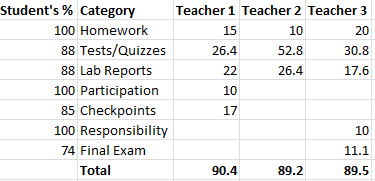
These teachers all teach the same class. Students are randomly scheduled into their class by the computer. This student could have performed exactly the same and, in one class, received an 89.2% (a B), an 89.5% (probably an A, but possibly a B), or 90.4% (an A), because the teachers choose to weight the categories differently. Oh, and there are two other teachers of this section that grade on total points, so the student would have yet another percentage that we can't determine from this information.
The same student, in the same class, with the same curriculum, at the same school. What grade should they get?
All three of these examples are real, from my school, from the end of last semester, although I did manipulate the overall percentages for effect (but the assignments and student scores on examples 1 and 2, and the teacher weights on all three examples, are real).
So, even if you believe grades are worthwhile (or if you don't believe grades are worthwhile but you have to give them anyway), I would at least ask that you spend a little more time thinking about them. Your computer grade book is mathematically accurate; it computes exactly what you tell it to compute. But that doesn't mean it makes sense. You are the professional, and if you give a grade to a student you should come up with a more thoughtful way to assign that grade than simply relying on a percentage.
One of the big frustrations I have when discussing grades with others (whether that be teachers, students, or parents) is that the argument frequently comes down to an unfounded faith in percent. The argument goes something like this:
- Well, we have to have grades. (I disagree.)
- You have to set a cut off somewhere. (Why?)
- This is the percent the student got, math never lies, so therefore this grade is accurate and fair. (Oh really?)
It's toward the end of the semester and a student has an 89.5% in a class. They turn in a review guide and get a 20 out of 20 on it. What happens to their overall grade? Does it go up? Stay the same? Or go down?
The vast majority of folks say it will go up. The answer, of course, is it depends. In this particular case, the grade goes down. Yes, a student who has an 89.5% in the class turns in their review guide assignment like a good student should and gets a 100% on it, yet their grade still goes down.
How is that possible? Well, this teacher weights their grades by category. This assignment falls in the Homework Category which gets a weight of 10%. Because this teacher previously offered some extra credit (which is a whole different blog rant), the student's percentage in the homework category before the review guide was turned in was 105.7%. After turning in her correctly done review guide, her percent in that category drops from a 105.7 to a 105, and her overall grade drops from an 89.5 to an 89.4 (which, for many teachers, is from an A to a B - most teachers in my building will "round up" an 89.5).
In effect, the student is penalized for turning in a perfect assignment. What grade should they get?
Recent Example #2
At the end of the semester a student has an 89.1% in a class out of a total of 2,389 points. What happens to their overall grade if they scored 1 point higher on one single assignment earlier in the semester?
Again, of course, it depends. In this particular case, it would raise their overall grade to 89.815% which, again for most teachers in my building, is probably the difference between a B and an A. Some of you will doubt that 1 point out of 2,389 can raise their grade from an 89.1 to an 89.815, but it can. This teacher weights categories as well, and one of their categories is titled Homework Checks and is worth 10% of the overall grade. Here is the student's scores in that category:
See that Slope Quiz on October 31st that the student scored a 7 out of 8 on? If they had received an 8 out of 8, their category percentage rises to 100%, which increases their overall percentage in the class by 0.715%, from 89.1 to 89.815.
One point, on one quiz, on one day. What grade should they get?
Recent Example #3
Here's a student's percentages in different categories for a particular class:
Homework: 100%
Tests & Quizzes: 88%
Lab Reports: 88%
Participation: 100%
Checkpoints: 85%
Responsibility: 100%
Final Exam: 74%
Well, we could have a long and valuable philosophical discussion about this, but the point of this example is that this student could get two different grades in the same class at my school. How? It depends on what teacher they have and how that teacher weights their categories. Here's what it looks like for three teachers of this class in my building:
And here's what that translates to for the student's percentages in each category:
These teachers all teach the same class. Students are randomly scheduled into their class by the computer. This student could have performed exactly the same and, in one class, received an 89.2% (a B), an 89.5% (probably an A, but possibly a B), or 90.4% (an A), because the teachers choose to weight the categories differently. Oh, and there are two other teachers of this section that grade on total points, so the student would have yet another percentage that we can't determine from this information.
The same student, in the same class, with the same curriculum, at the same school. What grade should they get?
All three of these examples are real, from my school, from the end of last semester, although I did manipulate the overall percentages for effect (but the assignments and student scores on examples 1 and 2, and the teacher weights on all three examples, are real).
So, even if you believe grades are worthwhile (or if you don't believe grades are worthwhile but you have to give them anyway), I would at least ask that you spend a little more time thinking about them. Your computer grade book is mathematically accurate; it computes exactly what you tell it to compute. But that doesn't mean it makes sense. You are the professional, and if you give a grade to a student you should come up with a more thoughtful way to assign that grade than simply relying on a percentage.
Saturday, May 03, 2014
What's the Best Way to Provide Feedback on a Paper?
So, my last post has generated some really great conversation in the comments. No easy answers, but lots to think about. As a result of one of those comments, I thought it might be good to solicit ideas from you guys on some of the ways you provide feedback for students on written work (in this case, thinking about the typical English paper, but it doesn't have to be). (Turnitin apparently does a nice job of facilitating that feedback and I don't have any angst over that part of the service :-).
Again, same caveat as on the last post, I'm not a Language Arts teacher and I do not claim to have any special pedagogical insight into providing feedback on papers. Let's also agree to stipulate that one-on-one conferences with each student to go over their writing is better than anything we're going to submit here.
But, given that it's next to impossible in most schools to have the time to do those one-to-one conferences with every student with every piece of writing, there is a need to provide some kind of feedback that's asynchronous. That's what I'd love to have you address in the comments: what strategies, tools and techniques have you used to best accomplish this?
So, from my non-Language-Arts-teacher perspective, my initial thought of the best way to provide feedback would look like this. The teacher reviews the student's writing on an iPad or similar tablet. This allows them to directly annotate on the written work just like they previously have on a written/printed document. But as they read through and annotate, they record a screencast that allows them to also record their verbal feedback, explaining the annotations and giving them more depth.
To me, that seems like it provides all the functionality of annotations (on either a written/printed piece or an electronic piece submitted somewhere like Turnitin) while also providing some (not all) of the benefits of a writing conference with the student. It also wouldn't take any more time than the traditional grading/annotating of a paper. (Okay, it would take a bit more time to encode and then upload the video for the student to review, but I don't see that as a huge time commitment. I could be wrong.)
So, Language Arts folks, what ways have you found to do this well? What about my proposed solution above doesn't work for you (or how would you improve it)? Would love to hear your thoughts.
Again, same caveat as on the last post, I'm not a Language Arts teacher and I do not claim to have any special pedagogical insight into providing feedback on papers. Let's also agree to stipulate that one-on-one conferences with each student to go over their writing is better than anything we're going to submit here.
But, given that it's next to impossible in most schools to have the time to do those one-to-one conferences with every student with every piece of writing, there is a need to provide some kind of feedback that's asynchronous. That's what I'd love to have you address in the comments: what strategies, tools and techniques have you used to best accomplish this?
So, from my non-Language-Arts-teacher perspective, my initial thought of the best way to provide feedback would look like this. The teacher reviews the student's writing on an iPad or similar tablet. This allows them to directly annotate on the written work just like they previously have on a written/printed document. But as they read through and annotate, they record a screencast that allows them to also record their verbal feedback, explaining the annotations and giving them more depth.
To me, that seems like it provides all the functionality of annotations (on either a written/printed piece or an electronic piece submitted somewhere like Turnitin) while also providing some (not all) of the benefits of a writing conference with the student. It also wouldn't take any more time than the traditional grading/annotating of a paper. (Okay, it would take a bit more time to encode and then upload the video for the student to review, but I don't see that as a huge time commitment. I could be wrong.)
So, Language Arts folks, what ways have you found to do this well? What about my proposed solution above doesn't work for you (or how would you improve it)? Would love to hear your thoughts.
Thursday, October 10, 2013
Your GDA Is More Important Than Your GPA
Just posted this to my Algebra class blog, thought I would share it here as well.
My daughter is thirteen and each morning I send her off to school with some combination of the following advice.
Have a great day. Work hard. Do your best. Learn a lot. Have fun. Be happy. Be kind. Be curious.
If she achieves most of those on any given day then I think it was a good day. I was thinking about this earlier this week when I was invited in to some of our Government classes here at AHS to talk about education. The students were having a fishbowl discussion about education, and our school system, and what changes they might want to make to make it better. Mr. Escue and Mrs. Winn invited in some other teachers (including me) to participate in the fishbowl discussions and push their thinking a bit.
Several things struck me from the conversation, including how stressed many of these students appeared to be. They were mostly stressed by the pressure they perceived they were under to "perform well" and "get good grades." It was a real struggle to direct the conversation back to learning, and what they felt the purpose of high school should be, and away from grades, graduation requirements, and colleges.
As I was thinking about this last night I thought about what I tell my own daughter each day and wondered if she feels as stressed as these students do. It turns out she does feel many of the same pressures, even though she has heard her parents say many times what we feel is important (and can even repeat it back to us). That makes me think that we (as parents) and I (as a teacher) need to do a better job of stressing what I think is important to you (my students) as well as to my daughter. Even though what I say to my daughter each morning is pretty good and succinct, I tried to think of something that might sum it up a bit better in one sentence. This is what I came up with:
Your Good Day Average (or GDA) is more important than your Grade Point Average (GPA).
So I'm going to try to say that a bit more often to both my daughter and to you guys. Because I really do believe that if you work hard, do your best, learn a lot, have fun, be happy, be kind, and be curious - then you did have a good day.
This would be a great conversation to have with your parents as well to see what they think about all of this. What do they - and you - consider to be a good day?
Tuesday, August 06, 2013
Minimum Expectations
I spent the last two days in some district-provided professional development around the Common Core Math Standards. Overall it was a pretty good two days, in spite of my misgivings about Common Core in general, and other than I went away somewhat depressed with my own ability to do this well (but that's another post or three).
I wanted to take a moment to put down some thoughts/questions about a couple of problems we did today. Early in the day we did an activity where we were rating the complexity of various problems. One of the problems was:
I basically said something like, "Well, if your goal is simply to solve it and enter an answer, then I'd just use Desmos. How hard is that? It's a 1." (Yes, I know, I can be a pain sometimes. But they invited me.)

A little later in the day (or maybe it was earlier, I've lost track now) we then encountered this problem:

Once again we worked with it for a while and analyzed the complexity of the task and what students would need to know in order to complete the task. This time the discussion was about how difficult it was to find the minimum and how much that should factor into the complexity of the task. Again, I brought up Desmos, and suggested that if the students knew the appropriate formulas, this was a relatively trivial problem.

The scoring rubric we looked at assumed most students would make a table of values and the points they got was determined by whether they got the formula, did the substitution, and then how precise they were with their guess-and-check.
Now, I'm not saying that's a bad way to do this, but I think it brings up an interesting question. Let's assume this is not a calculus course where we're talking about finding maximum and minimum, and I think that's not a bad assumption to make considering it was labeled a Geometry problem (and considering that Calculus is no longer the assumed capstone course in Common Core - heck, even the College Board apparently agrees). So, in the age of Desmos, or Wolfram Alpha, or whatever, how much value is there in finding minimums and maximums by tables of values, or by factoring, or even by calculus?
I'm not saying there isn't value in those approaches, but I found it interesting that no one other than me thought to graph it (and these folks proved over the two days that they are generally brighter than me mathematically). I don't know this, but I would guess the reason is because they either don't know about Desmos (although most had graphing calculators with them), or simply don't think of a graph to solve this because we think like math teachers and graphing has always been difficult.
So I'm not making any grand pronouncements (for once), but I'm curious what the math folks out there think about this (and similar issues). What should be our "minimum" expectations?
Update 8-8-13: Desmos suggests perhaps having students design the can.
I wanted to take a moment to put down some thoughts/questions about a couple of problems we did today. Early in the day we did an activity where we were rating the complexity of various problems. One of the problems was:
Solve the following equation: (3x - 2)2 = 6x - 4The group generally agreed that this was not an overly complex problem, but there was a debate going on about exactly how complex it was. Because this was after rating a bunch of other problems, I was growing a bit tired of this (I see some value in comparing problems, but it felt more like we were determining where this would fit on the PARCC test and not discussing what a good problem looks like), so I said I thought this was really a 1 (being the least complex, and the debate previously was between whether it was a 2 or a 3).
When you are finished, enter your answer below.
I basically said something like, "Well, if your goal is simply to solve it and enter an answer, then I'd just use Desmos. How hard is that? It's a 1." (Yes, I know, I can be a pain sometimes. But they invited me.)

A little later in the day (or maybe it was earlier, I've lost track now) we then encountered this problem:

Once again we worked with it for a while and analyzed the complexity of the task and what students would need to know in order to complete the task. This time the discussion was about how difficult it was to find the minimum and how much that should factor into the complexity of the task. Again, I brought up Desmos, and suggested that if the students knew the appropriate formulas, this was a relatively trivial problem.

The scoring rubric we looked at assumed most students would make a table of values and the points they got was determined by whether they got the formula, did the substitution, and then how precise they were with their guess-and-check.
Now, I'm not saying that's a bad way to do this, but I think it brings up an interesting question. Let's assume this is not a calculus course where we're talking about finding maximum and minimum, and I think that's not a bad assumption to make considering it was labeled a Geometry problem (and considering that Calculus is no longer the assumed capstone course in Common Core - heck, even the College Board apparently agrees). So, in the age of Desmos, or Wolfram Alpha, or whatever, how much value is there in finding minimums and maximums by tables of values, or by factoring, or even by calculus?
I'm not saying there isn't value in those approaches, but I found it interesting that no one other than me thought to graph it (and these folks proved over the two days that they are generally brighter than me mathematically). I don't know this, but I would guess the reason is because they either don't know about Desmos (although most had graphing calculators with them), or simply don't think of a graph to solve this because we think like math teachers and graphing has always been difficult.
So I'm not making any grand pronouncements (for once), but I'm curious what the math folks out there think about this (and similar issues). What should be our "minimum" expectations?
Update 8-8-13: Desmos suggests perhaps having students design the can.
Friday, June 29, 2012
Flawed and Uneasy Compromise
I'm stuck. I don't particularly like how I'm assessing in Algebra, but I'm not bright (creative?) enough to figure out how to do it better.
I've tried to strike an uneasy balance the last two years between my fairly traditional Algebra curriculum and some of my more "untraditional" views. The compromise has been to assess over the traditional Algebra skills using a semi-standards-based-grading approach (see this and this and this and this to get an idea), while trying to utilize a more inquiry-based approach to exploring the concepts (followed by traditional, algorithm-based approaches via video in order to reinforce the skills and simultaneously free up the class time to actually do the inquiry first). It's been a flawed, uneasy compromise, but I still think it's been more successful than my more traditional approach in my first incarnation as a math teacher.
What I'd like, however, is to somehow transform my assessments into something a bit more higher order/meaningful, while still retaining the ability to assess whether the students have mastered the discrete skills that are still a big part of my curriculum. My students will have laptops this year (more on that in a future post) and, ideally, I would love my assessments to be open-Internet assessments.
But this is where I keep running into a brick wall - I haven't been able to figure out how to design assessments that not only test the skills that students are required to learn, but with problems that can't be solved effortlessly with Wolfram Alpha (and thereby don't give me enough information to tell what my students have learned about the Algebra). I haven't been able to figure out how to come up with more meaningful assessment activities for my students, but that still fit within the very limited time I get to see them (and also retain the ability to easily re-assess outside of class that I've utilized the last two years). I haven't been able to reconcile my belief that students still do need algebra-sense (akin to number sense), to know how to think about mathematics and perform some of those algorithmic algebra skills, with my just-as-strong belief that learning those skills in isolation and without context is pretty pointless (and not as successful as I'd like, either).
Some of this, undoubtedly, is a result of trying to balance two pretty incompatible things, yet that's still where I find myself. I can certainly stick with the assessments I've used the last couple of years and ignore my views about students being able to use resources on the Internet to help them, and redouble my efforts to come up with better inquiry-based activities to push my students' thinking. But I suspect that, while I might feel a bit more successful if I accomplish that, I'll be sitting here one year from today feeling essentially the same - that the whole is in this case actually somewhat less than the sum of the parts.
Now that I've gotten this far, I really have no idea what the point of this post is, other than a Hail Mary out to the blogosphere for someone to leap very high and pull me in. Any words of wisdom or links to resources would be appreciated (but, truly, I don't need any "I'm sure you're doing great . . ." type of comments, although I appreciate the kindness and intent of such comments).
I've tried to strike an uneasy balance the last two years between my fairly traditional Algebra curriculum and some of my more "untraditional" views. The compromise has been to assess over the traditional Algebra skills using a semi-standards-based-grading approach (see this and this and this and this to get an idea), while trying to utilize a more inquiry-based approach to exploring the concepts (followed by traditional, algorithm-based approaches via video in order to reinforce the skills and simultaneously free up the class time to actually do the inquiry first). It's been a flawed, uneasy compromise, but I still think it's been more successful than my more traditional approach in my first incarnation as a math teacher.
What I'd like, however, is to somehow transform my assessments into something a bit more higher order/meaningful, while still retaining the ability to assess whether the students have mastered the discrete skills that are still a big part of my curriculum. My students will have laptops this year (more on that in a future post) and, ideally, I would love my assessments to be open-Internet assessments.
But this is where I keep running into a brick wall - I haven't been able to figure out how to design assessments that not only test the skills that students are required to learn, but with problems that can't be solved effortlessly with Wolfram Alpha (and thereby don't give me enough information to tell what my students have learned about the Algebra). I haven't been able to figure out how to come up with more meaningful assessment activities for my students, but that still fit within the very limited time I get to see them (and also retain the ability to easily re-assess outside of class that I've utilized the last two years). I haven't been able to reconcile my belief that students still do need algebra-sense (akin to number sense), to know how to think about mathematics and perform some of those algorithmic algebra skills, with my just-as-strong belief that learning those skills in isolation and without context is pretty pointless (and not as successful as I'd like, either).
Some of this, undoubtedly, is a result of trying to balance two pretty incompatible things, yet that's still where I find myself. I can certainly stick with the assessments I've used the last couple of years and ignore my views about students being able to use resources on the Internet to help them, and redouble my efforts to come up with better inquiry-based activities to push my students' thinking. But I suspect that, while I might feel a bit more successful if I accomplish that, I'll be sitting here one year from today feeling essentially the same - that the whole is in this case actually somewhat less than the sum of the parts.
Now that I've gotten this far, I really have no idea what the point of this post is, other than a Hail Mary out to the blogosphere for someone to leap very high and pull me in. Any words of wisdom or links to resources would be appreciated (but, truly, I don't need any "I'm sure you're doing great . . ." type of comments, although I appreciate the kindness and intent of such comments).
Subscribe to:
Posts (Atom)