Similar to last semester, I asked parents and students to evaluate me at the end of the semester via a google form. I think it's always good to ask for this feedback, even though sometimes
you're not sure how honest and accurate it is. Even so, I learn
something from it each time.
I also think it's important to be transparent, so here are the links to
their responses. These responses are verbatim, except for some slight
editing where personal information was included. Both students and
parents could choose to leave their name if they wished (totally
optional), and some of the parent comments included their student's
name - I edited all of that out.
Student Feedback (36 out of 45 completed the survey)
Parent Feedback (16 responses to the survey)
Showing posts with label feedback. Show all posts
Showing posts with label feedback. Show all posts
Sunday, May 22, 2016

Thursday, December 17, 2015
Student and Parent Evaluations of Me
We began offering an Intro to Computer Science class this fall for the first time in a long time, and I had the, ahem, "opportunity" to teach it. (We are hopefully going to be hiring a teacher for the next school year who is a bit more qualified, but just didn't have the FTE to do that this year as we got it off the ground.)
As when I taught Algebra, I asked both the students and parents for feedback via a google form at the end of the semester. I think it's always good to ask for this feedback, even though sometimes you're not sure how honest and accurate it is. Even so, I learn something from it each time.
I also think it's important to be transparent, so here are the links to their responses. These responses are verbatim, except for some slight editing where personal information was included. Both students and parents could choose to leave their name if they wished (totally optional), and some of the parent comments including their student's name - I edited all of that out.
Student Feedback (36 out of 45 completed the survey)
Parent Feedback (12 responses to the survey)
As when I taught Algebra, I asked both the students and parents for feedback via a google form at the end of the semester. I think it's always good to ask for this feedback, even though sometimes you're not sure how honest and accurate it is. Even so, I learn something from it each time.
I also think it's important to be transparent, so here are the links to their responses. These responses are verbatim, except for some slight editing where personal information was included. Both students and parents could choose to leave their name if they wished (totally optional), and some of the parent comments including their student's name - I edited all of that out.
Student Feedback (36 out of 45 completed the survey)
Parent Feedback (12 responses to the survey)
Thursday, August 27, 2015
Staff Evaluation Of Me
Last spring I read Work Rules by Laszlo Bock, who's the Senior VP of People Operations (Human Resources) at Google. It was an interesting read in many ways, but one particular take away for me was the need to ask more directly for feedback. Like everyone I, of course, get informal day-to-day feedback from the folks I work with, and more formal feedback from my supervising administrator. But that's not the same as specifically asking for feedback, so I decided to ask my colleagues to complete a google form at the beginning of this school year. (I've also posted a link to a Google Form for student feedback for me several places around the building but, so far, I only have one response. If I get some more I'll share that as well.)
When I sat down to create the form I quickly got into the weeds. I wanted specific feedback, yet when I tried writing specific questions I ran into two problems. I felt like the questions were both too "leading" and too "limiting", and to get at everything I wanted feedback on required so many questions that it made the survey way too long. So I eventually decided on a few open-ended questions that I hoped would get me some decent feedback but make the survey short enough that people would complete it.
Here's a screenshot of the survey.
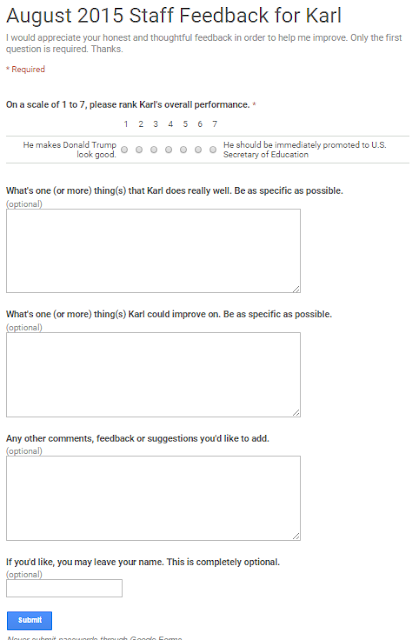
Based on the suggestions in the book and some other things I've read, I decided to go with a simple ranking of 1 to 7, one question on what I do well, one on what I can improve on, and then the usual "anything else they want to add." I was hoping that this would give them enough to give me some valuable feedback without getting too specific or too long. The downside, of course, is that's it's not very specific. They could take it anonymously or give me their name if they wanted to.
Here are the results. This is an exact copy of the actual results, except for the optional name column. In that column I replaced anyone's name with an asterisk for their confidentiality. So, as you look at that column, a blank space indicates that it was an anonymous response and an asterisk that they gave their name. (I received 62 responses. We have about 115 certified staff and about 40 classified staff.)
I think there are a couple of caveats (at least) to keep in mind when looking at these results. First, I think they will tend to skew positive, both because people who were ready to say nice things were more likely to take the time to complete the survey, and just because educators are generally nice. Second, I think you can't read too much into the results (positive or negative) because the questions were so open-ended. I think that's a trade-off I had to make, but still something to keep in mind.
So, I have my own thoughts on what the results mean, but I think I'll keep them to myself for now, because I'd love to hear what other people see in the results without influencing your thinking. So please leave your thoughts in the comments - it would probably be most helpful if you would focus particularly on the "things I could do better column", but all of it is fair game.
When I sat down to create the form I quickly got into the weeds. I wanted specific feedback, yet when I tried writing specific questions I ran into two problems. I felt like the questions were both too "leading" and too "limiting", and to get at everything I wanted feedback on required so many questions that it made the survey way too long. So I eventually decided on a few open-ended questions that I hoped would get me some decent feedback but make the survey short enough that people would complete it.
Here's a screenshot of the survey.

Based on the suggestions in the book and some other things I've read, I decided to go with a simple ranking of 1 to 7, one question on what I do well, one on what I can improve on, and then the usual "anything else they want to add." I was hoping that this would give them enough to give me some valuable feedback without getting too specific or too long. The downside, of course, is that's it's not very specific. They could take it anonymously or give me their name if they wanted to.
Here are the results. This is an exact copy of the actual results, except for the optional name column. In that column I replaced anyone's name with an asterisk for their confidentiality. So, as you look at that column, a blank space indicates that it was an anonymous response and an asterisk that they gave their name. (I received 62 responses. We have about 115 certified staff and about 40 classified staff.)
I think there are a couple of caveats (at least) to keep in mind when looking at these results. First, I think they will tend to skew positive, both because people who were ready to say nice things were more likely to take the time to complete the survey, and just because educators are generally nice. Second, I think you can't read too much into the results (positive or negative) because the questions were so open-ended. I think that's a trade-off I had to make, but still something to keep in mind.
So, I have my own thoughts on what the results mean, but I think I'll keep them to myself for now, because I'd love to hear what other people see in the results without influencing your thinking. So please leave your thoughts in the comments - it would probably be most helpful if you would focus particularly on the "things I could do better column", but all of it is fair game.
Wednesday, March 25, 2015
Whose Test Is It?
This is a long post, and rambles a bit. My Mom said the other day that I'm wordy, and she's right. But it's my blog and I'll be verbose if I want to, verbose if I want to . . . Also, keep in mind that I would prefer to radically change what we do each day in school (school should be "different", not "better"), but this post is written from the perspective of how we can do what we are currently doing better.
While it's clear I'm not a fan of standardized tests such as PARCC, there is one advertised feature of PARCC that I think is an improvement over previous state-mandated testing we've done. It's the idea that we would get the results back faster, in which case - whatever their value - we at least would perhaps be able to use them to help students. Now, so far, I don't see any indication that we actually will get those results back faster (end of the school year is better than next fall, but still not very helpful), but perhaps as they iron out the wrinkles that will happen.
Research indicates that timely and effective feedback is key for student learning growth so, if the point of assessment is to help students learn more effectively, then both "end-of-the-year" and "next fall" don't do us much good. While we don't have much (any?) control over state assessments like PARCC, we do have control over teacher generated and given assessments in our classrooms. So what frustrates me is the timeliness and effectiveness of the feedback we often give, because this is something we do have some control over.
The genesis of this post was when a student I know well took three major tests on the Friday before Spring Break. Which means that, in the best-case scenario, this student won't receive any feedback for at least ten days. How "timely" and "effective" do you think that feedback is going to be? Now, let me be clear, as a teacher I've done this before as well. You want to finish a "unit" before a scheduled break in school and you want to assess before that break while it's still fresh in their minds. But that doesn't make it right and, as I've gotten older (and hopefully wiser), I've done my best to resist that urge. While not a perfect solution, I at least tried to give any assessments the day before the last day before a scheduled break so that they could receive feedback before going on break.
Which brings up the next issue, which is how quickly we get these assessments back to our students. Now, in this case, it's going to be at least ten days due to Spring Break, but what about assessments that aren't given right before Spring Break? Here's my thinking. If something is important enough that we are going to assess (and grade) all of our students at one point in time, and we are expecting all of our students to be ready and to take that assessment, then we should be willing to commit to return that assessment to them, with feedback, the very next day that class meets.
This, obviously, is an opinion that some folks will take issue with. They'll point to a limited amount of time for teachers, and many competing obligations, and the sheer amount of time it takes to grade assessments of multiple sections in only one to three days (depending on your schedule and weekends). I readily acknowledge those issues, I just don't think they are a worthy excuse. Again, if this assessment is important enough to give to all your students at one time, and if the goal of the assessment is to determine how well they know this essential material and then to help them learn anything they are still confused about, then as teachers we need to get this back to our students with meaningful feedback as soon as possible. While immediate feedback is often best, slightly delayed (the next day that class meets) feedback can be useful as well. Greatly delayed feedback? Not so much.
So that addresses "timely," but what about "effective?" What does effective feedback look like? I am in no way an expert on this, and there are many books you can read to help you with this, but I do think I can identify a few practices that aren't effective. Let me focus on two of them. First, feedback that is just a grade, or perhaps a grade with a few things circled, is usually not going to be effective feedback. Second, an assessment that you don't give back to the students and allow them to keep is usually not going to be effective.
Letting students keep assessments is a controversial topic for some teachers, so let's explore that a bit. In my experience, every reason given for this basically boils down to the same reason: cheating (with a side helping of time). Some teachers don't like to let students keep the assessments because they are worried other students will use them to cheat, either because they were absent when the assessment was given and need to make it up, or that students will pass the assessment along to future students. There's a fairly easy way to solve that problem, of course, which is to have several versions of that assessment made, which is where the side helping of time comes in - teachers will say they simply don't have time to create multiple versions of their assessments. I disagree.
Creating quality assessments is obviously a complicated issue that can't be addressed in this post, but the majority of assessments I see in schools fall into three categories: textbook-generated assessments, teacher-created assessments, and essay-type assessments (either textbook or teacher generated). (There are obviously other types, but I think these three do a fairly good job of putting them into categories.) For those teachers that use textbook-generated assessments, the software will easily create multiple versions of the assessment for you. For those that decide to go a little further and create their own assessments, it will take a bit more time, but it's not that hard to create multiple versions of the same assessment. (And, if you're really good, which I'm not, great assessment questions are really hard to cheat on anyway, so you don't need multiple versions.) Essays are both easier and tougher. Easier because they are harder to cheat on, tougher because they do take a fair amount of time to evaluate and provide feedback on. In my perfect world, though, that feedback is being provided throughout the writing process, so there's really not one "due date" where the essays have to be turned in and evaluated en masse.
There are some other strategies that I think are helpful. In math and science classes especially, for example, I still see most teachers giving unit assessments, that take a long time for students to take and a long time for teachers to evaluate. Why not give shorter assessments more frequently? This not only makes it easier to provide more timely feedback, but it gives students more frequent feedback as well. I also see many teachers trying to assess everything, instead of just what we've identified as being essential. Which is better, assessing everything and providing delayed and incomplete feedback? Or assessing only a few really important things, and giving our students thorough feedback in a timely fashion? I would suggest the latter.
Finally, let's talk about final exams. Many high schools, including mine, give final exams during the last week of the semester. At the end of first semester we have winter break, and then students may or may not have the same course and teacher when the next semester starts two weeks later. At the end of the second semester, students go to summer break. The vast majority of students don't get any feedback (other than the grade on the online portal) on these final exams. Some folks will suggest that since these are "summative" assessments, it's not that important to give feedback. I think that argument only works if you view each course as its own isolated world with a goal of finishing the course and getting a grade. If we truly value what we are teaching in that course and think that it's important for students to learn, then it doesn't "end" when the course ends. From this viewpoint, all assessment is formative.
If we're going to continue to have final exams, then I have a simple suggestion: don't give them on the last days of school each semester. Give them a few days before and then allow each class to meet at least one more time after the final exam in order to give the assessments back to the students and provide feedback to them. With my school's schedule, for example, that would require two class days after final exams, one running a MWF schedule and one running a TR schedule. Some folks will argue that students won't use that time well, or might not even show up, and that may be true. But if that's the case, then what does that say about what we're doing in the first place? If what we are doing is truly valuable, then students will want to show up.
For me, it boils down to what is the purpose of assessment. Whose test is it? If it's designed for the adults, then the prevailing practices are probably just fine. But if it's designed for the students, to help them learn and grow and be successful, then we need to do some rethinking about how we assess and provide feedback to - and for - our students.
While it's clear I'm not a fan of standardized tests such as PARCC, there is one advertised feature of PARCC that I think is an improvement over previous state-mandated testing we've done. It's the idea that we would get the results back faster, in which case - whatever their value - we at least would perhaps be able to use them to help students. Now, so far, I don't see any indication that we actually will get those results back faster (end of the school year is better than next fall, but still not very helpful), but perhaps as they iron out the wrinkles that will happen.
Research indicates that timely and effective feedback is key for student learning growth so, if the point of assessment is to help students learn more effectively, then both "end-of-the-year" and "next fall" don't do us much good. While we don't have much (any?) control over state assessments like PARCC, we do have control over teacher generated and given assessments in our classrooms. So what frustrates me is the timeliness and effectiveness of the feedback we often give, because this is something we do have some control over.
The genesis of this post was when a student I know well took three major tests on the Friday before Spring Break. Which means that, in the best-case scenario, this student won't receive any feedback for at least ten days. How "timely" and "effective" do you think that feedback is going to be? Now, let me be clear, as a teacher I've done this before as well. You want to finish a "unit" before a scheduled break in school and you want to assess before that break while it's still fresh in their minds. But that doesn't make it right and, as I've gotten older (and hopefully wiser), I've done my best to resist that urge. While not a perfect solution, I at least tried to give any assessments the day before the last day before a scheduled break so that they could receive feedback before going on break.
Which brings up the next issue, which is how quickly we get these assessments back to our students. Now, in this case, it's going to be at least ten days due to Spring Break, but what about assessments that aren't given right before Spring Break? Here's my thinking. If something is important enough that we are going to assess (and grade) all of our students at one point in time, and we are expecting all of our students to be ready and to take that assessment, then we should be willing to commit to return that assessment to them, with feedback, the very next day that class meets.
This, obviously, is an opinion that some folks will take issue with. They'll point to a limited amount of time for teachers, and many competing obligations, and the sheer amount of time it takes to grade assessments of multiple sections in only one to three days (depending on your schedule and weekends). I readily acknowledge those issues, I just don't think they are a worthy excuse. Again, if this assessment is important enough to give to all your students at one time, and if the goal of the assessment is to determine how well they know this essential material and then to help them learn anything they are still confused about, then as teachers we need to get this back to our students with meaningful feedback as soon as possible. While immediate feedback is often best, slightly delayed (the next day that class meets) feedback can be useful as well. Greatly delayed feedback? Not so much.
So that addresses "timely," but what about "effective?" What does effective feedback look like? I am in no way an expert on this, and there are many books you can read to help you with this, but I do think I can identify a few practices that aren't effective. Let me focus on two of them. First, feedback that is just a grade, or perhaps a grade with a few things circled, is usually not going to be effective feedback. Second, an assessment that you don't give back to the students and allow them to keep is usually not going to be effective.
Letting students keep assessments is a controversial topic for some teachers, so let's explore that a bit. In my experience, every reason given for this basically boils down to the same reason: cheating (with a side helping of time). Some teachers don't like to let students keep the assessments because they are worried other students will use them to cheat, either because they were absent when the assessment was given and need to make it up, or that students will pass the assessment along to future students. There's a fairly easy way to solve that problem, of course, which is to have several versions of that assessment made, which is where the side helping of time comes in - teachers will say they simply don't have time to create multiple versions of their assessments. I disagree.
Creating quality assessments is obviously a complicated issue that can't be addressed in this post, but the majority of assessments I see in schools fall into three categories: textbook-generated assessments, teacher-created assessments, and essay-type assessments (either textbook or teacher generated). (There are obviously other types, but I think these three do a fairly good job of putting them into categories.) For those teachers that use textbook-generated assessments, the software will easily create multiple versions of the assessment for you. For those that decide to go a little further and create their own assessments, it will take a bit more time, but it's not that hard to create multiple versions of the same assessment. (And, if you're really good, which I'm not, great assessment questions are really hard to cheat on anyway, so you don't need multiple versions.) Essays are both easier and tougher. Easier because they are harder to cheat on, tougher because they do take a fair amount of time to evaluate and provide feedback on. In my perfect world, though, that feedback is being provided throughout the writing process, so there's really not one "due date" where the essays have to be turned in and evaluated en masse.
There are some other strategies that I think are helpful. In math and science classes especially, for example, I still see most teachers giving unit assessments, that take a long time for students to take and a long time for teachers to evaluate. Why not give shorter assessments more frequently? This not only makes it easier to provide more timely feedback, but it gives students more frequent feedback as well. I also see many teachers trying to assess everything, instead of just what we've identified as being essential. Which is better, assessing everything and providing delayed and incomplete feedback? Or assessing only a few really important things, and giving our students thorough feedback in a timely fashion? I would suggest the latter.
Finally, let's talk about final exams. Many high schools, including mine, give final exams during the last week of the semester. At the end of first semester we have winter break, and then students may or may not have the same course and teacher when the next semester starts two weeks later. At the end of the second semester, students go to summer break. The vast majority of students don't get any feedback (other than the grade on the online portal) on these final exams. Some folks will suggest that since these are "summative" assessments, it's not that important to give feedback. I think that argument only works if you view each course as its own isolated world with a goal of finishing the course and getting a grade. If we truly value what we are teaching in that course and think that it's important for students to learn, then it doesn't "end" when the course ends. From this viewpoint, all assessment is formative.
If we're going to continue to have final exams, then I have a simple suggestion: don't give them on the last days of school each semester. Give them a few days before and then allow each class to meet at least one more time after the final exam in order to give the assessments back to the students and provide feedback to them. With my school's schedule, for example, that would require two class days after final exams, one running a MWF schedule and one running a TR schedule. Some folks will argue that students won't use that time well, or might not even show up, and that may be true. But if that's the case, then what does that say about what we're doing in the first place? If what we are doing is truly valuable, then students will want to show up.
For me, it boils down to what is the purpose of assessment. Whose test is it? If it's designed for the adults, then the prevailing practices are probably just fine. But if it's designed for the students, to help them learn and grow and be successful, then we need to do some rethinking about how we assess and provide feedback to - and for - our students.
Saturday, May 03, 2014
What's the Best Way to Provide Feedback on a Paper?
So, my last post has generated some really great conversation in the comments. No easy answers, but lots to think about. As a result of one of those comments, I thought it might be good to solicit ideas from you guys on some of the ways you provide feedback for students on written work (in this case, thinking about the typical English paper, but it doesn't have to be). (Turnitin apparently does a nice job of facilitating that feedback and I don't have any angst over that part of the service :-).
Again, same caveat as on the last post, I'm not a Language Arts teacher and I do not claim to have any special pedagogical insight into providing feedback on papers. Let's also agree to stipulate that one-on-one conferences with each student to go over their writing is better than anything we're going to submit here.
But, given that it's next to impossible in most schools to have the time to do those one-to-one conferences with every student with every piece of writing, there is a need to provide some kind of feedback that's asynchronous. That's what I'd love to have you address in the comments: what strategies, tools and techniques have you used to best accomplish this?
So, from my non-Language-Arts-teacher perspective, my initial thought of the best way to provide feedback would look like this. The teacher reviews the student's writing on an iPad or similar tablet. This allows them to directly annotate on the written work just like they previously have on a written/printed document. But as they read through and annotate, they record a screencast that allows them to also record their verbal feedback, explaining the annotations and giving them more depth.
To me, that seems like it provides all the functionality of annotations (on either a written/printed piece or an electronic piece submitted somewhere like Turnitin) while also providing some (not all) of the benefits of a writing conference with the student. It also wouldn't take any more time than the traditional grading/annotating of a paper. (Okay, it would take a bit more time to encode and then upload the video for the student to review, but I don't see that as a huge time commitment. I could be wrong.)
So, Language Arts folks, what ways have you found to do this well? What about my proposed solution above doesn't work for you (or how would you improve it)? Would love to hear your thoughts.
Again, same caveat as on the last post, I'm not a Language Arts teacher and I do not claim to have any special pedagogical insight into providing feedback on papers. Let's also agree to stipulate that one-on-one conferences with each student to go over their writing is better than anything we're going to submit here.
But, given that it's next to impossible in most schools to have the time to do those one-to-one conferences with every student with every piece of writing, there is a need to provide some kind of feedback that's asynchronous. That's what I'd love to have you address in the comments: what strategies, tools and techniques have you used to best accomplish this?
So, from my non-Language-Arts-teacher perspective, my initial thought of the best way to provide feedback would look like this. The teacher reviews the student's writing on an iPad or similar tablet. This allows them to directly annotate on the written work just like they previously have on a written/printed document. But as they read through and annotate, they record a screencast that allows them to also record their verbal feedback, explaining the annotations and giving them more depth.
To me, that seems like it provides all the functionality of annotations (on either a written/printed piece or an electronic piece submitted somewhere like Turnitin) while also providing some (not all) of the benefits of a writing conference with the student. It also wouldn't take any more time than the traditional grading/annotating of a paper. (Okay, it would take a bit more time to encode and then upload the video for the student to review, but I don't see that as a huge time commitment. I could be wrong.)
So, Language Arts folks, what ways have you found to do this well? What about my proposed solution above doesn't work for you (or how would you improve it)? Would love to hear your thoughts.
Subscribe to:
Posts (Atom)