Showing posts with label grades. Show all posts

Wednesday, December 01, 2021

Grading For Whom?

Back in the day I wrote a time or two about grades and grading. I'm currently reading a seemingly unrelated book that made me think about grades and grading through a new lens. For whom are we grading? The most common answers seem to be for colleges, for parents, and for students. Perhaps we should take a little time and look at each of those more closely.

For Colleges
It is certainly true that college admission's officers like them a good GPA. But it's also true that there are quite a few high schools that don't use grades and their students still get into college. So clearly grades aren't required to get into college, they are just a convenient shortcut for admissions officers (and perhaps also for high school counselors and teachers). And, of course, only about 30% of students in the United States complete a four-year degree, so we're definitely not grading for college for the other 70%.

For Parents
Many parents certainly do seem to care about grades. Or do they? I think many parents want to know the following:

  • Is my student learning?
  • Are they working hard?
  • Are they being a good human?
  • Is my kid going to be okay?

Grades really don't answer any of those questions particularly well, especially in comparison to other information we can provide to parents.

For Students
While there are certainly some students who don't appear to care about grades, most teachers would say that a large number of students care about grades on a scale from moderately to intensively. But, much like their parents, I think what they really want to know is the following:

  • Am I learning?
  • Do you think I'm being a good kid?
  • Do my teacher and my peers like me and do I fit in?
  • How can I keep my parents off my back?
  • Am I going to be okay?

Grades certainly can be used to keep parents off your back, but do a really poor job of addressing the other four, again especially in comparison to other kinds of feedback we can give them.

So for whom are we grading? Perhaps it's for us, for teachers. If that's the case, then why is that? Maybe it's for some of the following reasons:

  • Because we've always done it that way.
  • Because it's really hard to give more meaningful feedback and if we didn't have grades we'd have to figure out a better, more difficult, more time-intensive way to fulfill the various purposes of grades.
  • Because grades are one way to help control and manage a classroom of students who often don't want to be there.
  • Because if we got rid of grades, what else might we have to take a look at and perhaps change? We might have to examine all of the assumptions we currently hold and even reexamine what we even believe to be the purpose of school (or, perhaps more accurately, the purpose of education). That's scary.

 I wonder how you would grade those answers?

Monday, June 15, 2015

Idea #1: Eliminate Letter Grades, GPA and Class Rank

At the end of the school year I met with the administrator who does my evaluation and he/she asked me to think over the summer about some "big ideas" that would be worth discussing that could improve our school. This is the first of hopefully several blog posts that will explore some of those ideas. Warning - this will be extremely long, somewhat rambly, and very narrative/descriptive.


Name of Administrator,

You asked me to think of some "big ideas" that could help Arapahoe improve and meet the needs of our students even more effectively than we currently do. A former administrator of ours used to refer to this as "taking it to the next level" (and the gaming culture refers to this as "leveling up"). While well intentioned, I grew to dislike that phrase over time because I felt like it was too ambiguous and was too often for "show" and not for "substance." It also implies that there is a "level" we are at that applies equally to all students, a one-size-fits-all approach that suggests there is one right way to meet the needs of all of our students. I, of course, disagree with that, both in theory and in practice. So as I began to think about your request I decided to frame it more in the context of educational "first principles" instead of "levels"or even "improvements."

As I began sketching out a few of those big ideas, I quickly realized that some ideas were bigger than others, which meant I had to make a decision: do I start with the smaller big ideas or the really big big ideas? Many folks would suggest that we should start with the smaller ones, because - while big - they are still much less threatening to the existing structure and therefore more likely to be adopted or at least partially adopted. But as I thought about first principles, I decided to take the alternate approach. We should start with some of the biggest ideas first, because so much of our system (both current and hopefully future) flows from some basic decisions (assumptions) that we've made and often don't even go back and question. That doesn't mean that any of the ideas that follow can't stand on their own or aren't worthwhile even if we don't adopt the biggest ideas, it just means we should do the hard work of tackling the biggest ideas first because they will not only have the biggest impact, but will shape all the other ideas to come.

I've written previously about mission statements and how I don't think ours is a very good one. I think the problem boils down to first principles, and that we haven't truly identified what our core values and goals are for our students (or even for ourselves as educators). Clearly it wouldn't make much sense for me to to try to identify those core values for our school by myself, so I'm not going to try to do that here. But as I thought about what I could suggest that might be one level of abstraction removed from those core values, I thought of three majors areas: our system/schedule, our curriculum, and our assessment/reporting system. All three of those are worth discussing in depth, but for this first idea at least I've decided to focus on the last one: our assessment/reporting system.

Here is my basic assertion, which I would suggest is a basic truth about our current system: When we have an assessment and reporting system for learning that undermines the learning, the reporting system is fatally flawed and needs to change. To me, so many of the "problems" I see with our current system, and probably the single biggest impediment to meaningful change, is grades. Specifically, letter grades, and especially because those letter grades are typically assigned by averaging percents across multiple discrete assignments over an arbitrary amount of time (a semester). We then compound that huge mistake by translating those letter grades into GPA (more averaging of discrete and unrelated items), and then use that GPA to establish a Class Rank for each and every one of our students. In my view, this is both morally and pedagogically indefensible and needs to stop. Which is why it's the first of the "big ideas" I think we should discuss as a school.

There are a myriad of different ways that grades (along with GPA and Class Rank) undermine the learning; I will mention just a few (although I'd be happy to go more in-depth on any of them if you'd like).

Ask any teacher at AHS in the last two weeks of the semester what is frustrating them the most, and one of the first things out of their mouth will be students asking what they can do to improve their grade. (We even have a name for this, "grade grubbing.") It's frustrating because the students are basically asking what they can do to get more "points" - the conversation is not at all about learning. As educators, we complain endlessly about this, but fail to acknowledge that we have created it. If we want the conversation to be about learning, we need to remove the whole idea of "points" and "letter grades."

The idea of assigning a percent to what a student knows on a particular assignment, and then averaging those percents over an arbitrary amount of time to come up with an overall grade, is indefensible mathematically, pedagogically, practically, and based on what we know about human development. If we value learning, if we value growth, if we value effort, then letter grades must go.

Our staff has been asked to read Dweck's Mindset this summer so we can discuss in the fall. The central tenet of the book is that by focusing on a growth mindset, you will maximize potential, growth and achievement. Our current system undermines that every chance it gets. As an example, take two hypothetical freshmen starting at AHS in English 9. The first student has struggled previously and starts the year unable to write a complete and coherent sentence. By the end of the semester, that student has made great strides and can now write a pretty good paragraph, but still hasn't managed to put four or five of those paragraphs together to write a good essay.

The second student has had many advantages over the years, including an affinity for reading and writing, a supportive home life that has provided not only the encouragement but the background knowledge necessary to be a successful reader and writer, the fine motor skills that allows the student to physically write fairly effortlessly, has had excellent teachers over the previous nine years of schooling, and has the "slack" in their life to be able to recover from any minor setbacks they may encounter. They begin the year already being able to write a terrific five-paragraph essay and, by the end of the semester, can still do that.

In our current system, the first student is likely to get a 'C' or a 'D', and the second student will get an 'A'. If we believe that all students can learn, if we believe that our role is to help students improve and get better, if we believe that a "growth mindset" is key to helping all students achieve their potential, then letter grades must go.

GPA and Class Rank have never made much sense to me, even when I was in high school and an active participant in the "race." I still remember my counselor, one of my teachers, and several of my friends who all strenuously argued with me about a couple of my class choices. We had a weighted GPA system, where courses that were designated "college prep" received extra points toward your GPA (5, 4, 3, 1) vs. "regular" courses (4, 3, 2, 1). (At AHS, of course, we do the same thing with AP Courses.)

The classes I chose to take were a Typing class and some Accounting classes. Because I chose to take these instead of "college prep" courses, it "lowered" my GPA relative to other high-achieving students and dropped my class rank. Those classes, of course, turned out to be some of the most useful classes for my adult life. Being able to "type" quickly and accurately has completely altered both my level of productivity and what I've been able to achieve as an adult. Those accounting classes allowed me to get a job in high school and college working at a credit union, which not only helped me pay for college but spurred a lifelong interest in financial matters. As I've pursued that interest, it has allowed me to be very successful financially compared to my earnings "peers", has allowed me to serve on district committees to help negotiate salary and benefits for all employees, and has allowed me to be elected a Trustee of PERA, helping oversee the accounts of more than 500,000 members and more than $44 Billion dollars in assets. Yet our system values those classes "less."

This hasn't changed. When I was a full-time math teacher and taught Honors Trig/Pre-Calc, I often had students in class who didn't seem to be very interested in mathematics or even to like it very much. When I asked them why they were taking an Honors Math class if they weren't interested in the field, the response was always the same: I need to take this so that I can take AP Calculus so that I can keep my GPA and Class Rank. When I asked if there were other classes they would rather be taking, they could easily name 5 or 6 without even thinking about it. Even though I'm not a full-time math teacher at present, I still hear student conversations every year around scheduling time talking about the classes they "have to take" in order to eventually get the weighed GPA that AP classes give them.

We need to ask ourselves what the purpose of GPA and Class Rank is. I really, truly don't see any valid purpose, but here's my understanding of what advocates say is the purpose. We need an easy way to rank and sort our students, to determine who is "better" and "worse" than other students. Because that's the way to identify who is "successful" and who is "not," the way to provide "feedback" and to hold teachers and students "accountable" and to "motivate" students to do their best, and, of course, to make it easier for college admissions officers. I would suggest that only that last one is actually true, and I don't think that should be one of our core values and goals. (Since I know college admissions will be a sticking point for some, I will point out that some of the most elite schools in the U.S. don't give letter grades and their students get into college just fine, and so do home school students. And, of course, I think college should be the goal of only some of our students, and probably a lot fewer than most people expect.)

One last example. The students who just finished their Freshmen year at Arapahoe are the Class of 2018. As you would expect, there were a wide variety of GPA's among our freshmen class, but I think most observers at a distance would consider a 3.5 GPA for a freshman to indicate a fairly decent outcome (our freshmen don't take AP classes, so this is out of a straight 4 point scale). The interesting thing, however, is that a student who just completed their freshmen year at AHS with a 3.5 would currently be ranked 230th in the class, with little or no hope of having that be significantly higher by the time they graduate.

Exactly how many of our students is class rank actually helping? I would argue that, at most, it's helping the top 10 to 20 students; and even for those students, given all the other pieces of their admissions portfolio, I would question whether the class rank is much of a factor at all. For the other 500 students in the class the class rank is either useless, or actually hurts their college admissions process. Which is why many high achieving high schools - even ones who would disagree with the rest of this big idea - have eliminated class rank. They've figured out that it actually does a disservice to their students (and that's not even including the philosophical reasons not to do it).

All of these problems exist, of course, even if we assume that our grading process is fair and accurate. As I've written before, it's not. So the obvious next question is, what should we do instead? How should we assess and report student learning? (Note that I chose student "learning" very carefully as opposed to student "achievement", I think they are two different things and our focus on "achievement" has been a big part of our problem.)

Again, this is something that needs to be a school-wide discussion and, to be perfectly clear, I do not think there is one right way to do this. But I have learned previously that sometimes it's helpful for folks to have at least one possible vision of what it could look like in order to get the conversation started. So here's my conversation starter.

I think we should radically alter our current assessment and reporting system. I think we should eliminate letter grades, GPA and Class Rank and replace them with assessment and reporting that is not only much more accurate, but much more meaningful to students, parents, employers and colleges. I don't want to wade too far into the details, but I will get into the weeds just a little bit to give you an idea.

I think we should focus on providing on-going, meaningful feedback for students first, and then reports to document that feedback second. Feedback for students is only meaningful if it's actionable; if students actually act on that feedback and use it to help them learn. Our current system of feedback is typically very poor at accomplishing this. Again, ask just about any teacher at AHS about what happens when they return a graded assignment, and most of them will bemoan the fact that students just look at the grade, ignore the feedback, and then throw the assignment away. Instead of bemoaning this fact, we should change the system that has created this behavior. Since research indicates that providing feedback to students without a grade attached is the most successful at accomplishing this (as compared to only letter grade, or even to letter grade and feedback), we should focus our efforts on providing accurate, timely and effective feedback. (As an aside, I think that would be an excellent focus for our staff development efforts over the next year or two.)

Once we have dedicated ourselves to providing accurate, timely and effective feedback to our students, how then do we "report" out student learning to students, parents and the community? I would suggest one of the best ways to do that is with narrative reports. Instead of the false sense of precision that a "78%" in the grade book seems to give us, let's provide thoughtful, meaningful reporting tailored to each student. At this point many teachers are immediately objecting about the amount of time this would take and, for some of them, how hard this would be to do for each student. So let's address both of those.

First, the time it takes to do this. I would suggest that providing meaningful feedback throughout the school year is something that is essential to what we do and something that we claim to do already. So while shifting away from "points" and "percents" to something more in-depth might take more time throughout the semester, it will increase student learning and isn't that our goal? I also think that at least some of that time will be recouped by the time saved not figuring out points and entering assignments in the grade book. Since we presumably want something in the grade book throughout the semester, to indicate progress and for things like eligibility, I would propose a system that looks something like this.

While grades could be (and should be) adjusted more frequently as teachers gather more information, teachers would be asked to, at a minimum, have updated grades in the grade book at 6, 12 and 18 weeks. (As another aside, and to forestall some objections, I would point out that this is how we used to do it, so it can certainly be done that way if we choose.) The "grades" we enter in the grade book would not be letter grades, but our professional judgement as to how the student is currently progressing. Again, the details would have to be discussed and decided on as a staff, but as a starting point I would suggest three designations (if you wanted it slightly more granular, you could divide it into four categories, but I would definitely not go any further than four):
  • Progressing
  • Partially Progressing
  • Not Adequately Progressing (yet)
There are at least three ways these grades could be reported. The simplest would be just one grade in the grade book that is the teacher's overall assessment of the student at that point in time. Many folks might be concerned about the potential complications of this, but I think we need to step up and own our assessment and reporting. Most educators have been complaining that we wished the public and our elected representatives would trust us more, would trust our professional judgement. Well, here is an opportunity to walk that walk. Instead of relying on the false precision of meaningless points and percentages, we need to know our students well enough to accurately assess their progress.

As an alternative, we could get a bit more granular with the reporting. I see two ways of breaking it down further, either into major themes of the course (what we used to refer to as "essential learnings") or even further into specific standards. If we decided on essential learnings, then each course would have between 2 and 5 categories in the grade book, one for each essential learning, and at the 6, 12 and 18-week mark would be responsible for updating those 2 to 5 "assignments" with the student's current progress (again, could be updated more frequently, but at a minimum).

If you wanted to get more granular still, you could break it down to the standards level, and assign the Progressing/Partially Progressing/Not Adequately Progressing (yet) grade to each standard. Personally, I think this is too far, not as helpful as the first two options, and is in danger of replicating many of the problems of our current system, but I wanted to include it because I think an argument can be made for it.

At the end of each semester teacher and students would jointly develop a narrative report to document their progress. This would replace the less-than-meaningful "report cards" we currently generate with something that is both more accurate and more useful. This would take a significant amount of time and effort, but I think it is both doable and worth doing. My suggestion for how to find the time to do this is simple: eliminate final exam week and parent/teacher conferences.

Final exam week seems to be in direct contradiction to what we say we believe in. If we believe all students can learn, that learning is a process that is never finished, and that our goal is to create lifelong learners, why would we pick an arbitrary time to give a "summative" assessment? The idea of giving a "final" exam to a teenager is ludicrous. (In fact, it's ludicrous no matter one's age, but especially so for a teenager.) We even have a saying prominently displayed in our cafeteria, "Not for school, but for life, we learn." If we believe that, then final exams must go. (Note that if teachers are doing on-going assessment really well, we are constantly giving assessments that are both formative and "summative" - in the sense that they are summative up to that point. Teachers can still choose to give a somewhat summative "exam" at the end of the semester if they wish, we just wouldn't dedicate four entire days to it.)

In addition to eliminating final exams, I would propose we eliminate (at least in our current form) parent/teacher conferences. In the fall we currently spend two nights and two school days (one in-service, one "comp" day) on this, and I think most folks would agree that the actual results are not worth the time. In this day and age, we can easily communicate with students and parents whenever we need to, not at some arbitrary time partway through the semester that fits well in our calendar. This includes meeting face-to-face if necessary, and without the artificial constraints of parent/teacher conferences (meeting in the gym with hundreds of other people, with a five-minute limit, and usually without the student present).

When you combine the four days sacrificed for final exams and the two days for parent/teacher conferences, that frees up six days for end of the semester assessment for conferencing without cutting instructional time. (Second semester is slightly more complicated because we do scheduling after final exams three of those days, but that can be addressed.) My initial proposal is that we designate each of those 6 days for one of our six periods. So the first day would be to meet with students in period 1, the second day in period 2, etc. (There are obviously some teachers that have MWF and a TR class the same period, but those details can be worked out, including the fact that most teachers have a period completely off - which translates to a conferencing day that is freed up. Lots of details, but all doable.)

Teachers would meet with each student for roughly 10 minutes and have individual conferences with them. This could be done in a variety of ways, but I think the two most likely approaches would be teachers and students jointly developing something written ahead of time and then discussing and finalizing, or simply writing up (or audio recording) the 10 minute conversation (or a combination of these two approaches, depending on teacher preference and what works best for the particular course). With the technology we have available (Google Docs and Drive for writing and/or storing of the audio, cell phones or computers to record and easily upload the audio to Drive and share), this process is very doable. (Since one-size does not fit all, there might be several variations on this based on what teachers think would work best in their course.)

Given our class sizes and the nature of these conversations, these would be long, intense days, and I think teachers would be both exhausted and not at their best if these were 6 back-to-back days. So my suggestion would be to use the Monday and Friday of the last three weeks of the semester for this. (Using this fall's schedule as just an example, that would mean conferencing days on November 30th, December 4th, 7th, 11th, 14th and 18th). That would spread out the days, allowing three school days or two weekend days in between the intense days. The schedule for the three school days in the middle of each week could be adjusted to provide equity between classes that meet on different days. (Again, details, but very doable. And, again, this is just one possible way to give folks an idea of how it could be done.)

That addresses the time to do it; the second concern I expect to hear is how hard this would be to do for each student. I agree, this would be difficult, but I think it's what we signed up to do. To paraphrase President Kennedy,
We choose to do this not because it is easy, but because it is hard. Because it is what's necessary to truly meet the needs of our students, to provide them the education they deserve and that we have promised them. It is a challenge we are no longer willing to postpone, but one that we willingly accept.
If we truly believe that meaningful feedback for our students is the only way to help them learn, to grow, to achieve their potential, to fulfill our mission, we will accept this challenge. I look forward to having this discussion with the entire staff.

Karl

Friday, January 09, 2015

What If We Just Tried It?

Michael Feldstein, Dave Cormier (1, 2), Stephen Downes and many others in the comments had an interesting discussion around student learning and engagement that's worth your time to check out. While I agree with Chris Lehmann that perhaps engagement isn't always the word we're looking for, I think the discussion in the above posts is using engagement in the right way; the students aren't just engaging in the activity, but in the learning.

You should read the posts (and the comments), but I wanted to pull a few quotes out to highlight and think about.
So. In this case, we’re trying to make students move from the ‘not care’ category to the ‘care’ category by threatening to not allow them to stay with their friends. Grades serve a number of ‘not care to care’ purposes in our system. Your parents may get mad, so you should care. You’ll be embarrassed in front of your friends so you should care. In none of these cases are you caring about ‘learning’ but rather caring about things you, apparently, already care about. We take the ‘caring about learning’ part as a lost cause.
The problem with threatening people is that in order for it to continue to work, you have to continue to threaten them (well… there are other problems, but this is the relevant one for this discussion). And, as has happened, students no longer care about grades, or their parents believe their low grades are the fault of the teacher, then the whole system falls apart. You can only threaten people with things they care about. (Cormier, emphasis mine)
I've had many discussions with fellow educators around these same ideas, and I find it interesting that we so quickly dismiss "caring about learning" as a lost cause, and therefore have to find all these other ways to coerce students into learning. I wonder if we would just step back and really think about that statement, and what it says about what we're doing, if we just might figure out that we're doing it wrong.
Why bother learning how to use all these “effective instructional strategies” when people aren’t even going to engage with them? (David Wiley, in the comments).
For my purposes, I might modify that to say "when people aren't even going to care about what they're learning." More and more I'm struggling with the idea of learning about what someone else cares about, for someone else's sake, which is what I feel like we're doing. Yes, folks will argue it is still for the student's sake, but if they don't care about what they're learning, then aren't we putting our needs in front of theirs?
The issue for me, then, is more the mismatch between my students’ desires to connect and what I, or the curriculum, wants them to connect to. Almost all my students want to connect to certain people, ideas, skills, and professions, but most of them do not want to connect to academic writing, the subject I happen to teach. Schools are not adept at, or even interested in, identifying students’ existing interests and playing to those interests. We should be. There is great capital in students’ interests and desires for connection, and we are squandering it. (Keith Hamon, in the comments, emphasis mine)
Separate from the institution of school, when you think about learning, doesn't it start with interest? Then why in school do we think we need to start with curriculum and hope that it will generate interest?
My take is different. I see education less as an enterprise in making people do what they don't want to do, and more as one of helping people do what they want to do. (Stephen Downes)
 Exactly.
Stephen is referring to ‘education’ and not to ‘learning’. That word usually indicates that we are talking about the institutions that support learning inside of our culture rather than the broader ‘learning’ that happens as part of being alive. Our education system is always a victim of the need for bureaucratization. It’s terrible… but it’s a necessary evil. (Cormier)
I wonder at the assumption that it's a "necessary evil." I often argue the practical side as well, so I totally get what Dave is saying, but I wonder if we've ever really tried to do it differently? Given the affordances of modern learning (technology, access to information, connectivism, relatively high standard of living - at least in my neck of the world), perhaps we should examine the assumption that 'education' and 'learning' need to be so very different.
I’m suggesting that we need to replace the measurable ‘content’ for the non-counting noun ‘caring’. Give me a kid who’s forgotten 95% of the content they were measured in during K-12 and I will match that with almost every adult i know. Give me a kid who cares about learning… well… then i can help them do just about anything. We simply don’t need all that content, and even if we do need it, we don’t have it anyway . . . We currently have ‘this student has once proved they knew tons of stuff’ as our baseline for ‘having an education’. That’s dumb. (Cormier)
Exactly.
If you have a second, Dave, check out Matthew Lieberman’s book Social, particularly Ch.12 where he discusses education. He echoes your point on page p.282 where he writes: “We spend more then 20,000 hours in classrooms before graduating from high school, and research suggests that of the things we learn in school, we retain little more than half of the knowledge just three months after initially learning it, and significantly less than half of that knowledge is accessible to us a few years later.”
Brutal. Yet we continue to double down. (Dave Quinn, in the comments)
I think most of us know this, both intuitively and from experience, yet we continue to "double down." It's like we acknowledge that what we're doing is ridiculous but, hey, it would be really hard to do it differently, so let's just keep doing it.
The Gallup Purdue Index Report picks up where Wellbeing leaves off. Having established some metrics that correlate both with overall personal happiness and success as well as workplace success, Gallup backs up and asks the question, “What kind of education is more likely to promote wellbeing?” They surveyed a number of college graduates in various age groups and with various measured levels of wellbeing, asking them to reflect back on their college experiences. What they didn’t find is in some ways as important as what they did find. They found no correlation between whether you went to a public or private, selective or non-selective school and whether you achieved high levels of overall wellbeing. It doesn’t matter, on average, whether you go to Harvard University or Podunk College. It doesn’t matter whether your school scored well in the U.S. News and World Report rankings . . .
What factors did matter? What moved the needle? Odds of thriving in all five areas of Gallup’s wellbeing index were
  • 1.7 times higher if “I had a mentor who encouraged me to pursue my goals and dreams” 
  • 1.5 times higher if “I had at least one professor at [College] who made me excited about learning” 
  • 1.7 times higher if “My professors at [College] cared about me as a person” 
  • 1.5 times higher if “I had an internship or job that allowed me to apply what I was learning in the classroom” 
  • 1.1 times higher if “I worked on a project that took a semester or more to complete” 
  • 1.4 times higher if “I was extremely active in extracurricular activities and organizations while attending [College]” 
. . . It really comes down to feeling connected to your school work and your teachers, which does not correlate well with the various traditional criteria people use for evaluating the quality of an educational institution. If you buy Gallup’s chain of argument and evidence this, in turn, suggests that being a hippy-dippy earthy-crunchy touchy-feely constructivy-connectivy commie pinko guide on the side will produce more productive workers and a more robust economy (not to mention healthier, happier human beings who get sick less and therefore keep healthcare costs lower) than being a hard-bitten Taylorite-Skinnerite practical this-is-the-real-world-kid type career coach. It turns out that pursuing your dreams is a more economically productive strategy, for you and your country, than pursuing your career. It turns out that learning a passion to learn is more important for your practical success than learning any particular facts or skills. It turns out that it is more important to know whether there will be weather than what the weather will be . . .
. . . The core problem with our education system isn’t the technology or even the companies. It’s how we deform teaching and learning in the name of accountability in education. Corporate interests amplify this problem greatly because they sell to it, thus reinforcing it. But they are not where the problem begins. It begins when we say, “Yes, of course we want the students to love to learn, but we need to cover the material.” Or when we say, “It’s great that kids want to go to school every day, but really, how do we know that they’re learning anything?” It’s daunting to think about trying to change this deep cultural attitude. (Michael Feldstein, emphasis mine)
And there it is. It's a systemic problem, and we depend on that system to create order out of chaos and, of course, for our employment. It truly is daunting to think about trying to change this and yet . . . we should try anyway.

I think Carol Black nails it when she says,
This is when it occurred to me: people today do not even know what children are actually like. They only know what children are like in schools
I think we've forgotten that despite all the good intentions behind the idea of schools, and the fact that good stuff does indeed happen in them, they are terribly artificial constructs. Again, as Black says,
Traits that would be valued in the larger American society –– energy, creativity, independence –– will get you into trouble in the classroom . . .

When you see children who do not learn well in school, they will often display characteristics that would be valued and admired if they lived in any number of traditional societies around the world. They are physically energetic; they are independent; they are sociable; they are funny. They like to do things with their hands. They crave real play, play that is exuberant, that tests their strength and skill and daring and endurance; they crave real work, work that is important, that is concrete, that makes a valued contribution. They dislike abstraction; they dislike being sedentary; they dislike authoritarian control. They like to focus on the things that interest them, that spark their curiosity, that drive them to tinker and explore . . .

But any Maori parent knows that you have to watch a child patiently, quietly, without interference, to learn whether he has the nature of the warrior or the priest. Our children come to us as seeking beings, Maori teachers tell us, with two rivers running through them — the celestial and the physical, the knowing and the not-yet-knowing. Their struggle is to integrate the two. Our role as adults is to support this process, not to shape it. It is not ours to control. 
Last night my wife was talking about one of her first graders who is really struggling with school right now and she said something like, "He doesn't want to do anything he doesn't want to do." That makes us both wonder, "Then why are we making him do it?"

So many of the problems that our children have in school are a result of school itself, not any inherent problem in the children.
So one hypothesis is that American schools are not only assuming the normal developmental window for reading to be too narrow, they’re also placing it too early. In other words, it’s not like expecting all children to take their first steps at the average age of twelve months: it’s like expecting them all to take their first steps at the precocious age of ten months. In doing this you create a sub-class of children so bewildered, so anxious, whose natural processes of physical and neurological development and organization are so severely disrupted, that you literally have no way of knowing what they would have been like if you had not done this to them.
“Grade level standards,” please recall, do not exist in nature; they are not created scientifically, but by fiat. And there has been almost no serious study of cognitive development in children whose learning has not been shaped by the arbitrary age grading of the school system. Finland simply sets its standards at a place where most children will succeed. The U.S. sets them at a place where a really significant percentage will fail. This is a choice. In making it, we may be creating disabilities in kids who would have been fine if allowed to learn to read on their own developmental schedule. (Black)
So what if we stopped making them "do what they don't want to do?" What if we tried helping them do what they want to do?
We totally want to be in the business of helping people do what they want to do. Try it. No really. Just try it. Sit down with a child and help them do what they want to do. (Cormier)
What if we just tried it?

Wednesday, January 07, 2015

What Grade Should They Get?

If you've followed this blog for a while, then you're probably aware that I'm not a big fan of grades. I won't rehash the philosophical underpinnings of why I'd like to get rid of grades, but I thought I'd briefly share three recent examples that I think help illustrate why you might want to rethink the way you grade even if you don't agree with me that we should eliminate them entirely.

One of the big frustrations I have when discussing grades with others (whether that be teachers, students, or parents) is that the argument frequently comes down to an unfounded faith in percent. The argument goes something like this:
  • Well, we have to have grades. (I disagree.)
  • You have to set a cut off somewhere. (Why?)
  • This is the percent the student got, math never lies, so therefore this grade is accurate and fair. (Oh really?)
Recent Example #1
It's toward the end of the semester and a student has an 89.5% in a class. They turn in a review guide and get a 20 out of 20 on it. What happens to their overall grade? Does it go up? Stay the same? Or go down?

The vast majority of folks say it will go up. The answer, of course, is it depends. In this particular case, the grade goes down. Yes, a student who has an 89.5% in the class turns in their review guide assignment like a good student should and gets a 100% on it, yet their grade still goes down.

How is that possible? Well, this teacher weights their grades by category. This assignment falls in the Homework Category which gets a weight of 10%. Because this teacher previously offered some extra credit (which is a whole different blog rant), the student's percentage in the homework category before the review guide was turned in was 105.7%. After turning in her correctly done review guide, her percent in that category drops from a 105.7 to a 105, and her overall grade drops from an 89.5 to an 89.4 (which, for many teachers, is from an A to a B - most teachers in my building will "round up" an 89.5).


In effect, the student is penalized for turning in a perfect assignment. What grade should they get?

Recent Example #2
At the end of the semester a student has an 89.1% in a class out of a total of 2,389 points. What happens to their overall grade if they scored 1 point higher on one single assignment earlier in the semester?

Again, of course, it depends. In this particular case, it would raise their overall grade to 89.815% which, again for most teachers in my building, is probably the difference between a B and an A. Some of you will doubt that 1 point out of 2,389 can raise their grade from an 89.1 to an 89.815, but it can. This teacher weights categories as well, and one of their categories is titled Homework Checks and is worth 10% of the overall grade. Here is the student's scores in that category:


See that Slope Quiz on October 31st that the student scored a 7 out of 8 on? If they had received an 8 out of 8, their category percentage rises to 100%, which increases their overall percentage in the class by 0.715%, from 89.1 to 89.815.

One point, on one quiz, on one day. What grade should they get?

Recent Example #3
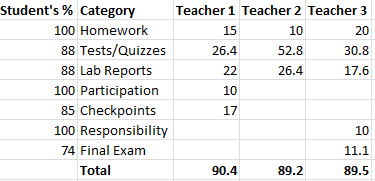
Here's a student's percentages in different categories for a particular class:

Homework: 100%
Tests & Quizzes: 88%
Lab Reports: 88%
Participation: 100%
Checkpoints: 85%
Responsibility: 100%
Final Exam: 74%

What grade should this student get in this class?

Well, we could have a long and valuable philosophical discussion about this, but the point of this example is that this student could get two different grades in the same class at my school. How? It depends on what teacher they have and how that teacher weights their categories. Here's what it looks like for three teachers of this class in my building:


And here's what that translates to for the student's percentages in each category:


These teachers all teach the same class. Students are randomly scheduled into their class by the computer. This student could have performed exactly the same and, in one class, received an 89.2% (a B), an 89.5% (probably an A, but possibly a B), or 90.4% (an A), because the teachers choose to weight the categories differently. Oh, and there are two other teachers of this section that grade on total points, so the student would have yet another percentage that we can't determine from this information.

The same student, in the same class, with the same curriculum, at the same school. What grade should they get?


All three of these examples are real, from my school, from the end of last semester, although I did manipulate the overall percentages for effect (but the assignments and student scores on examples 1 and 2, and the teacher weights on all three examples, are real).

So, even if you believe grades are worthwhile (or if you don't believe grades are worthwhile but you have to give them anyway), I would at least ask that you spend a little more time thinking about them. Your computer grade book is mathematically accurate; it computes exactly what you tell it to compute. But that doesn't mean it makes sense. You are the professional, and if you give a grade to a student you should come up with a more thoughtful way to assign that grade than simply relying on a percentage.

Saturday, May 24, 2014

Last Among Equals

Let me be perfectly clear: I think we put on a good graduation. Let me also say that I think everyone's motives are good and this is certainly not the most pressing issue we face in education. Having stipulated that, I still think the following is worth spending some time thinking about.

We just graduated the Class of 2014. As most of you know, this was a difficult year at my school, but students, staff and the community came together, persevered, and finished strong, and graduation was a fitting culmination for that effort. You can even watch video of our graduation if you want, as our student broadcast club streamed it live.

But each year I get a little more bothered about one part of our graduation (this is twenty-third AHS graduation I've attended). Our graduation starts with the graduates coming in, some opening remarks from students and staff, an amazing performance by our choir and symphonic band (starts at 27:30 of the video), and a keynote speech by a student speaker (who, as usual, was great - starts at 50:30 of the video, note the selfie she took). Then we get to the part where we read the graduates' names and they receive their diplomas. This is the part that increasingly bothers me and, while it's not the most important issue in the world, I still wonder if we should revisit how we do this.

We start by asking all of the honors graduates to stand and be recognized collectively (no names are read yet, this is at 1:07 of the video). These are students with GPA's between 3.50 and 3.79. They then sit down and we recognize the High Honors graduates, those with GPA's of 3.80 and above.

The high honors graduates names are then read first, individually, by the Assistant Principal in charge of Curriculum, with their college choice (or occasionally some other destination) read after their name (at 1:08:10 of the video). We start with the Valedictorian and Salutatorian, then all the other high honors graduates are read in alphabetical order. They come up one by one and receive their diplomas and then return to their seats. (Before I go on it's important to note that all of these students - both honors and high honors - were recognized three days before graduation at our Awards Convocation).

Now all the rest of the students names get read (at 1:28:25 of the video). They are read by two faculty speakers, who alternate reading names one by one from each half of the alphabet so that it goes faster. These students have their names read, but no college choice or other destination, although the honors students get a "with honors" appended after their name.

We end with some closing remarks, the moving of the tassel, and then they exit. All in all, it's a wonderful ceremony. And yet . . .

I have very mixed feelings about the special recognition of the honors and high honors graduates. On the one hand, we are an academic institution, these students have worked hard, and it's nice to be able to recognize their achievement and hard work. I don't mean to discount that at all, I just wonder why we feel the need to raise their accomplishment above others on the day of graduation?

Part of my concern is over how honors and high honors are determined. They are based on grades, of course, with AP classes counting more. ((All of our classes except AP classes are worth 4, 3, 2, 1 for A, B, C, D, and AP classes are 5, 4, 3, 1, so we have a significant number of students above 4.0.) I've written frequently before about my concern with grades, so I won't dwell on this here, other than to say that I have serious doubts about how well grades reflect learning, and I also question the wisdom of determining both the honor and the additional recognition at graduation partially on whether a student decides to take AP classes or not.

While my concern with grades is certainly a part of my concern over this custom, the main focus of this post is not on the relative worth of grades. It's more about whether it's appropriate at graduation to elevate some students over others. (Again, keeping in mind that these students were all recognized three days before at a special awards convocation that was held just for them, their friends, and their families.) After all, part of our graduation ceremony (all 23 of them I've been at), is our Principal saying she certifies to the Superintendent that all of these students have met the graduation requirements of Arapahoe High School and Littleton Public Schools. And then the Superintendent states to the Board of Education that he certifies the same thing. So assuming we believe that our graduation requirements actually mean something, all of these students have met the requirements we have put before them. So then why do elevate some graduates over others?

There are some students who graduate from my high school that from the day they start as a freshman know they will not be an honors or high honors graduate. Now, before you accuse of me of the "soft bigotry of low expectations", I'm a firm believer that each student can achieve and has amazing potential. I'm also a strong believer in Dweck's concept of Growth Mindset. It's not that I don't think all students can learn, or that they can't be successful, or that they can't achieve, it's just that I think we as educators put a premium on a very small subset of what it means to be successful. Students that can't - or don't want to - fit into that narrow band of school-based, school-defined success are somehow deemed less worthy.

Everyone who has been an educator (or been around kids at all) knows of students who work incredibly hard, who learn and achieve and go on to do great things. They typically have a growth mindset, and they constantly challenge themselves to achieve their own goals. But often that doesn't translate into an A in school, which means they won't get special recognition at our graduation. Just because a student's GPA is 3.79 or below doesn't mean their achievement is worth less recognition, or that their future plans are any less worthy than the high honors graduates' plans.

If we believe that school is for all students, and we believe that what we offer and require of all of our students is meaningful, and that students that meet those requirements have accomplished something, then when and how they receive that diploma shouldn't be differentiated by their cumulative GPA. We should celebrate all of our graduates, and not be silent about their plans for next year simply because they didn't reach an arbitrary number on a dubious scale. They shouldn't be last among equals.

Monday, January 28, 2008

How Should Colleges Assess and Improve Student Learning?

First, a few caveats.

  1. I don’t believe that all we’re about in education is preparing future employees.

  2. Just because Business says something is good doesn’t necessarily make it so.

  3. I don’t know enough about the methodology of this survey to judge bias.

Okay, now that we’ve got that out of the way, I found How Should Colleges Assess and Improve Student Learning? (pdf) rather interesting:

From November 8 to December 12, 2007, Peter D. Hart Research Associates, Inc., interviewed 301 employers whose companies have at least 25 employees and report that 25% or more of their new hires hold at least a bachelor’s degree from a four-year college. Respondents are executives at their companies, including owners, CEOs, presidents, C-suite level executives, and vice presidents.

So they polled these executives about the quality of college graduates and what they’d like to change, particularly in the area of assessment. Here are a few excerpts:

Employers are satisfied that the majority of college graduates who apply for positions at their companies possess a range of skills that prepare them for success in entry-level positions, but they are notably less confident that graduates are prepared for advancement or promotion. While recent graduates are seen to demonstrate solid skills in the areas of teamwork, ethical judgment, and intercultural skills, employers are less convinced of their preparedness in terms of global knowledge, self-direction, and writing.

When it comes to the assessment practices that employers trust to indicate a graduate’s level of knowledge and potential to succeed in the job world, employers dismiss tests of general content knowledge in favor of assessments of real-world and applied-learning approaches. Multiple-choice tests specifically are seen as ineffective. On the other hand, assessments that employers hold in high regard include evaluations of supervised internships, community-based projects, and comprehensive senior projects.

Employers’ emphasis on integrative, applied learning is reflected in their recommendations to colleges and universities about how to assess student learning in college. Again, multiple-choice testing ranks lowest among the options presented, just below an institutional score that shows how a college compares to other colleges in advancing critical thinking skills. Faculty evaluated internships and community-learning experiences emerge on top. Employers also endorse individual student essay tests, electronic portfolios of student work, and comprehensive senior projects as valuable tools both for students to enhance their knowledge and develop important real-world skills, as well as for employers to evaluate graduates’ readiness for the workplace.

And, from the “Key Findings”:

. . . Most employers indicate that college transcripts are not particularly useful in helping evaluate job applicants’ potential to succeed at their company.

. . . Few employers believe that multiple-choice tests of general content knowledge are very effective in ensuring student achievement. Instead, employers have the most confidence in assessments that demonstrate graduates’ ability to apply their college learning to complex, real-world challenges, as well as projects or tests that integrate problem-solving, writing, and analytical reasoning skills.

. . . Employers deem both multiple-choice tests of general content knowledge and institutional assessments that show how colleges compare in advancing critical-thinking skills of limited value for evaluating applicants’ potential for success in the workplace. They anticipate that faculty-assessed internships, community-based projects, and senior projects would be the most useful in gauging graduates’ readiness for the workplace.

. . . When asked to advise colleges on how to develop their methods for assessing students’ learning, employers rank multiple-choice tests of students’ general content knowledge and institutional scores for colleges as conspicuously low priorities.

So, let me summarize (bias alert! bias alert!) via a single multiple choice question:

1. According to this report:

a. Grades are pretty much a non-factor in the hiring process.

b. Multiple choice tests are an unreliable predictor of success.

c. Employers are pretty much satisfied with the content knowledge of their employees and think assessments that cover content are relatively meaningless.

d. Employers want their employees to be more globally oriented, to take charge of their own job, and they must be able to communicate effectively through writing.

e. Employers prefer meaningful, relevant, experiential learning over an isolated, content-focused-only approach.

f. All of the above.

So, keeping those caveats I started with in mind, what does this mean for what we’re doing here at Arapahoe? Regular readers of this blog can probably predict what I would say about the ramifications of this in terms of the way we grade, what and how we teach, coverage of the curriculum, and how much of the responsibility for learning we put in the hands of students. But, just in case there was any doubt (and that the above wasn’t biased enough), let me add on to the choices above.

a. Since the primary way that many folks use grades appears to be superfluous, perhaps we need to take a hard look at the efficacy of grading in the first place, and perhaps switch to a focus on formative assessment versus “grades.”

b. Other than standardized test companies, politicians, and teachers who have a tight deadline to turn in final grades (see previous item), who’s really in favor of multiple choice tests? (Yes, I’ve ranted about this before somewhere, but I can’t find it at the moment.)

c. Content is necessary, but not sufficient, to be successful in the 21st century. So perhaps we should stop trying to “cover” the content, and instead focus on understanding the essential concepts and applying them in real world settings.

d. Constructivism. Blogs. RSS. Read/Write Web. Personal Learning Networks.

e. We need to take a hard look at our current system.

I’d love to hear your thoughts (especially AHS folks, but of course everyone is welcome to chime in) on what specific changes we might think about making. If you do comment, please try to not focus on the rant portion of the above, but on the results of the survey and on meaningful changes that will benefit our students.

Sunday, October 28, 2007

Not Your Parents’ Parent-Teacher Conferences

At Arapahoe, we hold parent-teacher conferences in both the fall (two nights) and the spring (one night). Teachers are available from 4:00 until 7:30 each night for 5-7 minute conversations with parents. Parents are strongly encouraged to attend, but it is optional.

Many teachers at Arapahoe have been frustrated by how often those conferences tend to focus on grades, with parents wanting to know what students need to do to get their C to a B, or their B to an A. We are asking our students to really focus on the learning, not the grade, so it’s frustrating when this opportunity to talk with parents so often focuses on the grade (especially because they have real-time access to teachers’ gradebooks through our Infinite Campus Parent Portal).

This year Anne Smith was one teacher that decided to try something different.
Instead of concentrating on my students' progress via their grades in class, I conducted conferences with their learning as the focus. I asked my students to reflect on their learning based on the following questions:

  • Assess your learning in class so far this semester. Look at your participation, growth in writing, comprehension, etc..
  • Where, in terms of your learning, do you want to be at the end of the semester?
  • How are you going to get there?
  • What can I do to help?
  • Write a message to your parents.

The students then were asked to bring home a copy of their learning assessment for their parents to read before conferences as well as place a copy in my class drop box for me to access at conferences.

It seemed to work well.
What was difficult about this whole process was that 5 minutes for conferences was definitely not long enough. I had actual conversations with parents about their child and feel like I took away more from them about how their child is growing as a learner, or how their child needs to grow as a learner. I felt like I listened as much as I talked which is a huge change from the way I participated in conferences before. I was the one relaying all my information to the parent rather than allowing them to give me insight into their child and react to what their child had written.
Click through to her post to read samples of what some students’ wrote, and also read the 47 comments (as of this writing) from both students and parents. Because Anne took it a step farther,

I am going to ask my students and hopefully their parents to comment on this process as well. Yep, that's right I want the parents to create blogger accounts as well so they can participate in the conversation. After all, that was my goal all around to create a conversation about learning.
Definitely not your parents’ parent-teacher conferences.

From talking with Anne I think this worked very well, but I agree with her that 5-7 minutes is not enough for these important conversations (it was usually more than enough to talk about grades.) I also think we should have students at these conferences, although what Anne did was the next best thing. The more we can have students, parents, and teachers involved in conversations centered around learning, not simply grades, the better.