Showing posts with label science. Show all posts

Wednesday, October 09, 2013

"Anything that you can do in chemistry is done with computers these days."

The Nobel Prize for Chemistry was awarded today. I heard this story on NPR (more info) this morning and one line at the end struck me:
Anything that you can do in chemistry is done with computers these days.
Now, I don't think he meant that completely literally. Clearly physical experiments are still done and the end result of chemistry research usually ends up in some kind of physical, manufactured substance. But just as clearly computers are an integral part of chemistry today.

And that got me thinking (as always) about K-12 education. We have a great deal of technology in my high school, and in chemistry they do use probes connected to computers to gather and analyze data. And they also use computers to run some types of simulations and do all sorts of collaborative work.

But we're still not doing anything like what real chemists are doing. Even if our curriculum/standards allowed it, and even if our teachers agreed it was a good thing to do, we don't have the equipment. We have a fair amount of technology, and just got a boatload of chromebooks and some new probes down in science, but that's not the kind of equipment these guys are using, nor is our curriculum designed to allow students to do this kind of work.

So I'm struck again by all the talk of "STEM" and "world class education" and "raising the bar" that dominate so many of the education conversations among politicians and business leaders, yet no one appears to want to fund what it would really take to do this. All those folks seem to want "accountability" - dubiously measured by test scores - but don't seem to want to be accountable for providing the resources (and the freedom) to actually help our students achieve these goals.

These scientists used powerful computers, collaborated across distance and time, and spent a good deal of their time simply being curious (and failing at what they were trying to do). Those three things are not adequately supported, encouraged, or often even allowed in our K-12 schools.

If you want our students to really learn chemistry, we can't do it by using "ball-and-stick model" resources and "carrot-and-stick model" approaches. We need the funding - and the freedom - to learn.

Sunday, April 10, 2011

Dear Denver Post: No More Horoscopes

Dear Denver Post,

While I’ve sometimes questioned your overall commitment to education, your columnists and editorials frequently stress the importance of education and how important it is to us as individuals, a community, and a country. If that’s truly how you feel, then I have a suggestion for you – please stop printing horoscopes.

Clearly over the last few years your paper has gotten physically smaller. As the Internet and Craigslist have bit into your revenue, you’ve had to make hard decisions about what stays and what goes, and I assume you painfully agonize over what gets printed in the limited amount of space you have left for articles. Yet in both Saturday and Sunday’s paper you devoted about 260 square centimeters to horoscopes. (In comparison, you devoted almost exactly the same amount of space in Saturday’s paper to the horrific school shooting in Brazil and considerably less to the story about the Juno spacecraft.) This prominent endorsement of pseudoscience seems to be at odds with your stance on the importance of education.

Now I know some people will argue that this is political correctness run amuck, that horoscopes are simply a form of entertainment and therefore should be left alone. I could perhaps even agree with those folks except for one small problem, survey (pdf) after survey show that about one-fourth of Americans believe in Astrology.

One. Fourth.

To be effective citizens, Americans need to understand what science is – and what it isn’t. By continuing to use your valuable and increasingly limited newsprint space to print horoscopes, you are enabling (and, in fact, encouraging) a belief in pseudoscience and are helping create a less scientifically literate population. This needs to stop.

So here’s my proposal. Stop printing horoscopes each day in your paper and instead devote that 260 square centimeters to science. Each day you could run an article looking at the science behind the headlines. (Surely there’s no shortage of material: earthquakes, tsunamis, climate change, energy production, energy consumption, health care – to name just a few.) Now, I know that 260 square centimeters is not really enough to explain such complex issues, but it is enough to write an introduction to the issue, and then at the end of the article you could link to your website which could take a more in-depth look at the issue (perhaps including multimedia and links to other sources). You would be modeling for our students the importance of science and what lifelong learning looks like.

Dan Haley’s editorial in Sunday’s paper said, in relation to a different topic,
We consider it part of our responsibility, part of the newspaper being a good citizen.
Shouldn’t supporting a scientifically literate population be part of your responsibility to the citizens of Colorado as well?

Friday, December 19, 2008

Publish in Wikipedia – or Perish?

Via ReadWriteWeb comes this story from Nature that any scientist that submits an article to the journal RNA Biology for their new section on RNA molecules, must also create a Wikipedia page summarizing their work.

"The novelty is that for the first time it creates a link between Wikipedia and traditional journal publishing, with its peer-review element," says Alex Bateman, who co-heads the Rfam database. The aim, Bateman says, is to boost the quality of the scientific content on Wikipedia while using the entries to update the Sanger database.

RNA Biology will require Wikipedia pages from all authors who submit work to a new section of the journal, to be launched later this week, that describes families of RNA molecules. The first paper scheduled is "A Survey of Nematode SmY RNAs"1; its corresponding Wikipedia summary can be found here.
And it appears as though they’ve given this some thought and have experimented with other entries to Wikipedia, as there’s also a database they’ve been building that gets synchronized with Wikipedia every night.

The Sanger Institute created the Rfam database in 2005, and it now contains data on about 1,200 RNA families from some 200 complete genome sequences. Sanger last year started to experiment with the idea of using Wikipedia to improve the database. It set up an RNA subsection on the encyclopaedia, called RNA WikiProject 2, which has the same entries as those on the Rfam database. The database is synchronized each night with Wikipedia, so that any changes made to the Wikipedia pages are transferred to the corresponding entries in the Rfam database.

Bateman says he has been "pleasantly surprised" by scientists' willingness to edit the RNA Wikipedia pages. Most of the edits are made by a core group of around 15 researchers, but there's a long tail of other scientists who pop in sporadically, he says, often to fix or add information about molecules specific to their research.

Hopefully, this will be the start of a trend of other scientific journals doing the same thing.

The RNA wiki is a subset of a broader project, the WikiProject Molecular and Cellular Biology, which has marshalled hundreds of scientists to improve the content of biology articles in Wikipedia. It, in turn, is collaborating with the Novartis Research Foundation on GeneWiki 3, an effort to create Wikipedia articles describing every human gene. Beyond Wikipedia itself, scientists are also increasingly using wiki technology to get scientists to help curate other biological databases (see Nature 455, 22–25; 2008).
You should read through the comments on the Nature post as well, including this one by Bill Wedemeyer from Michigan State:

Over the past two years, I and some of my students at Michigan State University have carried out an analysis of the coverage, quality and stability of the scientific articles on the English Wikipedia. We've analyzed hundreds of randomly sampled articles from the basic sciences, and have had roughly 100 articles reviewed by tenured professors expert in the field. Our data, being written up for publication, do not support Mr. Kohs' hypothesis that the RNA articles will degenerate into vandalism-riddled nonsense. On the contrary, we found that the developed articles (the so-called Featured, A-level and Good Articles) are stable and of reliably good quality. I presented our preliminary findings at a conference in July. I applaud Dr. Bateman and his colleagues for their initiative, which seems a promising method for outreach, connecting the scientific world with the public that usually pays for the research. We all hope for "broader impact", and this initiative seems likely to be effective.

Perhaps I’m just being optimistic this morning (I tend to alternate days, or sometimes hours), but I think this holds real promise for realizing the potential of Wikipedia and other socially co-constructed content.

Wednesday, December 10, 2008

The Evolution of an Evolution Discussion

We are currently teaching the evolution unit in Biology at my school and I wanted to share a couple of interesting changes one teacher made this year. Jesse Craig started the discussion surrounding evolution with a live blog, where students could share what they knew – or thought they knew - about evolution. This was before they had talked about it in class at all. A little bit later he continued the conversation with a post around the idea of a spectrum of beliefs, asking students to try to place themselves on the spectrum and share their beliefs.

A little further along in the unit, when the kids had a little bit more scientific knowledge, Jesse set up a live blog with one of his former professors at Hastings College. This was from 8:00 – 8:30 pm our time one night, and he made the professor a panelist on Cover It Live so she could see all the questions coming in. The process wasn’t perfect, Jesse tried to pick and choose questions to approve to keep the conversation somewhat coherent (there were well over 300 comments but he only approved a small subset), but the professor could see all of them and sometimes chose to respond to ones that he hadn’t approved (which meant only the student that asked the question really knew what she was responding to). After talking with Jesse, we’re thinking that perhaps next time we might have the professor ustream her responses. This would allow her to respond more naturally and not be slowed down by having to type her responses. We’d still have the kids live blog their questions (and/or perhaps submit some questions in advance), but she could reply more “naturally” for her. All in all, though, it worked pretty well, and we had a good turnout among the students considering it was 8:00 at night.

Separate from his Biology classes, Jesse and two other Biology teachers also made guest appearances in our ninth grade honors English classes. They were discussing Inherit the Wind, so the English teachers invited the Biology teachers in to talk about what it was like to be a modern day Biology teacher. While some of those students were also in Biology, most were not. It was a rare chance for us to teach/learn cross disciplinary (and I’m frustrated with how rare those chances are, but that rant is for another time). Interestingly, several of those ninth grade English students who were not in Biology also participated in the live blog with the professor from Hastings College.

So, nothing revolutionary here. (Do I dare say it was evolutionary?) But another interesting example of ways to use some of these tools to broaden student thinking. First, it allowed them to explore their thinking and beliefs about an often controversial topic in a way that felt safer for most students than having to say it verbally in class. Then they were able to state where they fell on the spectrum of beliefs, again in a way that felt fairly safe. As they began to learn more about the science of evolution, they were then able to converse (at least to a limited extent) with an “expert” from the college level. Now, Jesse is pretty darn knowledgeable himself, but – just like a parent giving advice to your own child – often hearing it from someone other than your classroom teacher resonates more. (I think bringing in “experts” virtually is something we are going to try to do more and more of at my school.) And finally, for a few students at least, the ability to think about evolution in the context of history and literature.

So, I think there’s a lot more we could do with this, but it was a great start. The other interesting part, for me at least, was that I had nothing to do with it. Typically a teacher trying something new like this would ask for my help with the tech side, but Jesse just ran with it. I think that’s a very positive sign that perhaps we are slowly getting past the idea that these are “technology lessons” but instead are just good teaching and learning.

Sunday, December 07, 2008

Free Rice Has Added Additional Subjects

I blogged about Free Rice previously, a website where students (or anyone) can practice building their vocabulary and at the same time donate rice to the United Nations World Food Program. Well, it appears as though they've added some subjects:
ART - Famous Paintings
CHEMISTRY - Chemical Symbols (Basic), Chemical Symbols (Full List)
ENGLISH - English Grammar, English Vocabulary
GEOGRAPHY - Identify Countries on the Map, World Capitals
LANGUAGE LEARNING - French, German, Italian, Spanish
MATH - Basic Math (Pre-Algebra), Multiplication Table
This is not higher order thinking, but as I said before:
I think this is another interesting use of the web, combining educational activities (not just the fairly simple vocab building activity, but educating folks about hunger itself - including links to the sister site poverty.com) with contributing to the greater good. I could see this being a springboard for writing activities, social studies units on developing countries or poverty, and even some math and science activities (calculating how many grains of rice it takes to feed a certain number of people, nutritional value of the rice, caloric intake, etc.)

Lots of possibilities here for creative teachers and students and maybe, just maybe, doing some good in the process. And it's also, you know, kinda fun.
So, point your students (and your friends) to Free Rice and perhaps they can have a little fun, learn a little, and help provide rice to those in need.

Monday, October 27, 2008

Update on AHS Chemistry Podcasts - Physics, Too!

Just a quick post to update you on Brian Hatak's AHS Chemistry Podcasts that I blogged about previously. Some of the technological issues have begun to get ironed out and overall things are going well. That's not to say that there aren't a lot of improvements to be made - there are, but things are going well enough that now Jeff Smith, an AP Physics teacher, is doing the same thing.

Brian also asked his students to provide some feedback on how things are going, which we'll use to hopefully make improvements. Brian also wrote an article that will be appearing soon in ISTE's Learning & Leading with Technology magazine, so look for that in the near future.

Saturday, September 06, 2008

Advanced Placement is Changing

One of the many interesting discussions in our staff development efforts revolved around the idea that many of the changes we've been discussing (a more student-centered and constructivist approach, students taking more control over their own learning, students developing personal learning networks, etc.) are very difficult to implement in Advanced Placement courses because of the very defined curriculum and the all-important "big test" looming at the end of the school year. The gist of the argument is that while this approach would be great for students, it's next to impossible to do with the time constraints and the amount of material that must be covered by a fixed date in May when the test occurs. That doesn't mean, of course, that the course has to be straight lecture and ours are not, but the general feeling from the AP teachers involved in our staff development was that there simply wasn't enough time for a more inquiry-based approach, and that - while they might value many aspects of that approach - they were concerned that it might actually hurt the students on the AP exam.

Now, being the radical I am (and also being completely unaccountable because I don't actually have to teach these courses or own up to the results), I often pushed back with my usual, "What's best in the long run for the students? What will help them learn and grow and understand history/mathematics/science/language/etc. at a more deeper level? Don't you think that if they truly develop a deep conceptual understanding that they'll do just fine on the AP exam and it will more than make up for any drop in their score from missing a few more multiple choice questions? Is our only goal to prepare them for one exam when they're 17 or 18, less than a quarter of the way through their lives? If so, we should stop the Super Bowl and hand out the Lombardi trophy just before the first quarter ends. Yada Yada Yada." (Yes, I'm pretty much always that obnoxious. But they love me anyway. I hope.)

I think I always acknowledged how difficult this was and conceded that realistically they might have to make some compromises due to the constraints the AP curriculum/exam placed on them. In any event, I think we always had some very good discussions and generated some great ideas, and the end result was better instruction and learning for the students in those classes (even if my radical self always hoped for more).

(As a side note, this discussion was also happening at the same time that my school was opening up our AP courses to many more students, meaning these teachers were not only being harassed by me but were also dealing with more sections of AP classes, and those sections had significantly more students with more varied levels of preparation. I actually think this was good, because it made all of us really question what we valued and what we wanted for students, but it also didn't make it any easier.)

So I read with great interest when one of our AP teachers sent me an email indicating that the College Board was in the process of redesigning the AP History and Science curricula and exams. And when I followed the links and did a little more reading, I was very interested in some of the changes they were proposing:
The review of the AP Exams in science and history has resulted in a recommendation to improve these exams, reducing the breadth of content covered and reducing the emphasis on memorization of facts, and instead requiring a greater depth of study among a smaller number of topics, emphasizing inquiry and scientific reasoning.
Okay, so far so good, but I wanted a little more detail. That article then linked to a couple of PowerPoints, one for science and one for history, that were in support of a live presentation given at the AP Annual Conference. Those PowerPoints referenced two books: Learning and Understanding (full text at that link) by the National Research Council and Understanding by Design by Wiggins & McTighe. I found that fortuitous (always wanted to use "fortuitous" in a blog post), as one of the early influences on our staff development was How People Learn (full text at that link), an earlier work by the National Research Council; and UbD is one of the books informing our current staff development work. So it appeared as though the AP review underway was tracking right along with the themes in our staff development these last three plus years.

What else did those PowerPoints say? Well, they both included a slide with recommendations "applicable to all AP course subjects:"
  • Courses should emphasize deep understanding rather than comprehensive coverage.

  • Programs should reflect current understanding of learning in the discipline.

  • Programs should reflect current research directions within the discipline.

  • Courses should include a deep emphasis on inquiry and reasoning.
Alrighty then. I was beginning to feel much better about some of the ideas we'd been discussing these last few years, as it appeared as though perhaps the AP curriculum and exam might change in ways that would better align with the approaches we had been talking about. If you download those PowerPoints (and I think you should), also pay attention to the "notes" section on each slide, as many of the slides have additional information and "talking points" for the folks that were presenting that give some valuable insight into their thinking (not as good as being there live, but still helpful). Here are some notes that jumped out at me:
History Presentation, Slide 4, notes: A very specific consistency is supported by evidence; there is too much content in the "science" courses.

History Presentation, Slide 10, notes: Need to create flexibility for teachers to select topics of their choosing. In identifying essential historical knowledge, goal is to limit historical detail so teachers are not required to "cover" everything.

Science Presentation, Slide 18, notes: The Chemistry Commission recognized the need to replace the emphasis in the current exam on calculations and descriptions with an emphasis on the conceptual foundations of the discipline and on the ability of students to express the reasoning that underlies the calculations and descriptions.
Now it was getting just downright scary, as this could've been the summary of some of our staff development sessions (and a few of my Fischrants as well). There's much more in the PowerPoints, but I felt like I was probably still missing some pieces since I hadn't seen the live presentation. So I decided to read the executive summary (pdf) of Learning and Understanding (again, the full text is online, but I've only read the executive summary so far).

Some lengthy excerpts in case you don't want to read the executive summary:
This book takes a fresh look at programs for advanced studies for high school students in the United States, with a particular focus on the Advanced Placement and the International Baccalaureate programs, and asks how advanced studies can be significantly improved in general. (introduction)

. . . its primary motivator was the improved, research-based understanding of teaching and learning that has emerged recently, and its application to advanced study. (p. 1)

The committee found that existing programs for advanced study are frequently inconsistent with the results of the research on cognition and learning . . . Students learn best from teachers with strong content knowledge and pedagogical skills . . . High school teachers . . . have little opportunity to work with colleagues to improve curriculum or instruction . . .Research indicates that constrained curricula are more effective and equitable in helping students pursue advanced studies. (p. 2)

The goal of advanced study is to promote development of deep conceptual understanding and the ability to apply knowledge appropriately . . . Effective instruction is focused on enabling learning to uncover and formulate the deep organizing patterns of a domain, and then to actively access and create meaning around these organizing principles. (p. 6)

Seven research-based principles of learning can provide a framework . . . (p. 6-7)
  1. Learning with understanding is facilitated when knowledge is related to and structured around major concepts and principles of a discipline.

  2. A learner's prior knowledge is the starting point for effective learning.

  3. Metacognitive learning (self-monitoring) is important for acquiring proficiency.

  4. Recognizing differences among learning is important for effective teaching and learning.

  5. Learners' beliefs about their ability to learn affect learning success.

  6. Practices and activities in which people engage during learning shape what is learned.

  7. Socially supported interactions strengthen one's ability to learn with understanding.
Successful implementation of advanced study that promotes learning with understanding also depends upon creating opportunities for teachers' continual learning . . . It treats teachers as active learners, builds on their existing knowledge and beliefs, and occurs in professional communities where there are opportunities to discuss ideas and practices as colleagues. (p. 8)

The committee's analysis . . . yielded the following findings: (p. 8-9)
  • Excessive breadth of coverage (especially in 1-year science programs) and insufficient emphasis on key concepts in final assessments contribute significantly to the problem in all science fields . . . . [assessments] frequently focus on procedural knowledge at the expense of conceptual understanding.

  • Except for mathematics, these programs do not specify clearly what prior knowledge is needed for success.

  • Many programs and courses do not help students develop [metacognitive] skills.

  • The single end-of-year examinations and summary scores, as found in AP, do not adequately capture student learning.

  • Teamwork and collaborative investigation are especially important in advanced study . . . Better use of the Internet and technologies for collaborative learning is needed.

  • Students need opportunities to learn concepts in a variety of contexts. The AP and IB programs currently do not emphasize interdisciplinary connections sufficiently.
Students can study topics in depth and develop conceptual understanding only if curricula do not present excessive numbers of topics. Currently, AP and IB programs are inconsistent with this precept . . . Additionally, the College Board models AP courses on typical college introductory courses, rather than on the best college courses or educational practices based on research on learning and pedagogy. (p. 9-10)

A striking inadequacy of the AP and IB programs is the lack of detailed research about what their examinations actually measure, including the kinds of thinking that the examinations elicit. (p. 10)

At present, neither the College Board nor the IBO supports systemic and continuing professional development for teachers. (p. 10)

Recommendations (p. 12-13)
  • The primary goal of advanced study in any discipline should be for students to achieve a deep conceptual understanding of the discipline's content and unifying concepts. Well-designed programs helps students develop skills of inquiry, analysis, and problem solving so that they become superior learners. Accelerating students' exposure to college-level material, while appropriate as a component of some advanced study programs, it not by itself a sufficient goal.

  • Course options in grades 6-10 for which there are reduced academic expectations . . . should be eliminated from the curriculum.

  • Programs of advanced study in science and mathematics must be made consistent with findings from recent research on how people learn. These findings include the role of students' prior knowledge and misconceptions in building a conceptual structure, the importance of student motivation and self-monitoring of learning (metacognition), and the substantial differences among learners.

  • Curricula for advanced study should emphasise depth of understanding over exhaustive coverage of content . . . Because science and technology progress rapidly, frequent review of course content is essential.

  • Instruction in advanced courses should engage students in inquiry.

  • Teachers of advanced study courses should employ frequent formative assessment.

  • Schools and districts offering advanced study must provide frequent opportunities for continuing professional development.
Changes in the AP and IB Programs
The following substantial changes in the AP and IB programs are recommended: (p. 14)
  • The College Board should abandon its practice of designing AP courses in most disciplines primarily to replicate typical introductory college courses.

  • The College Board and IPO should evaluate their assessments to ensure that they measure the conceptual understanding and complex reasoning that should be the primary goal of advanced study.

  • Both the College Board and IBO should take more responsibility for ensuring the use of appropriate instructional approaches.
Okay, I'm convinced. Our staff development efforts are pretty much directly aligned with the changes that are coming to the Advanced Placement program. While these won't occur any earlier than May 2011, they appear to be serious about these changes. Which implies that we need to be serious about implementing these changes in our Advanced Placement courses beginning right now.

I also firmly believe that what's good for students in AP courses is good for students in all courses. I'm not suggesting that all courses be AP courses, different students have different needs. But the essential idea of what constitutes understanding in any given field is applicable to all students, and the basic design elements of a course/learning environment should apply to all our students, not just the ones deemed "advanced."

So, Advanced Placement is changing. Are you?

Wednesday, September 03, 2008

The Large Hadron Collider Rap

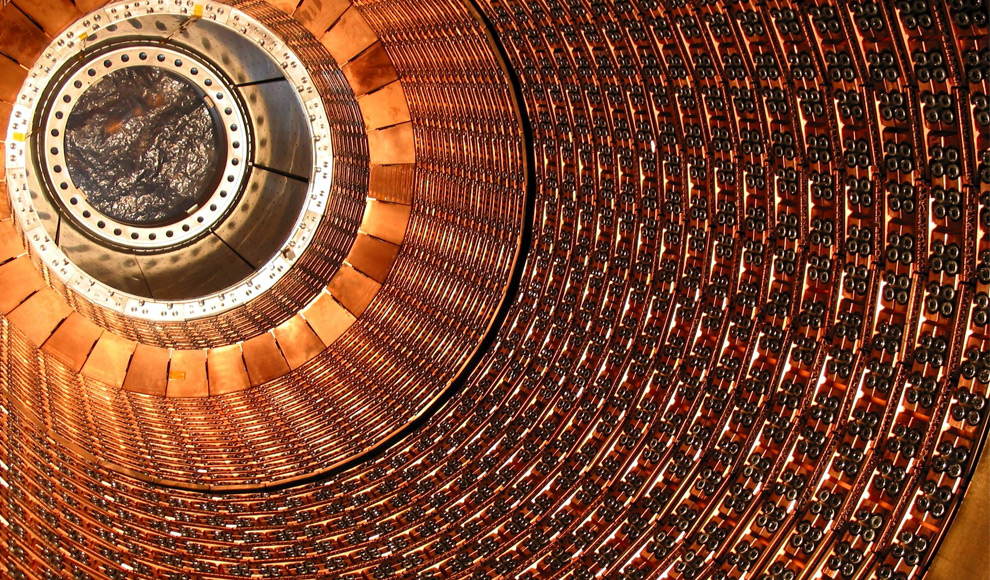
I shared this link with my science teachers a week or two ago because I thought it had some cool pictures of the new Large Hadron Collider at CERN.


Then today I stumbled across this LHC Rap on YouTube:


Lyrics here.

Now, I'm not sure I can make any profound statements about how this can revolutionize education, although I certainly think attempting to create a rap song/video/poetry - when done right - can help students try to focus on the essential concepts of any topic and how best to communicate those concepts (and can conceivably help other students get interested in the topic as well). But I just have to marvel at a world where high energy particle physics, YouTube and rap music can intersect so easily. I sometimes think we take all this stuff for granted - so much so that we often don't take advantage of it all.

Saturday, August 30, 2008

AHS Chemistry Podcasts

I first ran across the idea of podcasting Chemistry lectures about three years ago. Jean-Claude Bradley at Drexel University posted this:
A new way to teach. Having an archive of lectures available gives me a lot of added flexibility. This term I have assigned the archived lectures (podcasts and screencasts) and instead of lectures I run workshops during class time. I have the chance to interact one on one with every student who needs help with the specific problems that they have. I can use other modalities such as watch them play games or build molecular models from kits. In other words, I can be a teacher again, instead of a parakeet.
He also has a wiki with some links to his own and other university lectures that are podcasted.

I'm pretty sure I shared that with the folks in my staff development at some point and probably commented on how at least some university professors were trying to take advantage of some of the new technologies. And I recall a conversation with some folks where I mentioned this and talked about how it allowed the professor to offload the necessary (but routine) parts of his chemistry class so that he could get to the "good stuff" in class; the really interesting parts of Chemistry that he thought would grab the students' attention, but he often never had time for because he had to spend it on delivering the basics. And, as he blogged about, he wasn't worried so much about the attendance factor:
Attendance. It seems strange to me almost every article or comment on lecture podcasting assumes that a decreasing attendance is obviously a negative outcome. As educators we should be focusing on education, not counting bodies. If students are doing just as well and not attending class then that tells me that my multimedia channel is effective. This is exactly what I have observed in my online optional classes (using podcasting and screencasting), where attendance dropped to 10-20% by the last lecture.
Now flash forward to last year when Brian Hatak, one of the teachers at our school, came to me and said he had heard about these high school chemistry teachers in Woodland Park, Colorado podcasting their chemistry lectures and was wondering if we could do that. After some lengthy discussions about both the technology and the pedagogy, Brian decided to give it a shot this year:
Podcasts. Yes, chemistry podcasts.

For the past few years, I have felt frustrated with how my classroom was working. I would ask the students to read and they would act like they did, and perhaps some of them did, and then I would lecture over the material on the next class day. It seemed that the students were learning that they did not have to read since I would be covering the exact material in class. Then they would struggle on the homework problems and ask in class and earn average grades on the tests.

However, I felt as though I was doing a lot more of the problems then the students were. So, I started looking for a way to fix this.
Much like Jean-Claude Bradley at Drexel, Brian decided to try to offload the, umm, sometimes less than exciting (for some students) - but still very necessary - chemistry lecture/information delivery to outside of class. He found that he could "deliver" the necessary information in a relatively compact and cogent form via video podcast/screencast. He could take his time (and this does take some time up front) to fine tune it to make sure he hit all the points he wanted to, yet still take much less time than he used to in class (he's hoping most of the videos will be between 5 and 15 minutes, although a few will undoubtedly be longer). And, the students could watch it - or parts of it - multiple times if they needed to. Instead of frantically writing down notes in class and then later looking at them and understanding step 1 and step 3 but not having any idea of how he got from step 1 to step 3, they now could watch, pause, reflect, and re-watch until they felt pretty comfortable with the material. And, of course, they could come back to it as often as they needed to when they needed to review.

Previously Brian had been frustrated - like most teachers - with never having enough time in class. He felt like by the time he got done "covering" the material he didn't have enough time left to effectively answer student questions. He'd send them off to do homework on their own where he wasn't around to help them when they got stuck, and then feel frustrated when he'd have to go over it all again in the next class period. (Note: I think both Brian and I agree that it's not always a bad thing to struggle, but if the material is so difficult that students get frustrated and then give up - and lose their interest in Chemistry - then that's a bad thing.) So Brian decided to try to do almost the exact opposite of what he'd been doing before - have them do the lecture as homework and use class time to work with the students (much like Jean-Claude Bradley at Drexel appears to be doing). He could use class time to work with students in small groups or one-one-one, and also hopefully give him the time to explore some of the more interesting aspects of Chemistry. (Note: Our chemistry classes meet three times a week for 58 minutes on MWF, and then they have a two-hour lab once a week on either Tuesday or Thursday.)

Now, we just started school about two weeks ago, so we don't have any definitive results to share yet, but I think this shows a lot of promise. I've embedded one podcast below, but you can also visit Brian's TeacherTube channel to see all of them. He's just getting started, so still getting the hang of how to do this, but I think it's a good start.


As he progresses through the school year, Brian's also going to ask students to record some of their lab work and how they work out problems and share that out with the other students. He's really hoping to develop a community of learners, all helping each other - and future Chemistry students - learn the material.

I thought this was blogworthy in and of itself, but the story gets just a little bit better. Before the school year even began, Brian received an email from Ben, one of our students that was going to be in Brian's class. Ben had discovered what Brian had already uploaded:
I am personally very excited about the way you have decided to use technology to fundamentally change the way you run your class. The way you perceived an issue and saw how technology could be used to effectively address it is a prime example of how the expertise of teachers is key to effectively integrating technology into a class.

The screencasts you have a created are available on teachertube, which is a convenient way to view them. However, I thought that it would be even more convenient if your screencast was also a podcast. For this reason, I used several tools to turn the videos you post on teachertube into an iTunes subscribable podcast.

At this url, I have created a blog where the videos are reposted. It is the process of reposting that syndicates them into an XML format iTunes or other video podcast readers can understand. They are also available for download individually in a format that can be transferred to an iPod or viewed with Quicktime. The "PODCAST HELP PAGE" link on the sidebar goes to a website I quickly assembled that describes how to subscribe in iTunes, download episodes, or even view online with an iPhone or iPod Touch.

One of the reasons I am sending you this email is to make sure that this is acceptable to you. The screencasts are your intellectual property, after all. If it is acceptable, hopefully this will become a valuable way to access the content.
Well. Okay. Did I mention that it was still summer when this email came in?

Brian shared this with me and I suggested he email Ben so that Ben could teach us exactly how he was doing this (I was curious how he was getting the mp4 to be part of the RSS feed from Blogger so that iTunes would pick up on it) and so that Brian could give him the original mp4's so that Ben didn't have to convert them. Ben emailed us back with the details, and we are going to hopefully meet sometime next week to see what other ideas we might be able to brainstorm to make this work more effectively for the students. Ben has also given Brian rights to the blog so that he can post directly.

So give Brian some feedback on his post if you have suggestions (plus you can read about how he's having students use their cell phones instead of purchasing clickers). I'm also hoping Brian will blog soon about how he's modified a Wii to create a homemade - and much less expensive - whiteboard. As for me, I need to go mess up Ben's transcript so that he never graduates. At least he's only a Junior . . .

Sunday, August 24, 2008

Weather Channel Environmental Essay Contest

I get a lot of email. Even before this blog and that darned Presentation That Shall Not Be Named, I got a lot of email because I'm the technology guy at a large high school with over 2,100 students and about 165 staff members. Email is a natural way for most of those folks to get a hold of me when they need some help. Then when you throw in the email generated by this blog and that presentation, well, I get a lot of email.

I've also been getting quite a few email requests to post certain things on the blog, or offers of advertising, or press releases from various organizations (particularly political organizations trying to influence education policy). For the most part, I ignore all those, because it's hard for me to figure out when I might be crossing a line. (As an aside, I'd be curious about how other education bloggers deal with this - leave a comment or drop me an email.) But this one seems innocuous enough and some folks might be interested in it, so I'll pass it along.

The Weather Channel is hosting a Forecast Earth Summit, a conference for environmental experts and high school students in Washington, D.C. in December, and holding an essay contest to go along with it. From the email I received,
The Weather Channel’s Forecast Earth Summit is a conference for select future environmental leaders held in Washington D.C., December 5-7, 2008. The Weather Channel will provide free trips to D.C. for 20 high school students who are passionate about the environment. Share this widget to let them know about this opportunity while raising daily environmental awareness.
Here's some info on last year's summit in case anyone is interested in finding out more. Here's what that widget looks like:


AHS students, I expect at least one of you to be selected . . .

Monday, March 03, 2008

First Release of Encyclopedia of Life

I first posted about the Encylopedia of Life last May, now they have their first 30,000 pages up.
Comprehensive, collaborative, ever-growing, and personalized, the Encyclopedia of Life is an ecosystem of websites that makes all key information about all life on Earth accessible to anyone, anywhere in the world.

. . . In this first version of the portal, you will find:

About 25 exemplar species pages. These pages show the kind of rich environment, with extensive information, to which all the species pages will eventually grow. These pages have been authenticated (endorsed) scientists.

Tens of thousands of additional species pages. These pages are authenticated, but do not contain the rich array of information found on the exemplar pages.

About 1 million minimal species pages contain the scientific and common names for a species and often have a distribution map, but lack other authenticated information.

Looks like a good start.

Monday, January 21, 2008

How It All Ends: YouTube, Climate Change, and Inquiry

Thanks to Chris Lehmann and Will Richardson, I came across this video (well, actually, multiple videos). As Chris said, "This is one science teacher's attempt to influence the way we talk about the issue of climate change. Pass it on."


I find this worth blogging about for two reasons. First, full disclosure, I am concerned about climate change. But second, even if I wasn't, I find this approach very interesting and would like to explore the educational possibilities.

This teacher has taken an important, controversial topic, and attempted to start a global conversation. He started out with an earlier video titled, "The Most Terrifying Video You'll Ever See!" It got a lot of views, and also a ton of criticism (hmmm, sounds vaguely familiar). He then acknowledges that he had a giant hole in the original video, and then created a series of videos attempting to address every criticism of the original, with the How It All Ends video being the jumping off point.

He provides an index of all the videos and a suggested order of viewing in the "About This Video" section next to each of the videos on YouTube, but easier access can be found on this site. He provides some links at that site as well.

I think this is a very interesting approach, even if the topic wasn't so huge or as controversial as climate change. Lay out an argument, address and attempt to refute all the criticism, put it all out there on YouTube to be freely distributed, commented on, criticized, discussed, and generally put through the wringer, and then also provide some next steps for those interested in doing something about the issue.

I think this holds a lot of promise as an example of an inquiry approach to learning about climate change. I could see a science class taking this on, watching and discussing all the videos and investigating the related links. And then investigate the other side of the argument thoroughly, generate a list of links and resources, and then presenting them in one, unified "space." This would involve looking deeply at the science - as well as the related social issues - and I think would offer many possibilities for learning and doing science along the way. The students would learn a whole lot of science concepts in context - in relation to the bigger picture issue of climate change. Then each student (or perhaps group of students) would have to take a stand and make a persuasive argument using all the evidence collected, and present that argument both digitally in some form and in person to their peers and/or their wider community. Invite others in to critique (including Greg, the creator of How It All Ends.)

For me, this big picture approach would not only be more engaging for students and would be more likely to lead to more enduring learning of science concepts, but it would also immerse them in the scientific process itself. Not just the scientific process as applied to science - which I think most folks would agree is pretty significant in and of itself, but also the larger scientific process as it relates to politics and policy. As we've seen with so many issues (AIDS, evolution, stem cell research, climate change, etc.), you really can't separate the science from the politics and the policy when it comes to actually addressing the issues and attempting to solve the problem. What better way to show the relevance, the social impact, and the sheer beauty of science?

Thursday, November 29, 2007

Fight Hunger While Learning Vocab

In the spirit of my last post, here's a chance to have your students work on their vocabulary (English) and fight world hunger at the same time. Free Rice is a website that has a fairly simple premise:

  • Click on the answer that best defines the word.

  • If you get it right, you get a harder word. If wrong, you get an easier word.

  • For each word you get right, we donate 20 grains of rice to the United Nations World Food Program.

FreeRice has a custom database containing thousands of words at varying degrees of difficulty. There are words appropriate for people just learning English and words that will challenge the most scholarly professors. In between are thousands of words for students, business people, homemakers, doctors, truck drivers, retired people… everyone!

FreeRice automatically adjusts to your level of vocabulary. It starts by giving you words at different levels of difficulty and then, based on how you do, assigns you an approximate starting level. You then determine a more exact level for yourself as you play. When you get a word wrong, you go to an easier level. When you get three words in a row right, you go to a harder level. This one-to-three ratio is best for keeping you at the “outer fringe” of your vocabulary, where learning can take place.

There are 50 levels in all, but it is rare for people to get above level 48.

There are several pages on the World Food Program website that indicate that this is legitimate. I'm going to assume that the ads it displays are "appropriate," but your mileage may vary.

I think this is another interesting use of the web, combining educational activities (not just the fairly simple vocab building activity, but educating folks about hunger itself - including links to the sister site poverty.com) with contributing to the greater good. I could see this being a springboard for writing activities, social studies units on developing countries or poverty, and even some math and science activities (calculating how many grains of rice it takes to feed a certain number of people, nutritional value of the rice, caloric intake, etc.)

Lots of possibilities here for creative teachers and students and maybe, just maybe, doing some good in the process. And it's also, you know, kinda fun.

Saturday, July 28, 2007

Universities Outsource Astronomy . . . To Us

What do you do when you have a lot of data and not enough personnel and time to analyze it? Well, you outsource it of course. In this case, though, they're outsourcing it to us.
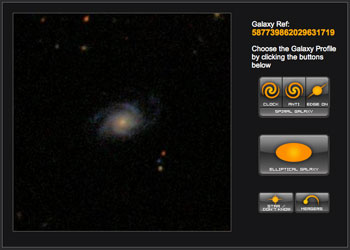
You're sitting on a pile of about a million telescopic photos of the universe, and each one needs to be classified. Bit of a job. So what do you do? Astronomers at the University of Portsmouth, Oxford University, and Johns Hopkins University came up with a solution last week that not only alleviated the burden but also generated an enthusiastic response from the public: They opened up the project to volunteers via the Internet.

The goal of the project is to identify and classify galaxies all over the universe and create a distribution map of galactic types--primarily spiral versus elliptical, but with some variations as well.

In order to accomplish this, the three universities opened up the project on a website called GalaxyZoo. Users log into the site, then are shown images of galaxies (and other cosmic entities). They then enter information about they images they see.
I sent this along to the science teacher at my school who teaches Astronomy - seems like a good project for the students in that class, don't you think? Now, if we could simply get our hands on that 142 megapixel camera they're using . . .

Thursday, May 10, 2007

The Encyclopedia Of Life

1. Watch this embedded video (4:00).


2. Consider watching this TED video of E.O. Wilson (22:35).

3. Take a look at the FAQ's for the Encyclopedia of Life. Here are a few:
What does Encyclopedia of Life seek to accomplish? What are its objectives?

Ultimately, the Encyclopedia will serve as an online reference source and database for every one of the 1.8 million species that are named and known on this planet, as well as all those later discovered and described. Encyclopedia of Life will be used as both a teaching and a learning tool, helping scientists, educators, students, and the community at large gain a better understanding of this planet and all who inhabit it.

What impact will this have on science? On society?

Encyclopedia of Life should be one of the most significant developments we have ever experienced in the life sciences. It can be a “macroscope” comparable in power for discerning patterns in large amounts of information just as the microscope is for zooming to the small. Just as the biotechnology industry has been built upon the existence of large genomic sequence databases (such as GenBank), Encyclopedia of Life will have an equally catalytic effect on comparative biology, ecology, and related fields. By harnessing the research, commitment, and hard work of scientists across the world, The Encyclopedia will serve as a truly global resource for information regarding life on this planet. Such a comprehensive resource of information has never been available to the scientific community or society at large before. It will provide society at large a tool unequaled in scope and convenience for policy makers, educators, and the general public.


Who is ultimately responsible for constructing the Encyclopedia of Life?

Encyclopedia of Life is a collaborative effort. Ultimately, the tens of thousands of people with expertise around the world and their predecessors are responsible. In terms of practical accountability, efforts are currently being headed by a steering committee of senior officers from Harvard University, Smithsonian Institution, Field Museum, Marine Biological Laboratory, Biodiversity Heritage Library consortium, Missouri Botanical Garden, and the MacArthur and Sloan Foundations. The Atlas of Living Australia is in the process of joining, and we look forward to more major partners from all regions during the next year. Numerous organizations have already contributed to the conceptualization and development of the Encyclopedia.


Who will do the writing?

Unlike conventional encyclopedias, where an editorial team sits down and writes the entries, the Encyclopedia will be developed by bringing together (“mashing up”) content from a wide variety of sources. This material will then be authenticated by scientists, so that users will have authoritative information. As we move forward, Encyclopedia of Life and its board will work with scientists across the globe, securing the involvement of those individuals and institutions that are established experts on each species.


How will you ensure information on this website stays current?

Encyclopedia of Life and its staff intend to work with leaders in the scientific community to ensure that all content is accurate and current. Each day, we learn more about the species with whom we share this planet. For the Encyclopedia to succeed, it must receive regular and continued contributions from the field – from scientists across the globe – to ensure it stays current. Advanced software tools are being developed to mine the scientific literature in order to provide regular updates. In addition, the scientific community will use Encyclopedia-developed tools in their own research endeavors; when they are ready, they can submit updates with the push of a button.


What are you doing to ensure functionality in different languages/cultures?

A primary goal is to ensure that the content on the Encyclopedia is available in a wide variety of languages, so it can be accessed and utilized in communities across the planet. This is a global resource, and the ever-evolving product will express that. The Encyclopedia will work with individuals and organizations around the globe to translate the content into local languages. Also, a great benefit of standard formats for web pages is that it makes them easier to understand. We put a premium on good visualization, so that even those who may not appreciate text can still extract a lot of information. Finally, we will design the content in ways that it can be accessed usefully on handheld devices as well as on desktop screens.


Is this just for the scientific community?

No. Encyclopedia of Life is being developed to serve as a comprehensive resource for everyone, scientist, teacher, student, media, any interested party. It will be developed in a wide range of languages. Once completed, we believe the Encyclopedia will be a valuable learning and teaching resource for anyone who has an interest in Earth’s species.


How will scientists use this?

As a reference library and as a macroscope. For decades now, scientists in the biological community have called for the establishment of a database similar to what the Encyclopedia will become. They have developed many partial encyclopedias, covering different plant or animal groups. But the Encyclopedia will be the first common resource where scientists across the globe can both access and share information on all species. Encyclopedia of Life will unite key scientific communities throughout the world, improving communication, information sharing, and collaboration. It will allow researchers to explore and perceive patterns too large or complex to have been studied effectively with our old tools.


How will students use this?

It will allow a student to browse all of nature. The site will provide students one common web location where they can learn about every species that has populated the planet Earth. This one-stop shopping unites mammal, bird, bug, plant, bacteria, etc. in one location, providing a clear understanding of how our ecosystem works and improving student learning. Students and educators will be provided with a wide variety of tools for using the information on the species pages as well as for feeding their own information back into the system. Wherever a species name occurs, there may also be a hyperlink to its page in the Encyclopedia. So if you read a name of a flower in a poem or about an insect affected by global warming, you will be able to get a species biography instantly.


How will the public at large use this?

It can be a handy field guide that people take with them on hikes on a personal digital assistant. It can tell you all the plants that might be found in your neighborhood. In recent years, we have witnessed the impact that a website like Wikipedia can have on humanity, providing a common location for information on all things great and small. Encyclopedia of Life has the potential to be a similar phenomenon, serving as a catalog, database, and learning tool about every organism that has ever lived on the planet. In the same way that dictionaries help literacy, the Encyclopedia can help biodiversity literacy.


What about Wikipedia?

Wikipedia inspired us. Wikipedia accumulated about 1.5 million entries in English in its first four years. That gave us confidence that our tasks are manageable with current technology and social behaviour, although the expert community in a lot of the subjects for pages in Encyclopedia of Life may be only a handful of people. Wikipedia has also created some species pages, as have other groups. Encyclopedia of Life will, we hope, unite all such efforts and increase their value. The Wikimedia Foundation is a member of the Encyclopedia’s Institutional Council.

4. Check out who's involved.

5. Think about how you - and your students - can use this (launches in 2008).

6. Think about how you - and your students - can contribute.

7. Think about what this - and other similar projects sure to follow - means for education. And for the world.