If you're a faithful reader, you know that I have some concerns with the Common Core State Standards. At the moment, however, I am tasked to teach an Algebra course that is aligned to those standards, so I'm trying to make it the best experience possible for my students.
Earlier I shared my first semester lesson plans - please take a minute to read over the assumptions and caveats in that post. Over the last few days I've mapped out a rough outline of second semester. Please keep in mind that we're transitioning, so this doesn't fully align yet and there are definitely some more "advanced" topics that we aren't quite ready for yet. This year we started the year with solving and then graphing linear equations, next year we will probably quickly review and then start with Systems of Equations, which (if successful) will give us a bit more time later in the year to fold in some of those more advanced topics.
As always, these are a work in progress, and I'm open to suggestions (either in the comments or via email), particularly if you have ideas/links to additional good activities/learning experiences for students around these particular topics. While I've "created" this particular set of plans, you'll quickly see that I've borrowed ideas from the rest of the math-twitter-blogosphere so follow the links to get to the good stuff.
Showing posts with label transparent_algebra. Show all posts
Showing posts with label transparent_algebra. Show all posts
Tuesday, November 26, 2013

Wednesday, July 17, 2013
My First Semester Algebra 1 Lesson Plans (CCSS Edition) - Draft
As I indicated in a previous post, my school is in the process of rewriting our Algebra curriculum to more closely match the Common Core. I've now completed my first run through of my (very rough) first semester lesson plans to match up with this, so I thought I'd share.
Before I do that, a few important things to keep in mind:
Before I do that, a few important things to keep in mind:
- Read that previous post for the specifics of my situation (the biggest one being that I see my Algebra students fewer days/minutes than a lot of folks).
- Here is the rough outline of our translation of the Common Core Math Standards to our Algebra course.
- When that document refers to the "CK12 Textbook", that's the textbook alternative we are creating on the CK12 site. This is even more in draft form, so you won't find it on the CK12 site just yet. We are planning on working on it throughout the school year and, with a little luck, will "publish" it to the CK12 site for 2014-15. But here's a PDF that is the result of a very quick run through to try to modify an existing CK12 text to match CCSS-M and our Algebra course. It's a good start, but has a long way to go.
(Note: Our philosophy for this textbook is that it is a resource, not our curriculum or our lesson plans. As such, it is simply a place students can go to see additional examples, explanations, and practice problem sets, and therefore does not have to be perfect or match our individual teaching styles. Our additional "philosophy" is that we hope we can do a good enough job on this to convince our district not to spends tens of thousands of dollars purchasing a new "Common Core Aligned" Algebra textbook in 2014-15.)
- These plans are written for me, so sometimes it will not be clear to someone else what I'm talking about. I do link to some things that are linkable, but if you have questions about something, feel free to ask.
- There are also lots of question marks where I'm still debating what I want to do and/or whether I have enough time to do it.
- As always, these are my "big picture" plans and they will get adjusted frequently based on how things go with my students throughout the semester, so don't think of these as set in concrete. For me, though, I need a pretty specific plan to work from initially, both to make sure it flows mathematically/pedagogically, and to make sure I "cover" what I have to (as much as I dislike that word).
- You'll notice that there are five blank days at the end of the semester (as of this writing, anyway). Those are my "cushion" as inevitably things don't go as I planned (see #3). I really would prefer more than five, but given that I only get 62 class periods (with at least 9 of those shortened periods), that's the best I can manage at the moment (subject to revision as I go through it several more times - and hopefully with some feedback from you).
Friday, June 17, 2011
Transparent Algebra: Take Two
While I attempted to blog my way through my first year back in the Algebra classroom, I ended up not being able to keep up with it. So, as I'll be teaching one section of Algebra again next year, let's try take two:
What I'm going to try to do (at least for a while, we'll see how it goes) is begin to blog about my plans for next year. This summer I'm going back over my lessons from last year and trying to figure out where I should tweak a lesson, where I should do a major overhaul of a lesson, and where I need to come up with a completely different lesson. I hope that by sharing that process here that some of you will help me become a much better teacher (my students thank you in advance).So far I have Day 1 and Day 2 up, I would appreciate any feedback you'd be willing to share. Hopefully with the extra time that summer affords I will be able to keep up with this a little better and then we'll see what happens once school begins. My goal is to blog about my plans for each day of the year in advance (although it will likely not be much in advance once school starts up). So, if you're interested, head on over to Transparent Algebra and follow along.
Sunday, March 27, 2011
Freakish Final Four?
(Cross-posted on my Algebra class blog, but thought I'd share here as well.)
ESPN had over 5.9 million entries to its Tournament Challenge. Only two of them have the final four correct (here's one of the two, the one currently leading the overall challenge).

Given what you know about college basketball, the NCAA Tournament, and probability, are you surprised there are two that are correct? Or would you have expected there to be more that were correct? Or less?
If you answer, make sure you justify your answer.
ESPN had over 5.9 million entries to its Tournament Challenge. Only two of them have the final four correct (here's one of the two, the one currently leading the overall challenge).

Given what you know about college basketball, the NCAA Tournament, and probability, are you surprised there are two that are correct? Or would you have expected there to be more that were correct? Or less?
If you answer, make sure you justify your answer.
Sunday, November 28, 2010
A Quarter is More Than Just a Fraction
I just posted this on my Algebra class blog, but I thought I'd share it here as well. You're welcome to play along with your classes as well (or do something similar). Or, if anyone out there would like to join me in matching what my students raise, just contact me.
Arapahoe, as you know, puts our collective might behind several causes throughout the year. Currently we are asking students and staff to bring in a toy for Toys for Tots (pdf). I encourage you to participate in that, not just by bringing in a toy, but also attending the wrapping party and going to Schmitt Elementary on December 15th to help distribute the toys.
But I also want you to think more globally in this class. If you happened to read my blog over Thanksgiving break, then you read about Kiva and Team Shift Happens. Here’s a brief description of Kiva:
I want to be clear – this is not a requirement. This has no effect on your grade. There’s no extra credit, nor will I berate anyone who doesn’t participate. This isn’t about you. Or about me. This is about helping empower people who haven’t had the same opportunities that we enjoy. Some folks think teenagers won’t do this kind of thing if there’s not a payoff for them in it – we’ll see if they’re right.
I wrote a couple of years ago:
Then I’ll match whatever you donate (up to $100 – I’m not completely crazy). So I’ll take the total of whatever you guys bring in by the last day we meet (our final is on Tuesday, December 14th), and match it with an equal amount, then I’ll take the total and lend it out on Kiva. (If you’d like to help me pick which entrepreneur to lend to, start looking around Kiva and let me know who you think we should fund.)
So, if you occasionally visit Starbucks, consider skipping it once in the next couple of weeks. Or perhaps you could skip that overpriced, not-really-very-healthy-for-you “energy” drink I see some of you drink in the morning. Or if you go out for lunch, skip the soft drink a couple of times. Not only will you be doing your body a favor by skipping one or all of these, but a minor deprivation for you could turn into a possibly life-changing loan for someone else.
It might only be a fraction of a dollar to you, but to someone in the developing world – it’s priceless.

Arapahoe, as you know, puts our collective might behind several causes throughout the year. Currently we are asking students and staff to bring in a toy for Toys for Tots (pdf). I encourage you to participate in that, not just by bringing in a toy, but also attending the wrapping party and going to Schmitt Elementary on December 15th to help distribute the toys.
But I also want you to think more globally in this class. If you happened to read my blog over Thanksgiving break, then you read about Kiva and Team Shift Happens. Here’s a brief description of Kiva:
Kiva's mission is to connect people through lending for the sake of alleviating poverty.And here’s part of what I wrote on my blog about Team Shift Happens:
Kiva is the world's first person-to-person micro-lending website, empowering individuals to lend directly to unique entrepreneurs in the developing world.
I lend $25 to an entrepreneur ($25 is the minimum they accept). But I also purchase two $25 gift certificates that I then email to two members of my PLN. I’m asking those folks to then do two things.Over break I also read this post by Chris Harbeck, a teacher in Canada, and I thought I would challenge you guys in a similar way – challenge each of you to bring in $0.25 a day for each day our class meets between now and the end of the semester. Conveniently, our class meets ten times before the end of the semester, so that’s challenging you to donate a total of $2.50.
First, they can choose which entrepreneur to loan the $25 to. Then I’m asking them to consider doing the same thing – purchasing two $25 gift certificates and emailing them to two members of their PLN (with the same request that those folks continue the cycle, sending two Kiva gift certificates to folks in their network - a Kiva Pay It Forward plan).
I want to be clear – this is not a requirement. This has no effect on your grade. There’s no extra credit, nor will I berate anyone who doesn’t participate. This isn’t about you. Or about me. This is about helping empower people who haven’t had the same opportunities that we enjoy. Some folks think teenagers won’t do this kind of thing if there’s not a payoff for them in it – we’ll see if they’re right.
I wrote a couple of years ago:
Poor people in impoverished communities often don’t have access to financial institutions and capital, and microfinancing addresses this problem. It is especially helpful to women, who often are the key to raising families – and communities – out of poverty. It’s also my opinion that this is one of the best ways to help achieve peace in the world.So I challenge you to bring in what you can. If that’s a quarter a day (or $2.50 total), that’s great. If it’s less, or more, that’s great as well. You can bring money to class each day expressly to donate, or you can simply find me during the day when you perhaps have some change in your pocket (after lunch?) and donate (no amount is too small – or too large). You can choose to participate yourself, or you can cajole your family and friends to donate some change as well if you want – it’s up to you.
Then I’ll match whatever you donate (up to $100 – I’m not completely crazy). So I’ll take the total of whatever you guys bring in by the last day we meet (our final is on Tuesday, December 14th), and match it with an equal amount, then I’ll take the total and lend it out on Kiva. (If you’d like to help me pick which entrepreneur to lend to, start looking around Kiva and let me know who you think we should fund.)
So, if you occasionally visit Starbucks, consider skipping it once in the next couple of weeks. Or perhaps you could skip that overpriced, not-really-very-healthy-for-you “energy” drink I see some of you drink in the morning. Or if you go out for lunch, skip the soft drink a couple of times. Not only will you be doing your body a favor by skipping one or all of these, but a minor deprivation for you could turn into a possibly life-changing loan for someone else.
It might only be a fraction of a dollar to you, but to someone in the developing world – it’s priceless.
Tuesday, November 09, 2010
We See This as the Future of Higher Education
(Cross-posted on my Algebra class blog - thought I'd share it here as well.)
I’d like you to read this article in the New York Times titled, Learning in Dorm, Because Class is on the Web (two pages, make sure you click through to page two). Go ahead, go read it, then come back.
This article illustrates that many colleges – which most of you will be attending in 3-4 years – are starting to utilize some of the same video techniques we’re trying to use in our Algebra class. There are a variety of different ways colleges are using this, some are pretty similar to what I’m doing, others are very different (consider yourself lucky, you only have to watch 8-10 minutes of me, not an 85 minute streamed lecture!).
Note that some colleges are doing this primarily for financial reasons,
Notice how some students don’t like this approach.
First, students must watch/complete the “lecture” or “content-delivery” video portion of the class outside of class. Clearly some college students – as well as some of you – are not doing this. If this part isn't done, the entire model falls apart.
Second, just as critically, students must be active participants in class to maximize the value of our time together. Students must be willing to use class time as an opportunity both to explore and to practice mathematical ideas and concepts, not as a time to sit back and be “told” or “shown” what to do. This is why I continue to try to get you guys to think more on your own, to talk and work in your groups, and to take risks in your learning, instead of simply waiting for me to show you the “right” answer.
So I’m hopeful that as we continue with this approach we all will get better at it. I need you to hold up your end of the bargain (watch/complete the videos outside of class - including the Guided Practice and Self-Check portions, complete the homework and online pre-assessments, actively participate/explore/think in class, and come in for help and to re-assess), and I hopefully will get better at structuring class to complement the video instruction outside of class. Together we can not only help you master Algebra, but prepare you to be successful learners in college and beyond.
I’d like you to read this article in the New York Times titled, Learning in Dorm, Because Class is on the Web (two pages, make sure you click through to page two). Go ahead, go read it, then come back.
This article illustrates that many colleges – which most of you will be attending in 3-4 years – are starting to utilize some of the same video techniques we’re trying to use in our Algebra class. There are a variety of different ways colleges are using this, some are pretty similar to what I’m doing, others are very different (consider yourself lucky, you only have to watch 8-10 minutes of me, not an 85 minute streamed lecture!).
Note that some colleges are doing this primarily for financial reasons,
You have X amount of money, what are you going to do with it?others are exploring whether it can be a more effective way of delivering instruction,
She said an advantage of the Internet is that students can stop the lecture and rewind when they do not understand something.No matter the reason, it appears likely that more classes will be offered this way by the time you get to college.
We see this as the future of higher education.So consider our Algebra class a chance not only to learn Algebra (and enjoy my amazing wit), but an opportunity to begin preparing yourself to be successful in college – and beyond – by learning how to learn through online components of courses.
Notice how some students don’t like this approach.
In a conventional class, “I’m someone who sits toward the front and shares my thoughts with the teacher,” she said. In the 10 or so online courses she has taken in her four years, “it’s all the same,” she said. “No comments. No feedback. And the grades are always late.”This is one of the reasons why I believe hybrid classes – where there’s an online component and a face-to-face component - are perhaps currently the best of both worlds when done well (although that may change as we get better at implementing online courses). But several things have to happen in order for classes like this to work.
First, students must watch/complete the “lecture” or “content-delivery” video portion of the class outside of class. Clearly some college students – as well as some of you – are not doing this. If this part isn't done, the entire model falls apart.
Second, just as critically, students must be active participants in class to maximize the value of our time together. Students must be willing to use class time as an opportunity both to explore and to practice mathematical ideas and concepts, not as a time to sit back and be “told” or “shown” what to do. This is why I continue to try to get you guys to think more on your own, to talk and work in your groups, and to take risks in your learning, instead of simply waiting for me to show you the “right” answer.
So I’m hopeful that as we continue with this approach we all will get better at it. I need you to hold up your end of the bargain (watch/complete the videos outside of class - including the Guided Practice and Self-Check portions, complete the homework and online pre-assessments, actively participate/explore/think in class, and come in for help and to re-assess), and I hopefully will get better at structuring class to complement the video instruction outside of class. Together we can not only help you master Algebra, but prepare you to be successful learners in college and beyond.
Friday, November 05, 2010
Can't We Just Memorize a Formula to Plug Stuff Into?
(Cross-posted on my Algebra class blog. Thought I'd share it here as well.)
I've been wanting to share something with you the last couple of days in class but just haven't had time, so I decided to just put it here on the blog instead. I'm currently reading The Myths of Innovation by Scott Berkun and I came across a couple of passages that I thought were relevant to our class. In a section of the book talking about the myth that good ideas are hard to find, he writes:
What does this have to do with Algebra? Well, this is very similar to the philosophy of what I'm asking you to do in this class. Yes, we do have some formulas that you're going to need to learn and "plug stuff into." But our more important goal is for you to open your minds and be willing to explore ideas. This is why I'm always asking you to try to figure things out, both individually and as a group, and not wait for me to tell you how to do it.
Sure, we can "skip to the good ideas" and I can just show you how to do certain procedures, but that ends up not being very meaningful for you, and you're also not very likely to remember it very long. Instead, I want you - as much as possible - to play with the ideas. To be curious, and creative, and try to figure things out and find patterns and methods on your own, including exploring various real-world applications of the mathematics. And, yes, that's harder than just memorizing the formula and doing random problems out of the book. But I think it's also much, much, much more worthy of your time.
As Eric Hoffer said,
I've been wanting to share something with you the last couple of days in class but just haven't had time, so I decided to just put it here on the blog instead. I'm currently reading The Myths of Innovation by Scott Berkun and I came across a couple of passages that I thought were relevant to our class. In a section of the book talking about the myth that good ideas are hard to find, he writes:
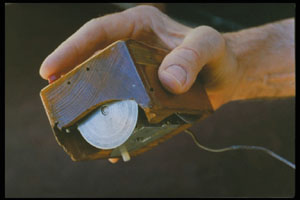
While waiting in a city park to interview someone for this book, a nearby child played with Silly Putty and Legos at the same time. In my notepad I listed how many ideas the young boy, not more than five years old, came up with in 10 minutes. Sitting in the grass, he combined, modified, enhanced, tore apart, chewed on, licked, and buried various creations I'd never have imagined. His young mother, chatting on a phone while resting her morning coffee on the park bench, barely noticed the inventive creations her toddler unleashed on the world. After being chased away for making her nervous (an occupational risk of writers in parks), I wondered what happens to us, and what will happen to this boy, in adulthood. Why, as is popularly believed, do our creativity abilities decline, making ideas harder to find? Why aren't our conference rooms and board meetings as vibrant as childhood playgrounds and sandboxes? (p. 82)The passage also includes this picture of the first computer mouse with the caption, "The superficials of innovation are rarely impressive. This is a version of the first computer mouse."
. . . To open minds and find good ideas, return to the kid in the park. What is it about his attitude that allows fearless idea exploration? Linus Pauling, the only winner of two solo Nobel Prize awards in history, had this to say about finding ideas: "The best way to have a good idea is to have lots of ideas." This sounds idiotic to most ears because it cuts against the systemic, formulaic, efficiency-centric perspective worshiped in schools and professions. It seems wasteful to follow Pauling's advice. Can't we just skip to the good ideas? Optimize the process? Memorize a formula to plug stuff into? Well, you can't. (p. 85-86).
(image source: Wikipedia)
What does this have to do with Algebra? Well, this is very similar to the philosophy of what I'm asking you to do in this class. Yes, we do have some formulas that you're going to need to learn and "plug stuff into." But our more important goal is for you to open your minds and be willing to explore ideas. This is why I'm always asking you to try to figure things out, both individually and as a group, and not wait for me to tell you how to do it.
Sure, we can "skip to the good ideas" and I can just show you how to do certain procedures, but that ends up not being very meaningful for you, and you're also not very likely to remember it very long. Instead, I want you - as much as possible - to play with the ideas. To be curious, and creative, and try to figure things out and find patterns and methods on your own, including exploring various real-world applications of the mathematics. And, yes, that's harder than just memorizing the formula and doing random problems out of the book. But I think it's also much, much, much more worthy of your time.
As Eric Hoffer said,
In a time of drastic change it is the learners who inherit the future. The learned usually find themselves equipped to live in a world that no longer exists.I want you to be a learner; to take the attitude of "fearless idea exploration." In my class, in all your classes, and in life in general.
Wednesday, October 20, 2010
Neuroscientist and Cheerleader: Our Next Skype Session
PBS has a great series titled The Secret Life of Scientists and Engineers. A month or so ago the featured scientist was Mollie Woodworth, a Ph.D. candidate at Harvard in neuroscience who also happens to be a cheerleader (for MIT, no less).
When I watched some of the videos and read her blog on the site, I knew she would be another great choice to Skype with my Algebra kids. Not only is she energetic and engaging and can talk about how she uses math in her career, but she also has the opportunity to perhaps break some stereotypes high school students sometimes have about both women and cheerleaders. You can read the background information we provided to my students on the class blog and here are the questions we'll be asking:
Update 10-25-10: Here's the archive of our session. Mollie was fantastic.
When I watched some of the videos and read her blog on the site, I knew she would be another great choice to Skype with my Algebra kids. Not only is she energetic and engaging and can talk about how she uses math in her career, but she also has the opportunity to perhaps break some stereotypes high school students sometimes have about both women and cheerleaders. You can read the background information we provided to my students on the class blog and here are the questions we'll be asking:
- How do you define “math?” How would you describe what “math” means to a scientist to non-scientists? - Me
- Was there a time in your life when you ever thought about quitting cheerleading and just focusing on your studies? Did you ever get really overwhelmed? - Becca
- Is it possible that, in the near future, we will find a way to successfully clone any type of cell, even going so far as stopping cellular aging? - Alex
- Do people think you’re not as bright as you are because you’re a cheerleader? - Jeremy
- As you began moving in the direction of science did you begin to notice ties between what you were studying and math? - Mackenzie
- What advice would you give us about succeeding in math? - Grant
Update 10-25-10: Here's the archive of our session. Mollie was fantastic.
Tuesday, October 05, 2010
Parent/Teacher Conferences
At my high school we hold parent/teacher conferences in the fall and spring. In the fall it's two consecutive nights from 4:00 - 7:30 pm and in the spring it's just one night. All the teachers are in our two gyms and we have "five to seven minute conferences" with parents.
You probably won't be surprised to find out that I don't particularly like this format. While I think it's great we dedicate time for conferences, the one-size-fits-all conference format isn't ideal, and I would much prefer that the students be present for the conference as well. (In fact, I would prefer student-led conferences, but I could live with students-at-least-being-present conferences).
Having said that, this is the format and structure I have, so I'm trying to make it be as meaningful as I can. I had intended to write this post about two weeks ago, so that I could get feedback before conferences were upon us, but that didn't happen. So, instead, I'm going to share what I just gave to my students and ask for feedback so that if I'm still in the classroom a year from now I can do this better next time.
Below is what I shared with my students (inside Google Apps - they write to the prompt and put it in a folder shared with me). I'm going to ask them to share it with their parents before conferences (I may even email it to their parents before conferences, still deciding), but I will also have it available at conferences in case they did not. I'm also going to email the parents to encourage them to come and to tell them that I think it's very important for the student to be present if at all possible.
I would love your thoughts/suggestions for ways to make it better (although please keep in mind the restrictions I'm working under - I don't have the ability to change the basic format of the nights).
Parent/Teacher Conferences are coming up next week. Since these conferences are about you, I think you should be there. It makes very little sense to me that we should have a conference about you and you’re not there, so I’m encouraging your parents to come and to bring you with them. Please bring your Algebra notebook as well, so that we can look at your work if we need to.
Whether you end up attending or not, I want you to spend some time thinking about what you want your parents to know about this class and how you are doing. Here are some questions for you to respond to.
Thanks.
You probably won't be surprised to find out that I don't particularly like this format. While I think it's great we dedicate time for conferences, the one-size-fits-all conference format isn't ideal, and I would much prefer that the students be present for the conference as well. (In fact, I would prefer student-led conferences, but I could live with students-at-least-being-present conferences).
Having said that, this is the format and structure I have, so I'm trying to make it be as meaningful as I can. I had intended to write this post about two weeks ago, so that I could get feedback before conferences were upon us, but that didn't happen. So, instead, I'm going to share what I just gave to my students and ask for feedback so that if I'm still in the classroom a year from now I can do this better next time.
Below is what I shared with my students (inside Google Apps - they write to the prompt and put it in a folder shared with me). I'm going to ask them to share it with their parents before conferences (I may even email it to their parents before conferences, still deciding), but I will also have it available at conferences in case they did not. I'm also going to email the parents to encourage them to come and to tell them that I think it's very important for the student to be present if at all possible.
I would love your thoughts/suggestions for ways to make it better (although please keep in mind the restrictions I'm working under - I don't have the ability to change the basic format of the nights).
Parent/Teacher Conferences are coming up next week. Since these conferences are about you, I think you should be there. It makes very little sense to me that we should have a conference about you and you’re not there, so I’m encouraging your parents to come and to bring you with them. Please bring your Algebra notebook as well, so that we can look at your work if we need to.
Whether you end up attending or not, I want you to spend some time thinking about what you want your parents to know about this class and how you are doing. Here are some questions for you to respond to.
- Has class met your expectations? Why or why not?
- What’s going well for you?
- What’s challenging for you?
- What could I do as your teacher that would help you be more successful?
- What could you do as a student that would help you be more successful?
- Is there anything your parents can do to help you be more successful?
- Is there anything else you think your parents should know about this class or about how you are doing in this class?
Thanks.
Monday, September 27, 2010
IKEA and Geothermal Energy: Skyping with Ms. Anderson
IKEA is in the process of building a giant store about five miles from my school. This is no ordinary store construction, however, as they are putting in a geothermal energy system to help heat and cool the store. When I saw the article about it, I thought this would be another good opportunity for my students to Skype with someone, so I tracked down the contact info of the engineer from NREL that was mentioned in the article. She kindly agreed and the Skype session will happen this Wednesday.
You can read the background info we provided to my students on the class blog, and here are the questions we'll be asking:
If all goes well, I'm hoping to ustream it as well, so you're welcome to tune in on our ustream channel. We'll be skyping from approximately 9:35 - 10:00 am Mountain Time (PLC day for us, so late start) on Wednesday, September 29th.
Update 9-29-10: Archive of the ustream.
You can read the background info we provided to my students on the class blog, and here are the questions we'll be asking:
- How do you define “math?” How would you describe what “math” is to non-engineers? Me
- What is the difference between geothermal energy and other forms of energy? Grant
- How does the temperature change from the winter to summer underground, and how effective is the water being pumped to control the temperature of the building, especially due to the bipolar weather of Colorado? Alex
- Do you think that this system could one day be in the average American home? Why or why not? Jordan
- When you were in school getting all those different degrees, did you know that you would be doing everything you are? Did you ever want to start all over? Becca
- Two part question: Out of everything you have done and will do in your life, what would you want a youth to remember out of it all? With all your work with renewable energy/heat pump technology what are you most happy about doing and what are some ideas you have to work on in the future? Jessica
If all goes well, I'm hoping to ustream it as well, so you're welcome to tune in on our ustream channel. We'll be skyping from approximately 9:35 - 10:00 am Mountain Time (PLC day for us, so late start) on Wednesday, September 29th.
Update 9-29-10: Archive of the ustream.
Wednesday, September 22, 2010
Welcome Sunday Telegraph and Daniel Pink Blog Readers
If you’re visiting this blog for the first time due to this article in the Sunday Telegraph or this post on Daniel Pink’s blog, welcome. As Mr. Pink thankfully mentioned in both places, I did not originate the idea of flipping homework and lectures. Many other folks are doing this also and, frankly, most of them are doing it better than I am. Two of the teachers I know that have done the most work in this area are Jonathan Bergmann and Aaron Sams – you might check out some of their work. (And, if you’re a teacher that’s also using video in a similar way and you threw up a little when Daniel Pink chose to link to me, please leave a link to your work in the comments so people can perhaps take a look.)
If you’re interested in learning more about my partial return to the math classroom, you can check out all the posts related to that endeavor and/or the Transparent Algebra blog.
If you’re visiting for my other claim to my fifteen minutes of fame, you might check out the Shift Happens wiki or the last blog post I wrote about that to learn more about Did You Know?/Shift Happens.
If you’re interested in what else goes on around here, then look around a bit. My blogging has tapered off lately as budget cuts have added a bit to my plate, but you might be interested in the Best (?) Posts of 2009, 2008, 2007, 2006 to get a feel for the place.
If you’re interested in learning more about my partial return to the math classroom, you can check out all the posts related to that endeavor and/or the Transparent Algebra blog.
If you’re visiting for my other claim to my fifteen minutes of fame, you might check out the Shift Happens wiki or the last blog post I wrote about that to learn more about Did You Know?/Shift Happens.
If you’re interested in what else goes on around here, then look around a bit. My blogging has tapered off lately as budget cuts have added a bit to my plate, but you might be interested in the Best (?) Posts of 2009, 2008, 2007, 2006 to get a feel for the place.
Wednesday, September 01, 2010
What I Said Today
[cross-posted on Transparent Algebra]
Today was our Skype session with Professor Garibaldi, and I thought that went well. After the Skype session we only had about twenty minutes left (shortened classes due to a PLC day) so I took that opportunity to talk with my class a little bit. I realized that I hadn't done a good job of conveying my thoughts and beliefs about the class, of sharing my passion, of explaining why I setup class the way I did and what I was expecting from them - and what I was hoping for them.
So here, more or less, is what I said. I'm sure it wasn't quite this smooth, as when I write I automatically correct and tweak, but this is pretty close to what I said (and definitely the spirit of what I hope I conveyed).
I wanted to talk a little bit about this class and why I’m doing the things I’m doing. Mr. Krause, one of our English teachers, is doing a project right now where his students are asking people how they define success. I answered that for several groups of students, but I wanted to talk for a minute about how I’ll decide if I’m successful with you guys in this class.
I won’t think I’m a success if you get a good grade in Algebra, although I certainly hope you do and I’m going to try really hard to help you do that. I won’t think I’m a success if you score well on tests like CSAP or ACT, although I hope you do, and even though a lot of well-intentioned people think that’s how I should define success. I won’t even think I’m a success if you go to a good college and then get a good job, although I certainly want you to do that because I’d like to retire someday and I need you all to have good jobs to support me.
No, I’ll consider myself successful if you turn out to be good, kind, caring adults. If you’re a good spouse, child and parent. If you contribute to the world and to your community and help those around you. If you participate. And learn.
And here’s the deal. The education that I received was a pretty good one. But it’s not good enough for you guys. Not anymore. You see, in a rapidly changing, information abundant world, the people who are going to be successful – both professionally and personally – are the learners. And by “learners” I don’t mean people who just learn what we teach you here at AHS.
Now, I want to be clear, that doesn’t mean I don’t think you should learn what we teach you here at AHS. I don’t want you to go to your second period teacher, raise your hand, and say, “Mr. Fisch said I don’t need to learn what you’re teaching.” Please, don’t do that. That’s not at all what I’m saying. Your teachers here work very hard trying to share important, meaningful and relevant knowledge and skills. And that’s important, but it’s not enough. Because to be successful in the 21st century you’re going to have to be a learner, you’re going to have to learn how to learn, and go after things on your own. You’re going to have to be independent, curious, passionate learners, who don’t just sit back and wait for someone to tell them what they’re supposed to know, but who go out and try to figure things out for yourself. Who pursue your interests, your goals, your passions with intensity, and who actively participate in everything you do. Who go out and find other learners who are passionate about what you are passionate about and learn from them – and alongside them.
To quote myself (sorry), the world has shifted. The world of school, and the world of work, and the world in general has shifted, and so I need you to shift as well, and that’s what I’m trying to do in this class. I’m trying to get you to be actively involved in your own education, to be independent and curious learners in mathematics, even if Algebra is never going to be your favorite subject.
I believe you need the skills I’m trying to get you to learn for three main reasons. First, to be a successful citizen in the 21st century you have to be numerate. In order to deal with all the data that is going to get thrown at you, and to make good, responsible, effective decisions, you’re going to need a lot of the skills we’re learning in Algebra.
And frankly, that’s not necessarily true about all the math classes you’ll take. Honestly, if you take Trig and Pre-Calc, the skills you learn there are very important if you go into the math and sciences, but perhaps not so much day-to-day life for most of you (some folks will disagree with that). But the skills we learn in Algebra you’ll be using every day to make sense of all that data in the world, to be informed voters and decision makers.
The second reason to learn the skills is if you decide that you are passionate about math and science, you need these skills in order to progress to more complex topics and to go deeper.
The third reason – and it’s the one I think is least important but you may think is the most important – is that right now in the short term you have to learn these skills to get a good grade in this class, to do well in school, and to get into college if that’s what you choose. So while I prefer that you focus on the first two reasons, this one is still a valid one for many of you.
And this is why it’s critical you do the assignments I’m asking you to do, like watching the videos I’ve created for you. Those videos are designed to help you master the skills, and to become more independent learners. But they’re also designed to free up class time so that we can become more curious, active learners, in class, and so we can explore interesting (or not for some of you) applications of Algebra like the bike gear ratios or Tim Tebow’s speed at the NFL Combine or a variety of other activities we’ll be doing this year. In order to apply the skills in class, I need you to do the necessary work outside of class.
But in order for that to happen, in order for us to use our class time to be the kind of learners I think you need to be to be successful in this century, your century, I need you to step up and take care of business. I need you to watch the videos, and use them as they’re intended, and do the other things I ask you to do outside of class. And I really, really need you to participate in class, to be active learners. To ask questions, and be involved, and talk to each other, and help each other, and be willing to take risks in order to learn more, even if that makes you a little nervous or uncomfortable. I need you to do more of the talking in class, and me to do less. I need you to do more of the thinking, and the questioning, and the figuring out.
So I’m asking you to please, please consider what kind of future you want, not just for yourself, but for those around you, and make an effort to be as independent, as curious, as responsible, as passionate of a learner that you can be. And I promise that I’ll bring the passion every day and do the very best I can to help you become that learner.
Today was our Skype session with Professor Garibaldi, and I thought that went well. After the Skype session we only had about twenty minutes left (shortened classes due to a PLC day) so I took that opportunity to talk with my class a little bit. I realized that I hadn't done a good job of conveying my thoughts and beliefs about the class, of sharing my passion, of explaining why I setup class the way I did and what I was expecting from them - and what I was hoping for them.
So here, more or less, is what I said. I'm sure it wasn't quite this smooth, as when I write I automatically correct and tweak, but this is pretty close to what I said (and definitely the spirit of what I hope I conveyed).
I wanted to talk a little bit about this class and why I’m doing the things I’m doing. Mr. Krause, one of our English teachers, is doing a project right now where his students are asking people how they define success. I answered that for several groups of students, but I wanted to talk for a minute about how I’ll decide if I’m successful with you guys in this class.
I won’t think I’m a success if you get a good grade in Algebra, although I certainly hope you do and I’m going to try really hard to help you do that. I won’t think I’m a success if you score well on tests like CSAP or ACT, although I hope you do, and even though a lot of well-intentioned people think that’s how I should define success. I won’t even think I’m a success if you go to a good college and then get a good job, although I certainly want you to do that because I’d like to retire someday and I need you all to have good jobs to support me.
No, I’ll consider myself successful if you turn out to be good, kind, caring adults. If you’re a good spouse, child and parent. If you contribute to the world and to your community and help those around you. If you participate. And learn.
And here’s the deal. The education that I received was a pretty good one. But it’s not good enough for you guys. Not anymore. You see, in a rapidly changing, information abundant world, the people who are going to be successful – both professionally and personally – are the learners. And by “learners” I don’t mean people who just learn what we teach you here at AHS.
Now, I want to be clear, that doesn’t mean I don’t think you should learn what we teach you here at AHS. I don’t want you to go to your second period teacher, raise your hand, and say, “Mr. Fisch said I don’t need to learn what you’re teaching.” Please, don’t do that. That’s not at all what I’m saying. Your teachers here work very hard trying to share important, meaningful and relevant knowledge and skills. And that’s important, but it’s not enough. Because to be successful in the 21st century you’re going to have to be a learner, you’re going to have to learn how to learn, and go after things on your own. You’re going to have to be independent, curious, passionate learners, who don’t just sit back and wait for someone to tell them what they’re supposed to know, but who go out and try to figure things out for yourself. Who pursue your interests, your goals, your passions with intensity, and who actively participate in everything you do. Who go out and find other learners who are passionate about what you are passionate about and learn from them – and alongside them.
To quote myself (sorry), the world has shifted. The world of school, and the world of work, and the world in general has shifted, and so I need you to shift as well, and that’s what I’m trying to do in this class. I’m trying to get you to be actively involved in your own education, to be independent and curious learners in mathematics, even if Algebra is never going to be your favorite subject.
I believe you need the skills I’m trying to get you to learn for three main reasons. First, to be a successful citizen in the 21st century you have to be numerate. In order to deal with all the data that is going to get thrown at you, and to make good, responsible, effective decisions, you’re going to need a lot of the skills we’re learning in Algebra.
And frankly, that’s not necessarily true about all the math classes you’ll take. Honestly, if you take Trig and Pre-Calc, the skills you learn there are very important if you go into the math and sciences, but perhaps not so much day-to-day life for most of you (some folks will disagree with that). But the skills we learn in Algebra you’ll be using every day to make sense of all that data in the world, to be informed voters and decision makers.
The second reason to learn the skills is if you decide that you are passionate about math and science, you need these skills in order to progress to more complex topics and to go deeper.
The third reason – and it’s the one I think is least important but you may think is the most important – is that right now in the short term you have to learn these skills to get a good grade in this class, to do well in school, and to get into college if that’s what you choose. So while I prefer that you focus on the first two reasons, this one is still a valid one for many of you.
And this is why it’s critical you do the assignments I’m asking you to do, like watching the videos I’ve created for you. Those videos are designed to help you master the skills, and to become more independent learners. But they’re also designed to free up class time so that we can become more curious, active learners, in class, and so we can explore interesting (or not for some of you) applications of Algebra like the bike gear ratios or Tim Tebow’s speed at the NFL Combine or a variety of other activities we’ll be doing this year. In order to apply the skills in class, I need you to do the necessary work outside of class.
But in order for that to happen, in order for us to use our class time to be the kind of learners I think you need to be to be successful in this century, your century, I need you to step up and take care of business. I need you to watch the videos, and use them as they’re intended, and do the other things I ask you to do outside of class. And I really, really need you to participate in class, to be active learners. To ask questions, and be involved, and talk to each other, and help each other, and be willing to take risks in order to learn more, even if that makes you a little nervous or uncomfortable. I need you to do more of the talking in class, and me to do less. I need you to do more of the thinking, and the questioning, and the figuring out.
So I’m asking you to please, please consider what kind of future you want, not just for yourself, but for those around you, and make an effort to be as independent, as curious, as responsible, as passionate of a learner that you can be. And I promise that I’ll bring the passion every day and do the very best I can to help you become that learner.
Friday, August 27, 2010
Math on the Rocks: Skyping with Professor Garibaldi
Sometime this summer someone tweeted out this video from Emory University.
It features Professor Skip Garibaldi talking about the mathematics of rock climbing and I immediately tagged it to use when teaching proportion. But then as I thought about it, I thought this might be the perfect guy to be my first Skype connection into my class. I searched and found his email address at Emory, then contacted him with the basic pitch. We traded a few emails and we'll be Skyping on Wednesday, September 1st.
You can read a little bit more about Professor Garibaldi on this post on the class blog, where I gave my students some background information to help them develop some questions for him. The basic structure is that he's going to talk for five to ten minutes about rock climbing, or the lottery, or mathematics, or learning in general, then we'll ask him a few questions. Students submitted questions via a Google Form, and I was going to try to use Google Moderator to have them vote on them, but I had trouble getting it to work the way I wanted it to, so I ended up selecting the questions myself.
We're keeping it to about twenty minutes for several reasons, not the least of which is that he has to teach a class twenty-four minutes after we start. We'll see how it goes, but I'm hopeful the students will find it interesting and meaningful.
Here's part of the email I sent Professor Garibaldi describing what I hoped we get out of this:
Oh, I also have to say that I think this (see the entry for September 1st) is kinda cool.
It features Professor Skip Garibaldi talking about the mathematics of rock climbing and I immediately tagged it to use when teaching proportion. But then as I thought about it, I thought this might be the perfect guy to be my first Skype connection into my class. I searched and found his email address at Emory, then contacted him with the basic pitch. We traded a few emails and we'll be Skyping on Wednesday, September 1st.
You can read a little bit more about Professor Garibaldi on this post on the class blog, where I gave my students some background information to help them develop some questions for him. The basic structure is that he's going to talk for five to ten minutes about rock climbing, or the lottery, or mathematics, or learning in general, then we'll ask him a few questions. Students submitted questions via a Google Form, and I was going to try to use Google Moderator to have them vote on them, but I had trouble getting it to work the way I wanted it to, so I ended up selecting the questions myself.
- How do you define “math?” How would you describe what “math” is to non-mathematicians? -Me
- Does learning about things that interest you, like rock climbing and the lottery help you learn/teach better? -Kara
- Can you recall an analysis/equation that was particularly frustrating for you to work on and what did you do to work through it. -Gabby
- If you dropped out of high school as a sophomore, how could you go on and graduate and get a bachelor's degree and a PhD? -Ashley
- What made you realize the connection between algebra and rock climbing? -Mackenzie
- If you were playing the lottery with, say, 5-10 tickets, what effect would that have on the risk? -Caleb
We're keeping it to about twenty minutes for several reasons, not the least of which is that he has to teach a class twenty-four minutes after we start. We'll see how it goes, but I'm hopeful the students will find it interesting and meaningful.
Here's part of the email I sent Professor Garibaldi describing what I hoped we get out of this:
I'm hoping to accomplish three main things by inviting folks such as yourself to skype in:
1. Give them an idea of "when are we ever going to use this?"
2. Have someone who is passionate about math (and learning) talk about how they use/think about math/learning. (And hopefully get them more excited about math and learning.)
3. Expose them to professionals from a variety of backgrounds (and geographic areas) to expand their view of the world and what's possible.If we touch on one or all of these, I'll consider it a success. Depending on a few things, I'm hoping to ustream it out for parents to view as well, so you're welcome to tune in on our ustream channel. We'll be skyping from approximately 9:21 - 9:41 am Mountain Time (PLC day for us, so late start) on Wednesday, September 1st.
Oh, I also have to say that I think this (see the entry for September 1st) is kinda cool.
Tuesday, August 24, 2010
Transparent Algebra: First Week
So my Algebra blogging has been taking up what little "extra" blogging time I have, but here's the summary of the first week of Algebra: I'm rusty. So far I've over-planned (or underestimated the amount of time things take, depending on your perspective) every day. I guess the good news is that I don't think I've done any irreparable harm to my students. (I think.)
Day 1 - Saw them for 10 minutes before the Freshmen class meeting. Pointed them to the blog to get them started.
Day 2 - Mandatory Math Department Skills Assessment
Day 3 - First real day of teaching. Probably had about 130 minutes of material for a 59 minute class. Oops.
Day 4 - Did better on the timing, but still too much material.
My class only meets four days a week (MWRF), so that was the first week. Feel free to follow along on Transparent Algebra if you're interested.
Day 1 - Saw them for 10 minutes before the Freshmen class meeting. Pointed them to the blog to get them started.
Day 2 - Mandatory Math Department Skills Assessment
Day 3 - First real day of teaching. Probably had about 130 minutes of material for a 59 minute class. Oops.
Day 4 - Did better on the timing, but still too much material.
My class only meets four days a week (MWRF), so that was the first week. Feel free to follow along on Transparent Algebra if you're interested.
Friday, August 13, 2010
Transparent Algebra: The Blog
So I've been writing about my planning and thought processes as I get ready to teach Algebra for the first time in a long time. With students starting on Monday, I thought it was time to move that over to Transparent Algebra. I hope to find time to regularly reflect there, but we'll see. No promises. If you're interested in that part of what I'm doing, please consider heading over and subscribing.
While I'll probably cross-post here occasionally, this blog will return to its usual content. Well, assuming I have any time to blog here as well.
While I'll probably cross-post here occasionally, this blog will return to its usual content. Well, assuming I have any time to blog here as well.
Thursday, August 05, 2010
Transparent Algebra: Parent Communication
As is hopefully pretty obvious by the titles of many of my recent posts, I want my Algebra class to be transparent: transparent to students, transparent to parents, transparent to everyone. While I think I did an okay job with parent communication during my first stint in the classroom, the communication was generally after the fact, dealing with a behavior problem or an academic issue. I did communicate positive information as well, but this time I want to not only communicate those pieces of information, but I also want to share more of what we're doing, as well as why we're doing it. As I plan for this, I'm primarily struggling with two things: how much is too much information and how involved should parents be.
I generally like information. Lots of information. And, as the staff at my school will attest, I'm not adverse to sending out fairly long, involved emails that try to communicate important information in (sometimes excruciating) detail. At times folks have let me know that those emails are not always helpful, because they contain so much information that they often end up going unread. So as I contemplate how to communicate with the parents of the students in my class, I worry that I will bombard them with so much information that they'll end up ignoring it. How to strike the balance between being informative but not overwhelming?
My other concern is that high school is a time for parents to step back a little and students to step up. My philosophy has always been that I want the important conversations to typically be between me and the student, not me trying to get the student to comply by going through his or her parents. Yet I also think that parents should still be involved, and usually want to be involved, just not as a referee. If I communicate too much with parents, will I undermine the students' investment in my class?
With those concerns as backdrop, here are the various ways I'm currently planning on communicating with parents.
I generally like information. Lots of information. And, as the staff at my school will attest, I'm not adverse to sending out fairly long, involved emails that try to communicate important information in (sometimes excruciating) detail. At times folks have let me know that those emails are not always helpful, because they contain so much information that they often end up going unread. So as I contemplate how to communicate with the parents of the students in my class, I worry that I will bombard them with so much information that they'll end up ignoring it. How to strike the balance between being informative but not overwhelming?
My other concern is that high school is a time for parents to step back a little and students to step up. My philosophy has always been that I want the important conversations to typically be between me and the student, not me trying to get the student to comply by going through his or her parents. Yet I also think that parents should still be involved, and usually want to be involved, just not as a referee. If I communicate too much with parents, will I undermine the students' investment in my class?
With those concerns as backdrop, here are the various ways I'm currently planning on communicating with parents.
- I've already called all the parents to confirm their student has broadband access from home. When I did that, I asked for an email address I could use to contact them.
- I followed-up that phone call with an initial email message with some general information about the class.
- Yesterday I then sent a second email message, which had information for both the parents and the students.
- As you can see from that second message, I'm encouraging them to subscribe to the class blog via RSS or email. If they choose to do that, they'll get a daily glimpse into what we're doing, as that's where I'll post any homework the students have or other important information about the class.
- I'll be encouraging them to come to our scheduled parent-teacher conferences, preferably with their student present.
- I'm still thinking about how best to do this, but I want to encourage them not to wait until the scheduled parent-teacher conferences, but to come in and visit before that. I want to invite them in to observe/participate in a class, then perhaps stick around after and talk with me a bit about what they saw, as well as about their student. But this is one where I worry about my second concern, is that inviting them too far in, and will that make the students uncomfortable?
- I'll be emailing them periodically with good news, such as when their student does well on an assessment or has a great idea in class.
- I will, of course, contact parents if students are struggling, either academically or behaviorally, if talking with the student first doesn't seem to be helping.
- I'm trying to be pretty available for them to contact me as well, sharing my Google Voice number, my email address, and various other parts of my digital footprint.
- I hope to share interesting things that are going on in class, some of which may not be apparent even if they subscribe to the class blog. So, if we Skype someone in, or are doing a particularly interesting activity, I'll share that out.
Tuesday, July 27, 2010
Transparent Algebra: Writing
It won’t come as a surprise that I value writing. A lot. For me, writing helps me think about whatever I’m thinking about. It makes me clarify what I understand and don’t understand, and what I believe. One of the main reasons I blog is to help me think about stuff.
I also value writing in the classroom, whether that’s a Language Arts classroom, an Art classroom, or, yes, a Math classroom. I want my students to reflect on their own learning process, to think more about whatever they are thinking about, and to be able to communicate that to others both verbally and in writing. My struggle is how to do that well in a Math classroom.
It’s a struggle for me primarily for three reasons. First, the old excuse of time. I’ve complained previously (see my comment here, the one from me that starts “@David Cox - You're going . . .” - I can't link directly to it) about not having as much time as I’d like in my Algebra class, and providing time for writing is one more thing to try to squeeze in.
The second issue is overcoming expectations. Students (and their parents, and my administrators) have an expectation of what a math classroom looks like. I’m pushing the envelope on those expectations in quite a few ways, and writing will be one more way. While I’m willing to have those conversations, there’s also the practical matter of not pushing too far, too fast, or I might lose some folks along the way.
The third, and perhaps most important issue, is that I’m not sure how to do it well. When I’m writing primarily for myself, like on this blog, I know what to do. But when I’m having students write in the service of mathematics learning, then I feel like I need to reach a higher standard of purpose and meaningfulness. I don’t want to have them write just because I find writing valuable, I want them to write because it is valuable for them.
So, given all those caveats (yeah, okay, excuses), here are my fledgling ideas for how I’m going to use writing in my classroom. Please chime in not only with suggestions about my ideas below, but additional suggestions of how I could use writing in my Algebra classroom. This first year back I anticipate not being able to do as much writing as I eventually hope to, but the great thing about this blog is that it will still be here a year from now when I try to improve what I did this year.
That's what I've got so far. I’d love your thoughts on any of the above ideas, including suggestions for prompts, as well as any additional suggestions for me to mull over and perhaps implement sometime this year (or next).
I also value writing in the classroom, whether that’s a Language Arts classroom, an Art classroom, or, yes, a Math classroom. I want my students to reflect on their own learning process, to think more about whatever they are thinking about, and to be able to communicate that to others both verbally and in writing. My struggle is how to do that well in a Math classroom.
It’s a struggle for me primarily for three reasons. First, the old excuse of time. I’ve complained previously (see my comment here, the one from me that starts “@David Cox - You're going . . .” - I can't link directly to it) about not having as much time as I’d like in my Algebra class, and providing time for writing is one more thing to try to squeeze in.
The second issue is overcoming expectations. Students (and their parents, and my administrators) have an expectation of what a math classroom looks like. I’m pushing the envelope on those expectations in quite a few ways, and writing will be one more way. While I’m willing to have those conversations, there’s also the practical matter of not pushing too far, too fast, or I might lose some folks along the way.
The third, and perhaps most important issue, is that I’m not sure how to do it well. When I’m writing primarily for myself, like on this blog, I know what to do. But when I’m having students write in the service of mathematics learning, then I feel like I need to reach a higher standard of purpose and meaningfulness. I don’t want to have them write just because I find writing valuable, I want them to write because it is valuable for them.
So, given all those caveats (yeah, okay, excuses), here are my fledgling ideas for how I’m going to use writing in my classroom. Please chime in not only with suggestions about my ideas below, but additional suggestions of how I could use writing in my Algebra classroom. This first year back I anticipate not being able to do as much writing as I eventually hope to, but the great thing about this blog is that it will still be here a year from now when I try to improve what I did this year.
- About Me
The first writing assignment the students will do is an About Me piece. In fact, I’m actually giving this to the students before the school year even starts. I already called all the parents to make sure they had broadband access at home and I asked for an email address when I talked with them. I then emailed them some preliminary information about the class (more on parent communication in a future post). Next week I’m going to follow-up that email with a second email, that will have a little more information for the parents, but is primarily information that I’m asking them to pass along to their student. (Once the school year starts we’ll have Google Apps for Education, and therefore students will have an email address I’ll use but, for now, I’m going through their parents.) One part of that is giving them the About Me assignment.
They do not have to work on this before school starts, it will be an assignment the first week, but I highly recommend that they do for two reasons. First, that’s one less piece of homework they’ll have to do that first crazy week back. And second, it will allow me to know a little bit about them before that first week of school. Here’s the prompt as well as my own About Me piece, as I want to – as often as is practical – complete any writing assignments I assign to my students. This will also give them a chance to know a little bit about me before the first week of school. - Reflection
One of my stated goals for this course is for students to be metacognitive, to think about their own learning and use that self-knowledge to become better learners. So a yet-to-be-determined number of times a semester I’m going to ask them to reflect on their learning. I’m not sure of all of those prompts yet, I’d like to strike a balance between giving them something pretty specific to focus on (like Dean’s suggestion in the comments here), and leaving it general so they can write about what they feel is important.
I’ve tentatively scheduled the first reflective piece to be at the end of the first week of school. I’m going to ask them to reflect back on the first week, to share any questions or concerns they have about the structure and expectations of our class, and to set a couple of goals for the semester (one related to our class, one related to another class, or an activity or sport, or something outside of school). Then periodically throughout the semester/year, I’ll ask them to reflect on their learning, what’s working for them, what’s a challenge, and anything else they’d like to share. I’d love any suggestions for prompts you’d like to share in the comments. - Conferring
I really like the idea of conferring, where teachers meet with students to talk about their writing. I’m going to try something similar about the first of October, when I’ll ask my students to write something. It might be along the lines of the reflection mentioned above, or it might be about a mathematical topic, I’m not sure yet. In either event I’ll ask them to submit it and then schedule a time to come in and meet with me so that we can talk about it. The timing (first of October) is designed so that this happens once we're well into the school year, but before our scheduled Parent/Teacher Conferences. - Parent/Teacher Conferences
We have two nights scheduled for parent/teacher conferences in the middle of October. This is designed as a time for parents to have 5-7 minute conversations with teachers. While I like the spirit of this, I don’t particularly like the format, as I don’t think it’s particularly timely or useful. If a student is struggling in my class, I don’t want to wait until mid-October and conferences to talk about it. I also don’t think 5-7 minutes is necessarily optimal, and I’ve always been a fan of having the student present at any conference that talks about the student. While I can think of a few rare occasions when it would be helpful to meet without the student present, the vast majority of the time I think they should be there.
I’m going to suggest to the parents in my class that they bring their student with them. I’m also going to ask my students to write something for parent/teacher conferences a few days ahead of time. This will be along the lines of the reflection/conferring ideas, but directed toward this parent/teacher/hopefully-student conversation about how Algebra is going for them. I’ll then ask them to share it not only with me, but also with their parents before conferences. That piece of writing will then provide the focus for our conference, and should provide some student voice even if the parents choose not to bring the student. - Writing about Mathematics
I’ll be asking my students to write about mathematics on a fairly regular basis. They’ll have writing questions occasionally as an opener, sometimes as part of their assessments, and fairly frequently as part of our in-class activities. Again, I would love any suggestions you have in terms of prompts that would help elicit their thinking about mathematical ideas.
That's what I've got so far. I’d love your thoughts on any of the above ideas, including suggestions for prompts, as well as any additional suggestions for me to mull over and perhaps implement sometime this year (or next).
Wednesday, June 23, 2010
Transparent Algebra: Course Expectations
Teachers at my school are required to create a list of course expectations that they give to students (typically on the first day of school) and often also post to their website. This is pretty much what you would expect, a list of general information, procedures, and rules and regulations regarding the class.
I'm creating one as well, and it will be similar to everyone else's. But I won't be printing, copying and distributing mine, it will just live on the web and I'm going to ask students and parents to read it before school starts (via an email sent to the parents that I'll ask them to share with their student).
But I also wanted mine to be a little different in another way. Many of the course expectations from my school that I looked at when brainstorming what I wanted on mine included phrases such as:
That troubles me for two reasons. First, it seems like the basic assumption is that students are going to be a problem, so let's make sure we identify all the punishments up front. Now, I'm certainly all for transparency, and stating these policies up front is certainly transparent. But my basic assumption is that students are going to do the right thing most of the time, so I don't want my course expectations to focus on the outlier events.
Second, it troubles me because, in many respects, the course expectations are my first impression on my students and their parents. I don't want my course expectations to send the message that I think they're going to mess up, I want my course expectations to be welcoming, informative, and perhaps begin to convey a little bit of my philosophy. I realize I may be over-thinking this a bit, but you never get a second chance to make a good first impression, and I want mine to match what I hope my classroom is going to be like.
So, here's the current draft of my course expectations. I would really appreciate any feedback you're willing to give.
I'm creating one as well, and it will be similar to everyone else's. But I won't be printing, copying and distributing mine, it will just live on the web and I'm going to ask students and parents to read it before school starts (via an email sent to the parents that I'll ask them to share with their student).
But I also wanted mine to be a little different in another way. Many of the course expectations from my school that I looked at when brainstorming what I wanted on mine included phrases such as:
No food, drinks or hats are allowed in the classroom.It's not that I necessarily disagree with their policies, although I do with the points off for tardies and the late work policy, and I certainly don't approve of academic dishonesty. I guess what I didn't like was the overall tone of the course expectations. While about half of each course expectation was tone-neutral (essentially informative), the other half of each of them seemed very negative to me. They seemed to be listing all the ways kids could mess up in their class and what the penalty was for each type of infraction.
Any academic dishonesty as defined in your school calendar will result in a zero grade.
Three attendance points will be lost for each tardy.
Late homework will not be accepted.
That troubles me for two reasons. First, it seems like the basic assumption is that students are going to be a problem, so let's make sure we identify all the punishments up front. Now, I'm certainly all for transparency, and stating these policies up front is certainly transparent. But my basic assumption is that students are going to do the right thing most of the time, so I don't want my course expectations to focus on the outlier events.
Second, it troubles me because, in many respects, the course expectations are my first impression on my students and their parents. I don't want my course expectations to send the message that I think they're going to mess up, I want my course expectations to be welcoming, informative, and perhaps begin to convey a little bit of my philosophy. I realize I may be over-thinking this a bit, but you never get a second chance to make a good first impression, and I want mine to match what I hope my classroom is going to be like.
So, here's the current draft of my course expectations. I would really appreciate any feedback you're willing to give.
Friday, May 14, 2010
Transparent Algebra: Assessment Revisited
A while back I blogged about my current thinking regarding how I’m going to assess next year. I wanted to write some more about this because I received some really good pushback that I want to address, and because I want to help clarify some small revisions to my plan and blogging about it helps me think it through.
The two main pieces of pushback on that previous post were:
I commented at length on that previous post explaining how and why I’m having students re-assess outside of class. Go read that comment if you’re interested (I can’t seem to link directly to the comment, but it’s the one that starts with “Thanks everyone, this is really helping my thinking”), but, to sum it up, my school is different, and I think how it is different helps address some of the concerns that were stated. At the moment, I’m pretty comfortable with this one (subject to change, of course, in the fall when I put it into practice).
And I agree that if you put a grade in the gradebook it has the potential to undermine that assessment being formative. Certainly my class is not going to be as flexible as I would like it to be – I don’t foresee differentiating in class as much as a truly formative-based, adjust-what-you’re-doing-on-the-fly classroom would (at least not this first year back). But I see my assessments as allowing me to target which skills individual students are struggling with, and allow us to address those on a student-by-student basis in a timely fashion, so I still see these as “almost formative” (yes, I know it’s an oxymoron).
Because the grade in the gradebook is also dynamic (in the sense that a re-assessment that shows a higher level of understanding replaces the previous score), I think I can do a decent job of explaining to my students why that’s not a permanent assessment of their learning. Given the realities of time (I’ll see my Algebra students about 50% less than many other folks do), curriculum, my other full-time job responsibilities, and student-information-system gradebooks that have to be up-to-date on a weekly basis for eligibility purposes, I think this is a compromise I can live with and still have it be effective for my students (once again, subject to revision when put into practice).
So I want to lay out my slightly revised assessment plan and fill in a few more details. This will only fully make sense if you’ve read the previous post and comments as I don’t want to repeat everything.
The two main pieces of pushback on that previous post were:
- By having students re-assess outside of class, I’m making it “optional” which undermines both the intent and the effectiveness of the plan.
- By putting a grade in the gradebook, my assessments aren’t truly formative.
I commented at length on that previous post explaining how and why I’m having students re-assess outside of class. Go read that comment if you’re interested (I can’t seem to link directly to the comment, but it’s the one that starts with “Thanks everyone, this is really helping my thinking”), but, to sum it up, my school is different, and I think how it is different helps address some of the concerns that were stated. At the moment, I’m pretty comfortable with this one (subject to change, of course, in the fall when I put it into practice).
And I agree that if you put a grade in the gradebook it has the potential to undermine that assessment being formative. Certainly my class is not going to be as flexible as I would like it to be – I don’t foresee differentiating in class as much as a truly formative-based, adjust-what-you’re-doing-on-the-fly classroom would (at least not this first year back). But I see my assessments as allowing me to target which skills individual students are struggling with, and allow us to address those on a student-by-student basis in a timely fashion, so I still see these as “almost formative” (yes, I know it’s an oxymoron).
Because the grade in the gradebook is also dynamic (in the sense that a re-assessment that shows a higher level of understanding replaces the previous score), I think I can do a decent job of explaining to my students why that’s not a permanent assessment of their learning. Given the realities of time (I’ll see my Algebra students about 50% less than many other folks do), curriculum, my other full-time job responsibilities, and student-information-system gradebooks that have to be up-to-date on a weekly basis for eligibility purposes, I think this is a compromise I can live with and still have it be effective for my students (once again, subject to revision when put into practice).
So I want to lay out my slightly revised assessment plan and fill in a few more details. This will only fully make sense if you’ve read the previous post and comments as I don’t want to repeat everything.
- Grades are still going to be weighted 10% preparation, 70% formative, and 20% summative. For now, I’m sticking with still including the preparation grade as I think going cold-turkey on students in this area would be counterproductive. (This category includes homework, but also some writing/reflection pieces and some-in class preparation stuff as well.) I’m also leaning toward still calling the 70% formative part “formative,” even though it technically isn’t. But that’s the best label I can think of that I can use to make this transparent to students and parents and help me explain what I’m trying to do. We’ll see.
- I’m no longer going to define my assessments as six questions over three skills – it’s going to be more flexible than that. I still anticipate two to three questions per skill, but my assessments will often be over just one skill at a time, not three (depending on a variety of factors). The number of questions will be determined by how many I think I need to help me identify where students might be struggling and accurately assess mastery.
- In the previous post, I’m not sure I clearly laid out some of the other pieces of what would happen before the first true assessment. Certainly my openers and other in-class activities will give me – and my students – many opportunities to assess (both formally and informally) how they are progressing on a specific skill. I’ll also be offering a pre-assessment of sorts online, where students can self-assess a couple of days before the formal assessment that goes in the gradebook. Here’s a quick sample of what that will look like. (I had been planning on doing this as a PDF, but thanks to David Cox sharing his Examview question banks with me, it’s now going to look like this. This sample is taken from his work as I haven’t had time to start writing my own yet.) Go ahead and click “check your work” to note the type of feedback that students can receive from this. (Note that this is not formally graded or recorded, but also see David’s post of how you could do that if you chose to.)
Students will do this as a homework assignment and then make a note of it on their checklist that will look something like this, and then we’ll have a better idea of what we need to work on before the first formal assessment over the skill. When they take the first formal assessment (in class, pretty much as I described in the previous post, including the worked out solutions posted to the class web page that afternoon), it will get graded and entered in the gradebook (viewable online by students and parents, and identified by skill) along with information that identifies what (if anything) they need to work on. They will then make appointments (using something like this – thanks to Kate Nowak’s example) to come in and re-assess, and will have multiple opportunities to get help before that re-assessment (from me, from other math teachers, from peer tutors in our study center, from friends, from their siblings or parents, or even on their own with online and textbook support). - I’m currently leaning toward using a five-point scale to grade each assessment. Here is my scale and the descriptors (thanks to Matt Townsley):
5 = Demonstrates thorough understanding
4.5 = High level of understanding, but with small errors
3.5 = Demonstrates understanding, but with significant gaps
3 = Shows some understanding, but insufficient to be successful
2.5 = Attempts the problem
This gives me the gradations and descriptors that I’d like to use and that I think students (and parents) can understand, but still works reasonably well within a student information system gradebook that is going to average all the scores to determine an overall grade. (Again, please keep in mind that each re-assessment replaces the previous score if they demonstrate a higher level of understanding, they're not averaged.) It’s not perfect, but I think it’s a good start toward shifting the focus away from points and toward understanding.
Thursday, April 29, 2010
Transparent Algebra: In-Class Part 2 of TBD (When are we ever going to use this Wednesdays)
Does this sound familiar?
A.
Lot.
In the past my answer was typically one of the following:
First up, obviously, is the Internet itself, as well as various communication mediums like my blog and Twitter where I can reach out and ask those kinds of questions. While I certainly intend to do that (or, better yet, have the students do that), this post is more about my second option: Skype.
In my previous incarnation as a math teacher, it was certainly possible to try to find guest speakers that could come in and talk to my classes about how they use math. But it certainly wasn’t convenient (especially since my one class next year starts at 7:21 am), and the speaker had to be local, willing, and available. Often if you tried to bring a speaker in, you had to make it more of a big deal in order to justify the event, especially if it involved getting students out of class in order to have the speaker speak once to a large group.
This time I’d like to make it be not such a big deal, but more of a semi-regular occurrence in my class, just part of what we do. So my plan is to fairly regularly invite folks in via Skype to talk with my students (not saying I wouldn’t take a speaker in person, but remember the 7:21 am start time, as well as having to be local and available). Despite the title of this post, this may not always be on Wednesdays (although I like the alliteration of it), and I’m not sure how often to shoot for. My current thinking is that I want this to be often enough that it’s part of what we do, but not so often that it just becomes routine, so perhaps once every 4-5 weeks (still thinking about that).
I’m going to reach out to folks in a variety of places, including universities, companies and my PLN, and try to get folks from many different fields with multiple interests to Skype into my class for perhaps 20-25 minutes or so (depending on the speaker – if they want more time, then I’d provide that, but I don’t want it to be such a commitment that it discourages folks). I’d provide a little bit of background information ahead of time on the speaker and/or their field of work, and then the students will be responsible for researching a little bit more and generating questions they’d like to ask.
While I’m still thinking this part through, I’m considering having the students submit their questions via Google Moderator (part of our Google Apps installation) and then the class can vote up the questions they think are the best. Then when our guest Skypes in they can spend perhaps 8-10 minutes talking about what they do and their use of/thoughts on mathematics, and then the students would ask their questions.
The Form
The Results
Student: Mr. Fisch?Math teachers get this question a lot.
Me: Yes?
Student: When are we ever going to have to use this?
A.
Lot.
In the past my answer was typically one of the following:
You’ll need this in [fill in the name of the next math course they have to take].Yeah, I don’t like those answers much. The problem is, I often really don’t know, other than a vague sense of particular careers, careers that many of my students may not have an interest in. I’m hoping to do a better job of answering that question this time around, and I have a couple of tools at my disposal that I didn’t have last time.
If you go into a career in math, science or engineering, you’re really going to need this.
It teaches you reasoning and problem solving, and that will help you in whatever you do.
I really don’t know.
First up, obviously, is the Internet itself, as well as various communication mediums like my blog and Twitter where I can reach out and ask those kinds of questions. While I certainly intend to do that (or, better yet, have the students do that), this post is more about my second option: Skype.
In my previous incarnation as a math teacher, it was certainly possible to try to find guest speakers that could come in and talk to my classes about how they use math. But it certainly wasn’t convenient (especially since my one class next year starts at 7:21 am), and the speaker had to be local, willing, and available. Often if you tried to bring a speaker in, you had to make it more of a big deal in order to justify the event, especially if it involved getting students out of class in order to have the speaker speak once to a large group.
This time I’d like to make it be not such a big deal, but more of a semi-regular occurrence in my class, just part of what we do. So my plan is to fairly regularly invite folks in via Skype to talk with my students (not saying I wouldn’t take a speaker in person, but remember the 7:21 am start time, as well as having to be local and available). Despite the title of this post, this may not always be on Wednesdays (although I like the alliteration of it), and I’m not sure how often to shoot for. My current thinking is that I want this to be often enough that it’s part of what we do, but not so often that it just becomes routine, so perhaps once every 4-5 weeks (still thinking about that).
I’m going to reach out to folks in a variety of places, including universities, companies and my PLN, and try to get folks from many different fields with multiple interests to Skype into my class for perhaps 20-25 minutes or so (depending on the speaker – if they want more time, then I’d provide that, but I don’t want it to be such a commitment that it discourages folks). I’d provide a little bit of background information ahead of time on the speaker and/or their field of work, and then the students will be responsible for researching a little bit more and generating questions they’d like to ask.
While I’m still thinking this part through, I’m considering having the students submit their questions via Google Moderator (part of our Google Apps installation) and then the class can vote up the questions they think are the best. Then when our guest Skypes in they can spend perhaps 8-10 minutes talking about what they do and their use of/thoughts on mathematics, and then the students would ask their questions.
What do you think? Give the voted-up questions to the speaker ahead of time and have them just address it after their intro? Or have the speaker just answer on the fly as the students ask the questions?I’d also record the Skype call and post that to our class web page for further review by the students, or for their parents or other students who might be interested. I toyed with the idea of ustreaming it to try to allow parents to watch it live to get them more involved, but am worried that I’m taking on too much all at once (second computer, second webcam - adds complexity and stress).
What do you think? Is it worth the added time and hassle to ustream it out to parents?So, I’d love feedback on this idea in the comments, but I’d also like your help generating a list of folks to contact. I’d appreciate that if you know someone that might be appropriate and willing to participate, or if you are someone who is appropriate and willing to participate, that you fill out this Google Form (also embedded below) and give me a brief description and some contact information. Please note that the results of this are public (and embedded below the form itself) so that others can use this information as well. If you’re interested, but don’t want the info you give to be public, please email me directly instead. I have no idea if this will generate much response here, but I figured it was worth a shot – thanks in advance if you’re willing to share.
The Form
The Results
Subscribe to:
Posts (Atom)