<body><script type="text/javascript"> function setAttributeOnload(object, attribute, val) { if(window.addEventListener) { window.addEventListener("load", function(){ object[attribute] = val; }, false); } else { window.attachEvent('onload', function(){ object[attribute] = val; }); } } </script> <iframe src="http://www.blogger.com/navbar.g?targetBlogID=16660456&amp;blogName=The+Fischbowl&amp;publishMode=PUBLISH_MODE_BLOGSPOT&amp;navbarType=BLUE&amp;layoutType=CLASSIC&amp;searchRoot=http://thefischbowl.blogspot.com/search&amp;blogLocale=en_US&amp;homepageUrl=http://thefischbowl.blogspot.com/&amp;vt=-6046363915374505262" marginwidth="0" marginheight="0" scrolling="no" frameborder="0" height="30px" width="100%" id="navbar-iframe" allowtransparency="true" title="Blogger Navigation and Search"></iframe> <div></div>

Sunday, November 28, 2010

A Quarter is More Than Just a Fraction

I just posted this on my Algebra class blog, but I thought I'd share it here as well. You're welcome to play along with your classes as well (or do something similar). Or, if anyone out there would like to join me in matching what my students raise, just contact me.


Arapahoe, as you know, puts our collective might behind several causes throughout the year. Currently we are asking students and staff to bring in a toy for Toys for Tots (pdf). I encourage you to participate in that, not just by bringing in a toy, but also attending the wrapping party and going to Schmitt Elementary on December 15th to help distribute the toys.

But I also want you to think more globally in this class. If you happened to read my blog over Thanksgiving break, then you read about Kiva and Team Shift Happens. Here’s a brief description of Kiva:
Kiva's mission is to connect people through lending for the sake of alleviating poverty.

Kiva is the world's first person-to-person micro-lending website, empowering individuals to lend directly to unique entrepreneurs in the developing world.
And here’s part of what I wrote on my blog about Team Shift Happens:
I lend $25 to an entrepreneur ($25 is the minimum they accept). But I also purchase two $25 gift certificates that I then email to two members of my PLN. I’m asking those folks to then do two things.

First, they can choose which entrepreneur to loan the $25 to. Then I’m asking them to consider doing the same thing – purchasing two $25 gift certificates and emailing them to two members of their PLN (with the same request that those folks continue the cycle, sending two Kiva gift certificates to folks in their network - a Kiva Pay It Forward plan).
Over break I also read this post by Chris Harbeck, a teacher in Canada, and I thought I would challenge you guys in a similar way – challenge each of you to bring in $0.25 a day for each day our class meets between now and the end of the semester. Conveniently, our class meets ten times before the end of the semester, so that’s challenging you to donate a total of $2.50.

I want to be clear – this is not a requirement. This has no effect on your grade. There’s no extra credit, nor will I berate anyone who doesn’t participate. This isn’t about you. Or about me. This is about helping empower people who haven’t had the same opportunities that we enjoy. Some folks think teenagers won’t do this kind of thing if there’s not a payoff for them in it – we’ll see if they’re right.

I wrote a couple of years ago:
Poor people in impoverished communities often don’t have access to financial institutions and capital, and microfinancing addresses this problem. It is especially helpful to women, who often are the key to raising families – and communities – out of poverty. It’s also my opinion that this is one of the best ways to help achieve peace in the world.
So I challenge you to bring in what you can. If that’s a quarter a day (or $2.50 total), that’s great. If it’s less, or more, that’s great as well. You can bring money to class each day expressly to donate, or you can simply find me during the day when you perhaps have some change in your pocket (after lunch?) and donate (no amount is too small – or too large). You can choose to participate yourself, or you can cajole your family and friends to donate some change as well if you want – it’s up to you.

Then I’ll match whatever you donate (up to $100 – I’m not completely crazy). So I’ll take the total of whatever you guys bring in by the last day we meet (our final is on Tuesday, December 14th), and match it with an equal amount, then I’ll take the total and lend it out on Kiva. (If you’d like to help me pick which entrepreneur to lend to, start looking around Kiva and let me know who you think we should fund.)

So, if you occasionally visit Starbucks, consider skipping it once in the next couple of weeks. Or perhaps you could skip that overpriced, not-really-very-healthy-for-you “energy” drink I see some of you drink in the morning. Or if you go out for lunch, skip the soft drink a couple of times. Not only will you be doing your body a favor by skipping one or all of these, but a minor deprivation for you could turn into a possibly life-changing loan for someone else.

It might only be a fraction of a dollar to you, but to someone in the developing world – it’s priceless.



Kiva - loans that change lives

Labels: , , , ,

Add this post to Del.icio.us

4 Comments:

Blogger Karl Fisch said...

That's the kind of win-win action that I like to be a part of! I'll gladly contribute 50% of what Karl matches of his algebra students' contributions. --Linc. Fisch, Lexington, KY.

11/30/10 7:22 AM  
Blogger Paige Bryant said...

Dr. Fisch,

I'm from the University of South Alabama. I really enjoyed your blog, and it is nice to know that someone is making a difference. Don't worry I'm sure you can prove them wrong about the teenagers only wanting to give if they recieve something in return. Did you know that people who make less than 20,000 are more likely to give than those who make more than that? You reminded me of the fact that no matter how hard I think times are, there is always someone out there who needs more help than me. Thanks for sharing!

Paige

12/2/10 5:05 PM  
Blogger shelleywright said...

I love Kiva. It's probably my favourite organization, one that I'll be introducing my students to next semester. I know, from first hand experience, that kids love to help people. My grade 10 class has set a goal of raising $20,000 for Schools for Schools by Dec. 17th, currently, we're over $10,000. Even though we may not reach our goal, they have worked hard and learned a lot. And from them, I have learned never to underestimate teenagers.

12/5/10 5:54 PM  
Blogger Shital said...

Thank you for posting this. I have never even heard of anything like it and am entirely impressed.

As a mathematics educator, your title caught my eye. "A Quarter is More Than Just a Fraction" intrigued me because I knew that this was a mathematics educator who thinks outside of the box, a highly valuable task. You taught students the value of a penny giving no minimum amount of donation. At the same time, I'm sure that you got their minds to think differently. This is going to affect their way of approaching mathematics in future courses. Another thing that I found admirable in this "assignment (for lack of a better term)" is that you told them that this was neither for you nor them, but for the needy. They learn what others may go through and work out of the kindness of their hearts.

I now know how to connect community service with academics and plan to do so. Use it in other assignments so that students feel proud of learning from something that they helped produce. Please, keep on doing what you're doing.

12/10/10 5:27 PM  

Post a Comment

Thursday, November 25, 2010

Year 3: Team Shift Happens on Kiva

This is the third year that I'll be microlending through Kiva. You can read these three previous posts for even more detail, but here is the basic idea:
I lend $25 to an entrepreneur ($25 is the minimum they accept). But I also purchase two $25 gift certificates that I then email to two members of my PLN. I’m asking those folks to then do two things.

First, they can choose which entrepreneur to loan the $25 to. Then I’m asking them to consider doing the same thing – purchasing two $25 gift certificates and emailing them to two members of their PLN (with the same request that those folks continue the cycle, sending two Kiva gift certificates to folks in their network - a Kiva Pay It Forward plan). It would also be great if they blogged about it and left a comment on this post.

Since I’m apparently always going to be connected to the phrase Shift Happens, I thought I’d try to use that to do some good, so I created Team Shift Happens on the Kiva site:
We loan because Shift Happens, and we want to be the change we want to see.
So, those email requests will also ask that when they make those loans they consider adding them to Team Shift Happens so that we can keep track of the total. They still direct where the loan goes, it just gets aggregated under the team. Joining Team Shift Happens is completely optional, and is not the point of all of this, but it's just an interesting way to try to keep track of the lending spurred by the original blog post.
Team Shift Happens has loaned $10,375 so far. You don't have to join the team, but please consider giving. I'll be sending out my gift certificates today (Thanksgiving here in the U.S.), but these obviously make great gifts for many of the holidays coming up.

There are many worthy causes out there, this is obviously not the only one. But, if you're like my family and you already have more than enough "stuff," perhaps you could dedicate some of that disposable income to this cause.

For those of you interested in possibly doing this with your students, Bill Ferriter has compiled some nice classroom resources you can use with students around microlending.


Kiva - loans that change lives

Labels: , , , , ,

Add this post to Del.icio.us

5 Comments:

Blogger rrr said...

thanks for the post, how do you measure the return on investment?

11/25/10 10:34 AM  
Blogger Karl Fisch said...

rrr - You don't.

11/25/10 10:40 AM  
Blogger Dogtrax said...

Thanks for reminding me to revisit Kiva, and add another loan to the Shift Team.

11/26/10 5:02 AM  
Blogger rrr said...

if you don't get your money back with an interest, then it's charity not loans.

11/29/10 3:07 AM  
Blogger Karl Fisch said...

rrr- I think it's a loan - they pay it back. Once they pay it back I can either ask for my money back out of Kiva or re-loan it to someone else.

Personally, I don't think you have to charge interest to call it a loan. I know lots of folks who have loaned money to friends and family (did you ever loan money to your brother or sister) and didn't ask for interest when it was paid back.

In fact, since the last time I checked the payback rate on Kiva was over 97%, one could make the argument that these truly are loans, unlike what most banks in the U.S. - and the federal government - are doing, which might be more aptly described as "corporate charity".

11/29/10 9:02 AM  

Post a Comment

Tuesday, November 09, 2010

We See This as the Future of Higher Education

(Cross-posted on my Algebra class blog - thought I'd share it here as well.)

I’d like you to read this article in the New York Times titled, Learning in Dorm, Because Class is on the Web (two pages, make sure you click through to page two). Go ahead, go read it, then come back.

This article illustrates that many colleges – which most of you will be attending in 3-4 years – are starting to utilize some of the same video techniques we’re trying to use in our Algebra class. There are a variety of different ways colleges are using this, some are pretty similar to what I’m doing, others are very different (consider yourself lucky, you only have to watch 8-10 minutes of me, not an 85 minute streamed lecture!).

Note that some colleges are doing this primarily for financial reasons,
You have X amount of money, what are you going to do with it?
others are exploring whether it can be a more effective way of delivering instruction,
She said an advantage of the Internet is that students can stop the lecture and rewind when they do not understand something.
No matter the reason, it appears likely that more classes will be offered this way by the time you get to college.
We see this as the future of higher education.
So consider our Algebra class a chance not only to learn Algebra (and enjoy my amazing wit), but an opportunity to begin preparing yourself to be successful in college – and beyond – by learning how to learn through online components of courses.

Notice how some students don’t like this approach.
In a conventional class, “I’m someone who sits toward the front and shares my thoughts with the teacher,” she said. In the 10 or so online courses she has taken in her four years, “it’s all the same,” she said. “No comments. No feedback. And the grades are always late.”
This is one of the reasons why I believe hybrid classes – where there’s an online component and a face-to-face component - are perhaps currently the best of both worlds when done well (although that may change as we get better at implementing online courses). But several things have to happen in order for classes like this to work.

First, students must watch/complete the “lecture” or “content-delivery” video portion of the class outside of class. Clearly some college students – as well as some of you – are not doing this. If this part isn't done, the entire model falls apart.

Second, just as critically, students must be active participants in class to maximize the value of our time together. Students must be willing to use class time as an opportunity both to explore and to practice mathematical ideas and concepts, not as a time to sit back and be “told” or “shown” what to do. This is why I continue to try to get you guys to think more on your own, to talk and work in your groups, and to take risks in your learning, instead of simply waiting for me to show you the “right” answer.

So I’m hopeful that as we continue with this approach we all will get better at it. I need you to hold up your end of the bargain (watch/complete the videos outside of class - including the Guided Practice and Self-Check portions, complete the homework and online pre-assessments, actively participate/explore/think in class, and come in for help and to re-assess), and I hopefully will get better at structuring class to complement the video instruction outside of class. Together we can not only help you master Algebra, but prepare you to be successful learners in college and beyond.

Labels: , ,

Add this post to Del.icio.us

7 Comments:

Blogger Laura Scott said...

Great post!! I love the hybrid courses I am taking right now at the University of South Alabama! I agree that it is important to have face time with classmates and the professor, but it is awesome to wear comfy pjs and listen to lectures on my own time while eating dinner. I really enjoyed reading your thoughts on this!

11/11/10 3:43 PM  
Blogger Renee Hawkins said...

I've been researching Blended or Hybrid Learning for my school and introduced our faculty to "flip teaching" last summer. Some of our faculty are giving it a go with mix results. I say mixed only because of the "cultural shift" necessary for both teachers and learners. As you remind us, students need to be self-directed and self-assessing in order to better manage their own learning; teachers have to change their classroom strategies in order to give students opportunities to apply what they've learned. I'm curious as to how your students reacted to NYT article and to your blog. Great post. I've already shared it with my colleagues.

11/12/10 9:44 AM  
Blogger RJ @ 21st Century Appreciative Inquiry said...

I watched an interesting video last week on what one group, Peer to Peer U sees as the future of higher ed, at least in web development certification. All six minutes of the video is worth watching at least twice because what is said may have dramatic implications. BTW, I an in no way associated with Peer to Peer other than being interested in their concepts and their goals. You can see the video at http://p2pu.org/about.
Best regards,
RJ Johnson

11/26/10 1:13 PM  
Blogger Paige Bryant said...

Dr. Fisch,

I'm from the University of South Alabama. It's funny that you teach a math class in which you use technology because before this semester I would have thought you were crazy! This is my first year to have a math lab attached to my actually math class, and at first I wondered what the heck to I need a computer for, it's math-all I need is a pencil and a piece of paper. Not only am I able to do my homework online (save trees), but there are forums, messages are sent back and forth between students and the teaching aide, and the teacher, etc., but I if I can't figure out how to do the problem, I can do the tutorial, and it tells me if I'm worng or not right then. So tell your students you are 100% right! All but one of my classes require me to be on the computer most of the time, so be prepared and enjoy the ride. Thanks for sharing!

Paige

12/2/10 5:16 PM  
Blogger RJ @ 21st Century Appreciative Inquiry said...

I would like to follow up my previous comment about Peer to Peer University with some more details about why I was so fascinated with their approach.

•Representatives of p2pu have spoken at well-known American colleges as well as in China, India, South Africa, and Brazil. Their main markets will currently in the countries such as China and India, the same countries with so many honors students.
•Learning should be in small, flexible packages.
•By putting participants in small groups, they increase their subject matter learning, learn better how to collaborate, and share leadership.
•The university is made up of mainly volunteers and everyone can get involved with governance and strategy – this provides another very unique learning opportunity.
•They are teaming up with Mozilla, the provider of the most widely used web browser and proponent of open-source software and an open-internet. This should provide p2pu with enough clout for their webcraft certification to be recognized.
•Currently, the courses are zero cost. As they move forward they may take donations add to your certification for a fee.
•P2pu plans to be scalable. However, they have already turned students away from their first set of course offerings. It appears as if scalability refers to the ability to offer courses to more students at very low cost.
Best regards,
RJ Johnson

12/4/10 7:58 AM  
Blogger Michelle White said...

This post is a reflection of my philosophy of teaching and learning: a relationship in which the teacher is both the facilitator of learning and learner, and the student is both learner and teacher. The hybrid course seems to be a useful tool in helping students take a more active role in their learning and become more independent thinkers. I especially appreciate the comment about using strategies to help students take more risks in their learning. Using collaborative groups is a great way to help students take risks and learn to become active learners, as well as strong leaders and thinkers.

12/4/10 2:01 PM  
Blogger robin said...

I am in the process of becoming certified as a teacher and I really have enjoyed reading your blog and especially hearing about this idea of hybrid classes. I like how you have used technology paired with a rich classroom environment. I hope to find a way to incorporate this type of hybrid model to my classroom someday.

12/12/10 6:43 PM  

Post a Comment

Friday, November 05, 2010

Can't We Just Memorize a Formula to Plug Stuff Into?

(Cross-posted on my Algebra class blog. Thought I'd share it here as well.)

I've been wanting to share something with you the last couple of days in class but just haven't had time, so I decided to just put it here on the blog instead. I'm currently reading The Myths of Innovation by Scott Berkun and I came across a couple of passages that I thought were relevant to our class. In a section of the book talking about the myth that good ideas are hard to find, he writes:
While waiting in a city park to interview someone for this book, a nearby child played with Silly Putty and Legos at the same time. In my notepad I listed how many ideas the young boy, not more than five years old, came up with in 10 minutes. Sitting in the grass, he combined, modified, enhanced, tore apart, chewed on, licked, and buried various creations I'd never have imagined. His young mother, chatting on a phone while resting her morning coffee on the park bench, barely noticed the inventive creations her toddler unleashed on the world. After being chased away for making her nervous (an occupational risk of writers in parks), I wondered what happens to us, and what will happen to this boy, in adulthood. Why, as is popularly believed, do our creativity abilities decline, making ideas harder to find? Why aren't our conference rooms and board meetings as vibrant as childhood playgrounds and sandboxes? (p. 82)

. . . To open minds and find good ideas, return to the kid in the park. What is it about his attitude that allows fearless idea exploration? Linus Pauling, the only winner of two solo Nobel Prize awards in history, had this to say about finding ideas: "The best way to have a good idea is to have lots of ideas." This sounds idiotic to most ears because it cuts against the systemic, formulaic, efficiency-centric perspective worshiped in schools and professions. It seems wasteful to follow Pauling's advice. Can't we just skip to the good ideas? Optimize the process? Memorize a formula to plug stuff into? Well, you can't. (p. 85-86).
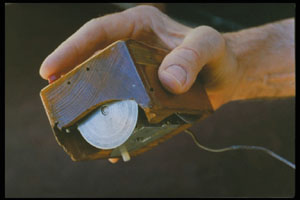
The passage also includes this picture of the first computer mouse with the caption, "The superficials of innovation are rarely impressive. This is a version of the first computer mouse."


(image source: Wikipedia)

What does this have to do with Algebra? Well, this is very similar to the philosophy of what I'm asking you to do in this class. Yes, we do have some formulas that you're going to need to learn and "plug stuff into." But our more important goal is for you to open your minds and be willing to explore ideas. This is why I'm always asking you to try to figure things out, both individually and as a group, and not wait for me to tell you how to do it.

Sure, we can "skip to the good ideas" and I can just show you how to do certain procedures, but that ends up not being very meaningful for you, and you're also not very likely to remember it very long. Instead, I want you - as much as possible - to play with the ideas. To be curious, and creative, and try to figure things out and find patterns and methods on your own, including exploring various real-world applications of the mathematics. And, yes, that's harder than just memorizing the formula and doing random problems out of the book. But I think it's also much, much, much more worthy of your time.

As Eric Hoffer said,
In a time of drastic change it is the learners who inherit the future. The learned usually find themselves equipped to live in a world that no longer exists.
I want you to be a learner; to take the attitude of "fearless idea exploration." In my class, in all your classes, and in life in general.

Labels: ,

Add this post to Del.icio.us

2 Comments:

Blogger Heather Bright said...

Dr. Fisch,

My name is Heather Bright from the University of South Alabama. I really enjoyed your blog and could relate to both things mentioned here.
On one hand children have millions of ideas because they haven't been told what's "right" to society. Adults have been forced to throw imaginative ideas out of the window because they didn't "conform" to everyone's world. That's what I think happened to our creative ideas.
On the other hand I get really frustrated with the brainstorming process and just want to have the answer given to me. I think a lot of that is the fear of failure. Society is constantly tell you that your ideas are stupid, so it's easier to just put in a formula and go on with your day.

This blog really reminded me to have the heart of a child, which means DREAM!! Thank you for sharing!

11/7/10 7:22 PM  
Blogger BenH said...

Because if you just plug stuff in, you end up like this guy.

11/9/10 5:24 PM  

Post a Comment